b2b web design agency, b2b website design, conversion-focused websites, lead generation websites, agency evaluation
B2B Web Design Agency: What It Does and How to Choose One
by raffiné studio

Most businesses choosing a B2B web design agency start with the wrong question: “Which agency makes the best-looking websites?” That question produces polished homepages, attractive typography and very little commercial clarity.
A better question is: which device, page type and service offer should be redesigned first?
That distinction matters because Australian conversion performance varies by device and industry. One benchmark records an overall Australian website conversion rate of 1.78% in September 2024, with desktop converting at 4.3% compared with 2.2% on mobile. Professional services can range from 1.6% to 7.4%, while legal landing pages reach a 12.3% median conversion rate, according to Australian conversion rate statistics by industry.
So a full redesign may be the wrong first move. Your highest-value intervention could be a mobile service page, a legal landing page, a buyer's agency booking flow or a form that sends enquiries nowhere.
A serious agency connects positioning, page architecture, search visibility, conversion measurement and lead follow-up. Visual design is part of that work, but it's the output of a business decision, not the starting point.
Why a B2B Web Design Agency Is Not Just a Design Vendor
Most B2B websites are redesigned because the colour palette feels dated. Problem is usually more basic: the homepage attracts attention but gives qualified visitors no specific reason to continue, then sends them towards a generic services page with no clear next step.
A freelancer with a Figma licence can produce a more attractive interface. That doesn't mean they can decide whether a mortgage broker needs separate pages for refinancers, investors and first-home buyers, or whether a buyers agency should prioritise suburb-specific landing pages over a new homepage.
A B2B web design agency should work at the intersection of:
Positioning, so the right buyer understands the offer quickly.
Conversion architecture, so each page leads to a sensible action.
Technical search visibility, so Google and AI systems can interpret the business.
Commercial measurement, so redesign decisions connect to qualified enquiries.
Australia's market makes this especially relevant. The Australian Small Business and Family Enterprise Ombudsman reports that 97.3% of Australian businesses were small businesses in June 2025, while 98% fall within the broader small-business definition and 92% of those small businesses have turnover below A$2 million, as summarised in Australian website design statistics. Most prospects for a Sydney agency aren't enterprise procurement departments. They're founders, directors and marketing managers trying to make a lean team generate better opportunities.
Commercial rule: Don't pay for a redesign until the agency can explain which page and buyer action deserve priority.
The agency's job is to make that decision defensible. It should identify where intent is being lost, what information buyers need before contacting sales, which device creates friction and how the resulting enquiry will enter the sales process.
That's a very different brief from “refresh the brand and make it feel premium”.
What a B2B Web Design Agency Actually Does
A capable agency performs four commercial jobs for an Australian service business. Each job should produce a tangible deliverable, not just a presentation full of moodboards.
1. It clarifies the offer and its audience
The agency starts by deciding who each important page is for, what problem that buyer has and what they should do next. A discovery brief might separate a commercial property investor from a residential buyer, or a business owner seeking accounting advice from a finance manager comparing firms.
The deliverable should include audience definitions, offer priorities, objections, proof requirements and calls to action. Without this work, the site tends to mirror the company's internal structure rather than the buyer's decision process.
2. It rebuilds information architecture around intent
A useful navigation system doesn't force visitors to understand your organisation before they can find help. It organises service pages, industry pages, team profiles, resources and contact paths around the questions buyers ask.
The agency should deliver a sitemap, page hierarchy, wireframes and conversion recommendations. That might mean a dedicated buyer's agency page, an advisor profile with credentials and disclosures, or a finance landing page with an embedded booking route.
3. It makes the site understandable to search systems
Technical SEO and AI-search readiness belong in the build, not as an afterthought. Semantic HTML, internal links, structured data, plain-English service descriptions, locations served and direct answers to common questions help search engines and AI assistants interpret the business.
Australian guidance on accessibility recommends designing public websites to at least WCAG 2.1 Level AA, with government guidance also referencing WCAG 2.2 Level AA for many web properties, as explained in web accessibility requirements in Australia and New Zealand. Accessible forms, keyboard navigation, useful colour contrast and clear labels also reduce friction for ordinary mobile users.
4. It measures and improves the pipeline
The agency should connect analytics, forms, phone calls, booking tools and CRM stages. The deliverable is a measurement plan that defines what counts as an enquiry, qualified lead, booked call and sales opportunity.
That matters because a website can report traffic while hiding whether the traffic produces suitable work. A redesign isn't complete when it launches. It's complete when the team can see what happened to the leads it generated.
Core Services That Drive Qualified Enquiries
A serious B2B web design agency sells a system, not an isolated visual asset. Each service should have a defined artefact and a clear effect on the path from visitor to sales conversation.
The Australian digital marketing software market reflects the direction of buyer investment. Independent market research estimates the market at about USD 1.95 billion in 2025, with a projection of USD 3.21 billion by 2030. SMEs accounted for 58.20% of the market in 2024 and are forecast to grow at a 13.90% CAGR through 2030, according to Australian ecommerce and conversion market research. A website that can't connect to analytics, CRM and automation is increasingly out of step with how small and medium-sized firms acquire customers.
Service | Typical deliverable | Pipeline effect |
|---|---|---|
Conversion-focused website design | Discovery brief, sitemap, wireframes and responsive page designs | Makes the right offer easier to understand and increases the likelihood of qualified enquiries |
Landing page systems | Reusable landing page template, campaign variants and call-to-action rules | Gives paid and social traffic a specific path instead of sending every visitor to the homepage |
Service and offer page writing | Search-informed page briefs, objection-led copy and proof requirements | Helps prospects self-qualify and reduces vague, low-fit form submissions |
CRO and analytics setup | CRO hypothesis backlog, event tracking and reporting dashboard | Shows which pages, devices and actions create meaningful enquiry activity |
Technical SEO and AI-search optimisation | Structured data plan, internal-linking map and answer-focused content structure | Improves how Google and AI assistants understand services, locations and expertise |
CRM and automation integration | Measurement plan, CRM routing, booking workflow and follow-up sequences | Shortens the distance between form submission and human response |
The conversion work should be specific. Independent B2B benchmark data places the median website conversion rate at about 2.9%, with a broadly good range of 2% to 5%, as outlined in B2B website conversion benchmarks. That benchmark doesn't tell you to chase a universal target. It tells you to investigate intent matching, form friction, page specificity and the difference between traffic sources.
A useful agency might recommend changing one high-intent service page before touching the rest of the site. It might also separate organic, direct, paid and social traffic in analytics, because blended reporting can hide where opportunities sit.
Scope test: If a proposal lists “design, development and SEO” without naming pages, tracking events, integrations and optimisation hypotheses, you're buying activities rather than a pipeline improvement plan.
Commodity services include a homepage refresh, stock imagery, generic blog production and a contact form that emails an inbox. Valuable services create a decision path, record the outcome and help the sales team act on it.
Value for Professional Services and Brokers
Professional services firms and brokers rarely need another digital brochure. They need a website that answers a specific buyer's concern, demonstrates credibility and makes the next conversation easy to start.
A generic build often gives a law firm a team page with limited context, an accountant a broad list of capabilities and a buyers agency a homepage dominated by stock property photography. Mortgage brokers may receive a contact form with no qualification fields. Financial advisers may have profiles that omit the trust and disclosure information a prospective client needs before booking.
The gap becomes obvious when the site is compared with the enquiry process.
Site element | Typical generic build | What enquiry growth demands |
|---|---|---|
Service pages | One broad page covering every capability | Separate pages organised around services, buyer problems and objections |
Advisor or team profiles | Names, job titles and portraits | Relevant credentials, experience, regulated disclosures and clear next actions |
Contact forms | Name, email and a general message box | Qualification fields that distinguish buyers, sellers, investors or business needs |
Booking flow | “Contact us” with no scheduling route | Calendar booking connected to the right person or service |
Trust evidence | Logos or generic claims | Reviews, licences, process detail, outcomes and proof relevant to the decision |
Navigation | Company-led menu structure | Buyer-led paths that reveal the right offer quickly |
A buyers agency, for example, should make it easy to understand whether it helps with property search, negotiation, auctions or a broader acquisition process. A broker needs a clear route for someone seeking a refinance, investment loan or commercial finance. A law firm should distinguish practice areas and show what happens after the initial enquiry.
The same principle applies to NDIS, financial advice and other regulated or trust-heavy services. When sites skip disclosures, credentials, process explanations and clear expectations, qualified visitors must do too much risk assessment alone.
For a practical sector-specific view, see web design for professional services. The agency should deliver objection-led service pages, useful profile pages, embedded booking tools and enquiry routing, not just a more polished template.
Local trust details also deserve deliberate placement. Australian conversion guidance says displaying local contact information can increase trust and conversion rates by up to 25% for Australian businesses, with recommendations including an Australian phone number, complete address and business hours on conversion pages, as set out in Australian website conversion recommendations.
How to Evaluate a B2B Web Design Agency
Shortlist agencies by the questions they ask before they show you a design. A competent partner wants sales call recordings, CRM stages, search query reports, analytics access and information about lead quality. A weak pitch begins with a moodboard and treats your business model as background information.
Use five tests.
Positioning
Does the agency name the industries and enquiry types it serves? “We work with B2B businesses” says almost nothing. A stronger answer identifies whether the team understands brokers, professional services, technical firms, property businesses or another defined category.
Portfolio fit
Look for projects with comparable buying journeys, not just attractive screenshots. Inspect whether the examples include service-specific pages, proof structures, qualification paths and measurable outcomes.
Process transparency
Ask what happens before design. The agency should explain discovery, page prioritisation, wireframing, copy development, technical review, accessibility checks and launch measurement in language your team can understand.
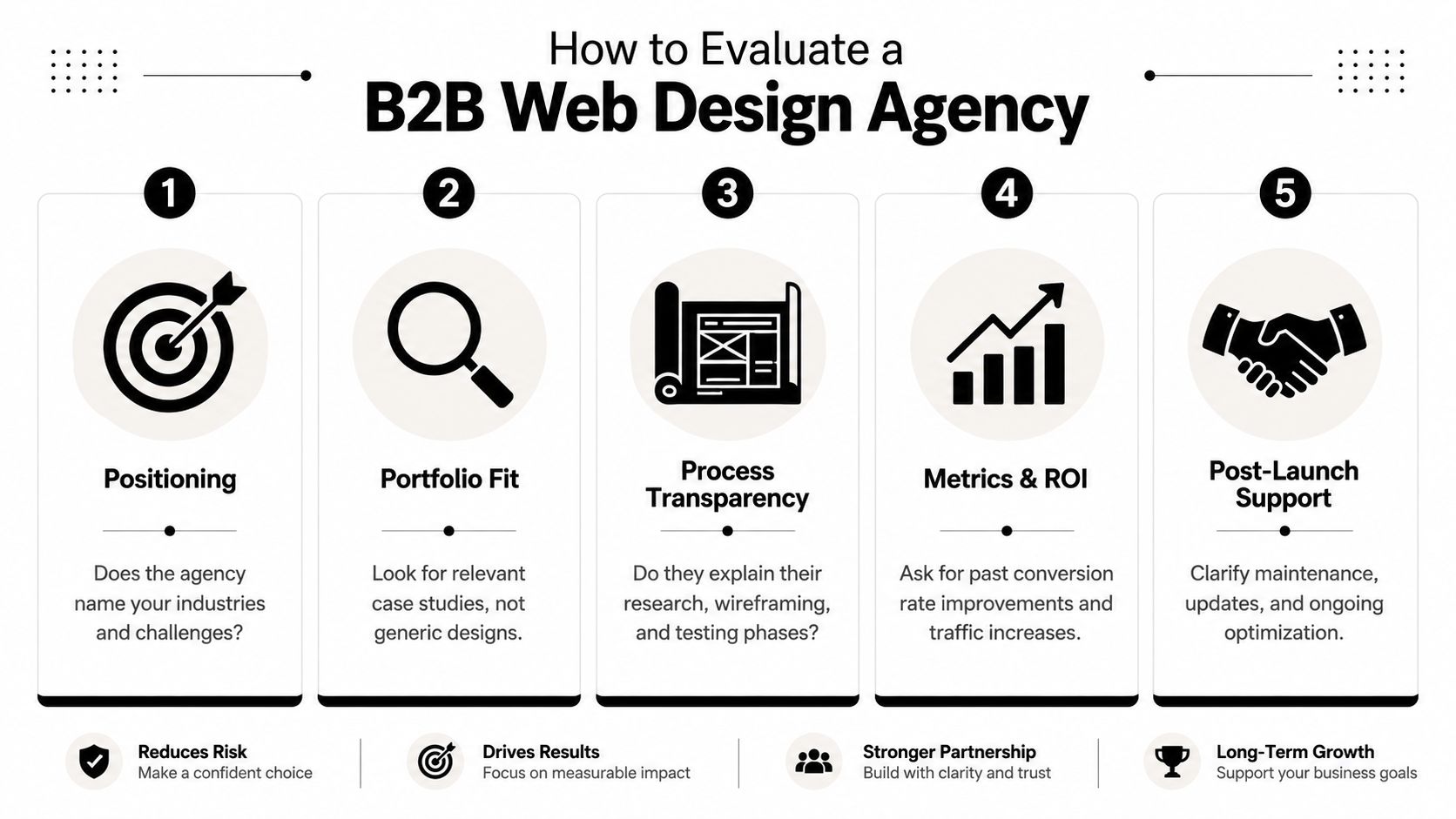
Metrics and commercial ownership
Ask how the agency would prioritise a single high-intent service page over a full redesign. The answer should refer to device performance, page intent, enquiry quality and the business value of the offer. It should also explain which metrics the agency will own and which remain with your sales team.
Lead capture needs more than a form notification. Guidance on tracking website leads across calls, forms and CRM systems recommends call tracking, UTM parameters with Google Analytics, hidden form fields, specialist conversion tools and CRM systems.
Post-launch support
Clarify what happens after launch. Ask whether the agency maintains tracking, reviews search performance, manages CRO hypotheses, updates landing pages and helps improve booking or follow-up workflows.
Ask every shortlisted agency: “If you could improve only one page in the first month, which page would you choose, what evidence supports that choice and how would we measure the result?”
Be cautious if pricing is hidden behind vague “scope” language, strategy is outsourced, or the agency can't show relevant enquiry evidence. You don't need a universal price list, but you do need enough detail to understand what you're paying for.
A Sydney-based comparison should also examine whether the agency understands local service markets. Choosing a web design agency in Sydney is less about proximity than whether the partner can connect local trust, search intent, conversion paths and sales follow-up.
The included video offers another useful perspective on evaluating a web design partner:
Case Study Signals Worth Looking For
A useful case study starts with a commercial problem, not a screenshot. Look for a brief that identifies the wrong kind of enquiry, a page that fails on mobile, a service offer visitors don't understand or a booking route that loses intent.
A credible narrative might describe a professional services firm receiving enquiries for the wrong practice area. The agency then isolates the relevant service page, rewrites its promise around buyer objections, adds proof and routes the call to the right team member. The outcome should be expressed in qualified enquiries, booked consultations, lead quality or sales activity, not only visual approval.
Strong case studies usually contain four signals:
A defined starting problem: The agency can explain what wasn't working and who was affected.
A narrow intervention: The work focuses on the page, device or offer creating the most commercial friction.
A measurement method: The team tracks form submissions, calls, bookings, source data and CRM stages.
A business outcome: The result relates to suitable opportunities, not just sessions or design awards.
Ask to see the proof behind the story. CRM-tagged leads, call-recording summaries, form qualification data and post-launch search reporting are more useful than a before-and-after homepage gallery.
AI search adds another layer. Australian commentary reports that 60% to 65% of Google searches end without a click and that AI Overviews appear in 39% of Australian queries, as discussed in AI visibility and AI search in Australia. Treat those figures as context for a changing discovery environment, not as a reason to publish thin FAQ pages.
A stronger case study shows how the site explains its services, locations, industries and common questions clearly enough for buyers and machines to interpret. Custom web design should produce a useful information system, not a one-off visual concept.
Also look for evidence of structured data, entity relationships, review signals, freshness and crawl-ready technical foundations. Australian guidance on AI visibility for businesses identifies these elements as part of helping firms surface in ChatGPT, Gemini, Claude, Perplexity and Copilot.
Discount vanity evidence. More traffic, an award badge or a prettier homepage can coexist with fewer suitable enquiries.
Choosing the Right Next Step for Your Website
Don't begin with a full redesign quote. Begin with a short diagnostic that identifies the highest-value page, offer and device combination.
Review your analytics by device and landing page. Separate direct, organic, paid and social traffic. Check whether forms create CRM records, whether calls are attributed and whether booked meetings can be connected to the original page or campaign.
Then ask every B2B web design agency three questions:
Which page and service offer would you redesign first, and what evidence supports that choice?
How will you measure enquiries by device, source, service and lead quality?
What happens after someone submits a form or books a call?
The third question exposes a common failure. Lead-response timing matters. Sources summarise evidence that responding within five minutes materially outperforms slower follow-up, while conversion probability drops sharply after about 30 minutes, as explained in lead response time research. Your website should trigger instant CRM routing, an acknowledgement and a booking workflow, while the team creates the first human response quickly.
Set measurement milestones at 30, 60 and 90 days, with the exact source and timeframe recorded for each review. At the first checkpoint, confirm tracking works. At the second, identify page and device friction. At the third, decide whether to expand, revise or stop the experiment.
Raffine Studio fits this workflow when a buyers agency, broker or professional services firm needs its website, SEO, AI search visibility, booking system and follow-up process connected. The right next step isn't a generic quote. It's a scoping conversation grounded in your enquiry data and the commercial page that deserves attention first.
Raffine Studio builds conversion-focused websites, landing page systems, SEO and AI-search visibility workflows for Australian buyers agencies, brokers and professional services firms. Visit Raffine Studio to discuss which page, device and offer should be prioritised before you commit to a broader redesign.