affordable web design for small businesses, small business web design, conversion focused websites, website cost Australia, web design packages
Affordable Web Design for Small Businesses That Converts
by raffiné studio

You've accepted the lowest website quote, the site looks polished, and then the enquiries don't arrive. The form is buried, the mobile version loads slowly, the service pages say little that helps a buyer choose, and nobody owns follow-up when a prospect submits an enquiry.
That isn't affordable web design. It's a low upfront cost attached to an expensive commercial problem.
For Australian small businesses, affordability should mean the lowest sensible total cost of ownership over the first year, measured against qualified enquiries and booked discovery calls. That includes the build, hosting, maintenance, plugins, SSL, integrations, search visibility and the internal time required to manage the site. Business.gov.au guidance on online and digital business costs treats website design, maintenance, digital strategy and ongoing costs as part of the affordability decision for SMEs.
A website only earns its keep when it connects the full path from website to traffic, conversion and follow-up. The right pages attract relevant searches. The right message turns visits into enquiries. The right booking and CRM workflow makes sure those enquiries receive prompt attention.
The recommendations below focus on what to keep, what to cut and how to judge a website by commercial output rather than visual novelty. That's the standard Raffine Studio applies when building lead-generation systems for buyers agencies, brokers and professional services firms.
Introduction Why Affordable Means Profitable Not Just Cheap
A cheap website can become costly the moment it fails to generate a conversation. You may save on the quote, then spend more on paid traffic, manual administration, rushed fixes and a second redesign because the first build never had a clear conversion path.
The Australian government's guidance is useful because it frames a website as part of an ongoing online presence, not a one-off design purchase. Design, maintenance, digital strategy and continuing expenses all belong in the same decision. A quote that excludes those items isn't necessarily wrong, but it's incomplete.
Commercial rule: Judge the site by its cost per qualified opportunity over 12 months, not by the number at the bottom of the proposal.
The market has a wide spread. A simple professional website can start around A$3,000, while professional agency-built sites commonly sit around A$5,000 to A$25,000 or more, depending on scope. Ongoing SEO can add A$500 to A$10,000 per month, depending on the work required and the competitiveness of the market. These ranges are summarised in Business.gov.au's online and digital guidance.
That doesn't mean every small business needs an expensive custom build. It means the owner needs to understand what the site must achieve. A local operator with one service and a phone number may need a compact website. A mortgage broker, buyers agency or law firm needs stronger messaging, service-specific pages, proof, enquiry routing and a booking journey.
Affordable web design for small businesses means spending on the parts that reduce commercial friction. Keep the clear offer, relevant content, mobile performance, trust signals and lead capture. Cut decorative features that don't help a visitor decide.
What Affordable Web Design Costs in Australia
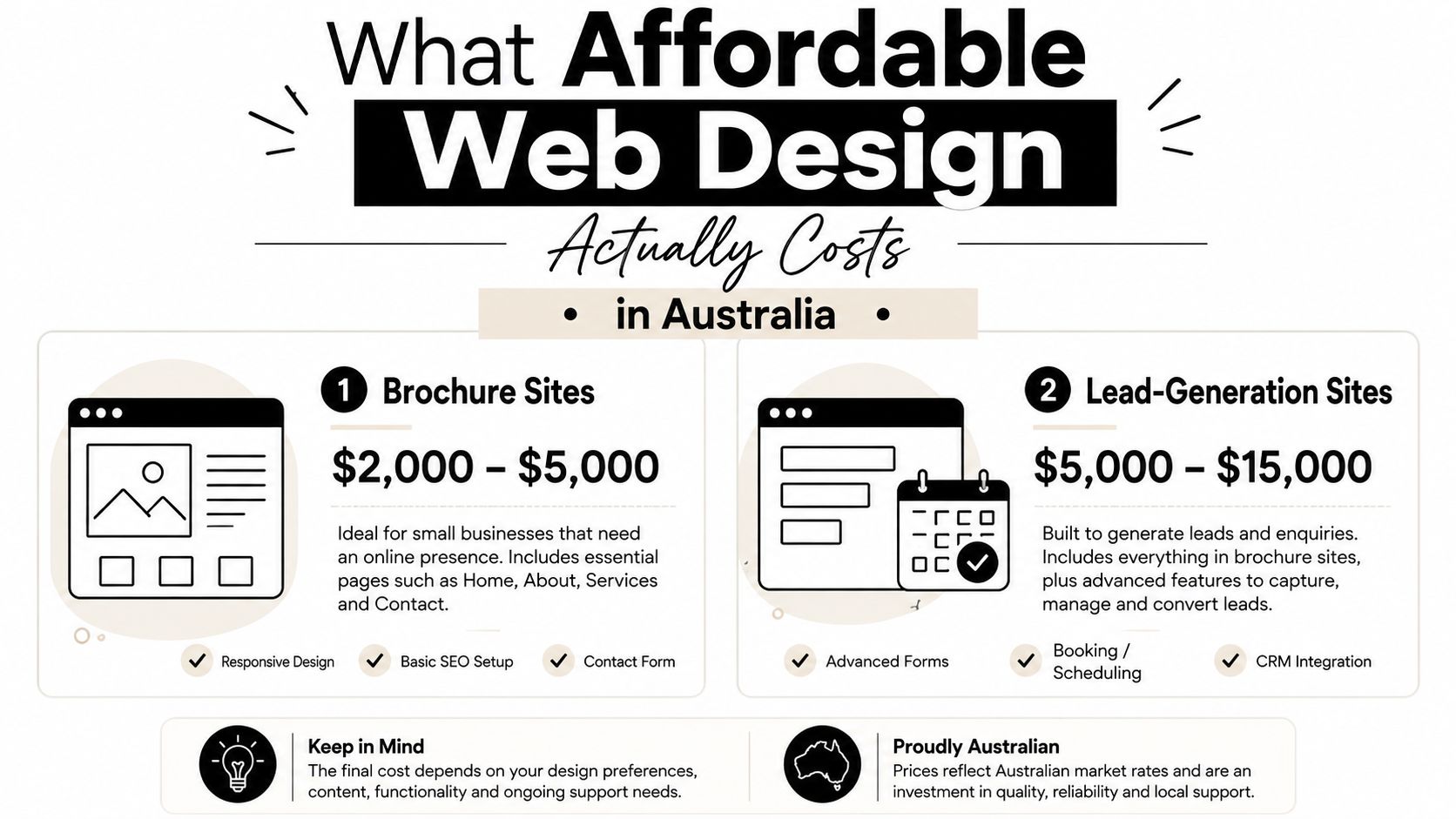
Australian pricing guides place professionally built small-business websites across a broad range of about A$3,000 to A$10,000. Agency projects can reach A$25,000 or more when strategy, integrations and custom functionality expand the scope. Onboard's Australian website cost guide outlines that market range.
A brochure site belongs at the simpler end. It presents the business, services, contact details and basic credibility information. A lead-generation site has a commercial job: attract relevant searchers, address objections and create enquiries. That usually requires service-specific pages, forms, booking functionality, analytics, CRM handoff and conversion-focused copy. GoDaddy's Australian website cost guide separates brochure sites from service websites with forms, integrations and booking features, which require more planning, user experience work and development.
The first-year number is the one that matters
A low build quote can become expensive once the site is live. Hosting, maintenance, plugins, SSL, integrations, content updates and SEO all affect the cost of keeping the website useful. Measure the investment by its total cost per booked discovery call over twelve months, not by the build price alone. Slow hosting, neglected updates or weak conversion paths can turn a cheap site into an expensive source of missed opportunities.
One 2025 Australian survey cited an average expected website cost of about A$3,200. Industry guides for 2026 place professional small-business builds more commonly around A$5,000 to A$25,000, with first-year totals around A$8,000 to A$35,000 or more after ongoing costs. FED's Australian website cost guide discusses the difference between initial build pricing and the wider first-year commitment.
Sydney pricing can run materially higher than regional markets because of agency overhead, specialist talent and the complexity of the target audience. Regional providers are not automatically cheaper, and Sydney studios are not automatically better. Ask who owns the work, what support is included and how booked calls will be measured.
Website type | What it should do | Budget implication |
|---|---|---|
Brochure site | Explain the business and provide contact details | Lower complexity |
Lead-generation site | Attract relevant traffic, build trust and create enquiries or bookings | More strategy, UX and integration work |
Custom platform | Support complex workflows or specialised functionality | Higher build and maintenance commitment |
Set the budget around the required commercial outcome. Keep the pages, speed, messaging and tracking that help generate calls. Cut features your team will not use.
Template vs Freelancer vs Agency Which Model Saves You Money
The cheapest build can produce the highest cost per booked discovery call over twelve months. Your choice affects strategy, delivery speed, search foundations, maintenance, hosting performance and the work left with your team after launch.
Templates suit contained problems
A template fits a new local business with one clear offer, a small service area and someone internally who can update content. It gives you a fast, functional starting point. Costs rise when the business forces a complex sales journey into a layout built for generic presentation.
A buyers agency may need suburb or service pages, qualification questions and a booking path. A mortgage broker may need separate journeys for first-home buyers, investors and refinancers. A professional services firm may need several practice areas, partner profiles and expertise-led content. A template can handle these requirements only while the structure remains simple.
Check hosting quality, update responsibility and tracking before choosing this route. A low build price is irrelevant if slow pages or neglected maintenance reduce enquiries.
Freelancers can be effective with a strong brief
A capable freelancer can provide more flexibility than a template with less overhead than an agency. The model works when the owner has a defined offer, supplies content promptly and makes decisions directly. It becomes risky when the project requires copy strategy, SEO architecture, analytics, CRM integration and ongoing optimisation across several disciplines.
Delivery timing also affects the twelve-month cost. Australian website project timelines by build model commonly places DIY or template projects at 2 to 4 weeks, freelancers at 4 to 8 weeks and agency projects at 6 to 16 weeks. These are planning ranges, not guarantees. Delayed content and unclear approvals extend any model, while an unfinished site delays lead generation.
Agencies earn their fee when the problem is commercial
An agency earns its fee when the website must connect positioning, content, SEO, conversion design, automation and measurement. That suits high-value services where one qualified call matters more than a large volume of low-intent forms. The agency must still show how it will measure booked calls, manage hosting and handle post-launch improvements.
Decision factor | Template | Freelancer | Agency |
|---|---|---|---|
Cost | Lower | Medium | Higher |
Timeline | Fast | Variable | Longer |
Customisation | Limited | Moderate | Full |
SEO approach | Basic | Intermediate | Strategic |
Internal workload | High | Medium | Lower |
For a practical overview of platform and structural choices, see WordPress website design in Sydney. Choose the model against total cost per booked discovery call, including build, hosting, maintenance, speed and missed opportunities. A template wins for a contained offer. A freelancer wins with a clear brief and capable owner. An agency earns the higher fee when commercial complexity demands coordinated execution.
How to Reduce Scope Without Killing Conversions
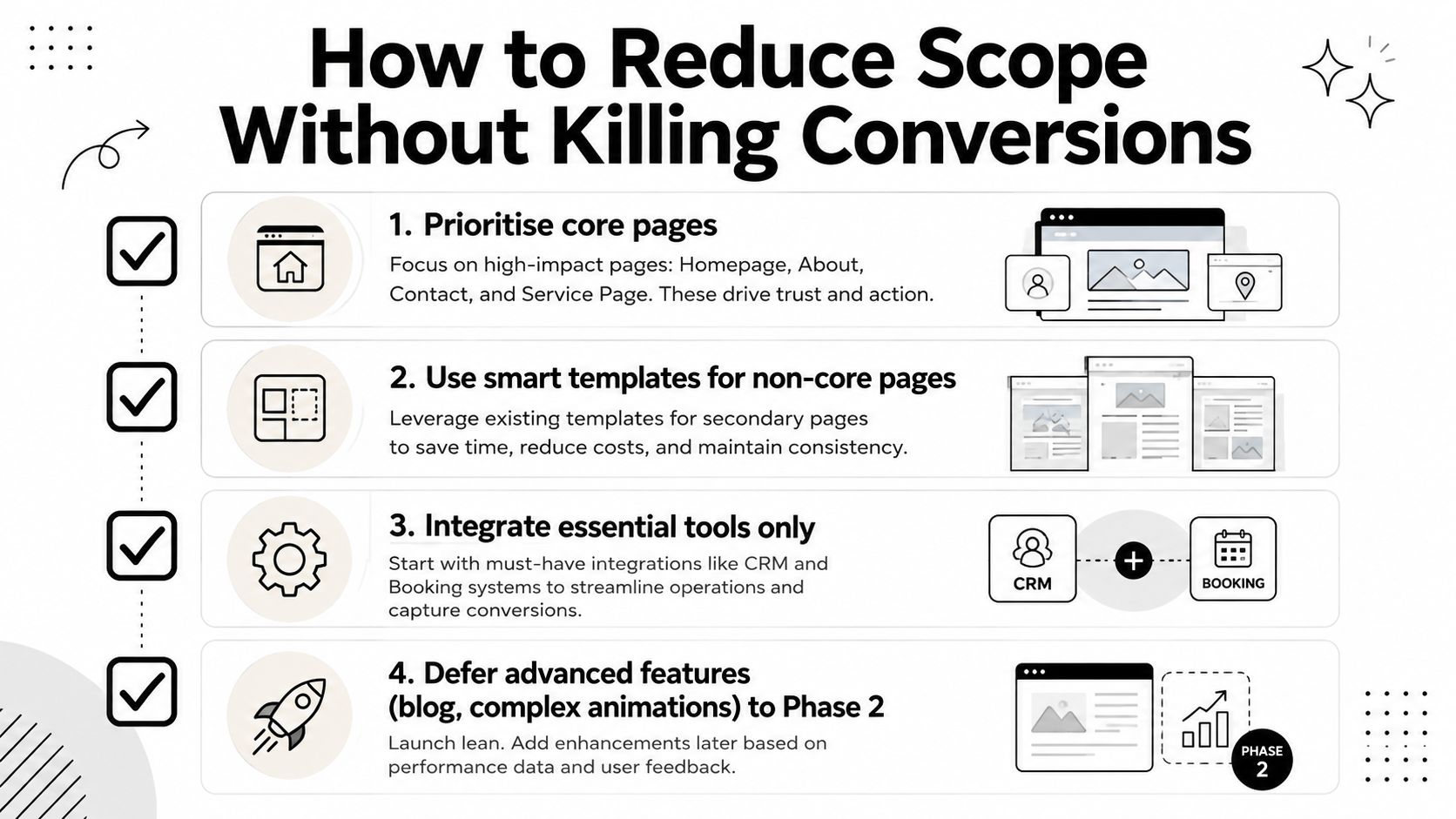
The safest way to reduce cost is to reduce breadth, not the parts of the site that help a visitor take action. A smaller website with a clear offer and strong service pages will outperform a larger website with vague content and a buried contact path.
Start by identifying the single commercial action that matters most. For many brokers, buyers agencies and professional services firms, that's a booked discovery call. Every page should either attract the right visitor, answer a decision question or move that visitor towards the action.
Keep the pages that carry the decision
A lean lead-generation website usually needs:
A direct homepage: State who you help, what problem you solve and what the visitor should do next.
A focused About page: Show relevant experience, approach and people. Avoid turning it into an internal history lesson.
Service pages tied to intent: Give each important service enough room to answer the specific question a prospective client is searching.
Proof near the decision point: Use testimonials, credentials, process detail or outcomes you can substantiate.
A frictionless Contact or Booking page: Make the next step obvious and easy on mobile.
Use a smart template for lower-priority pages. A team member profile, location page or resource page doesn't always need a bespoke layout. Consistent components reduce design and development time without removing useful information.
Defer features that don't help the first conversion
Complex animations, custom portals, oversized blogs, advanced calculators and elaborate interactive tools can wait. They add design, testing, content and maintenance requirements. They may become worthwhile later, but they shouldn't delay the core journey.
Scope test: If a feature doesn't improve relevance, trust, action or follow-up, move it to a later phase.
Protect mobile performance, information architecture, lead capture and measurement. Ask a provider to separate launch essentials from phase-two ideas, then price both clearly. Don't accept a vague “we can add that later” if the future cost and technical implications aren't documented.
Practical Tips to Launch Faster and Keep Costs Down
The cheapest launch is the one that avoids rework. Most avoidable waste comes from approving a design before the provider has tested mobile performance, confirmed content ownership and mapped what happens after an enquiry.
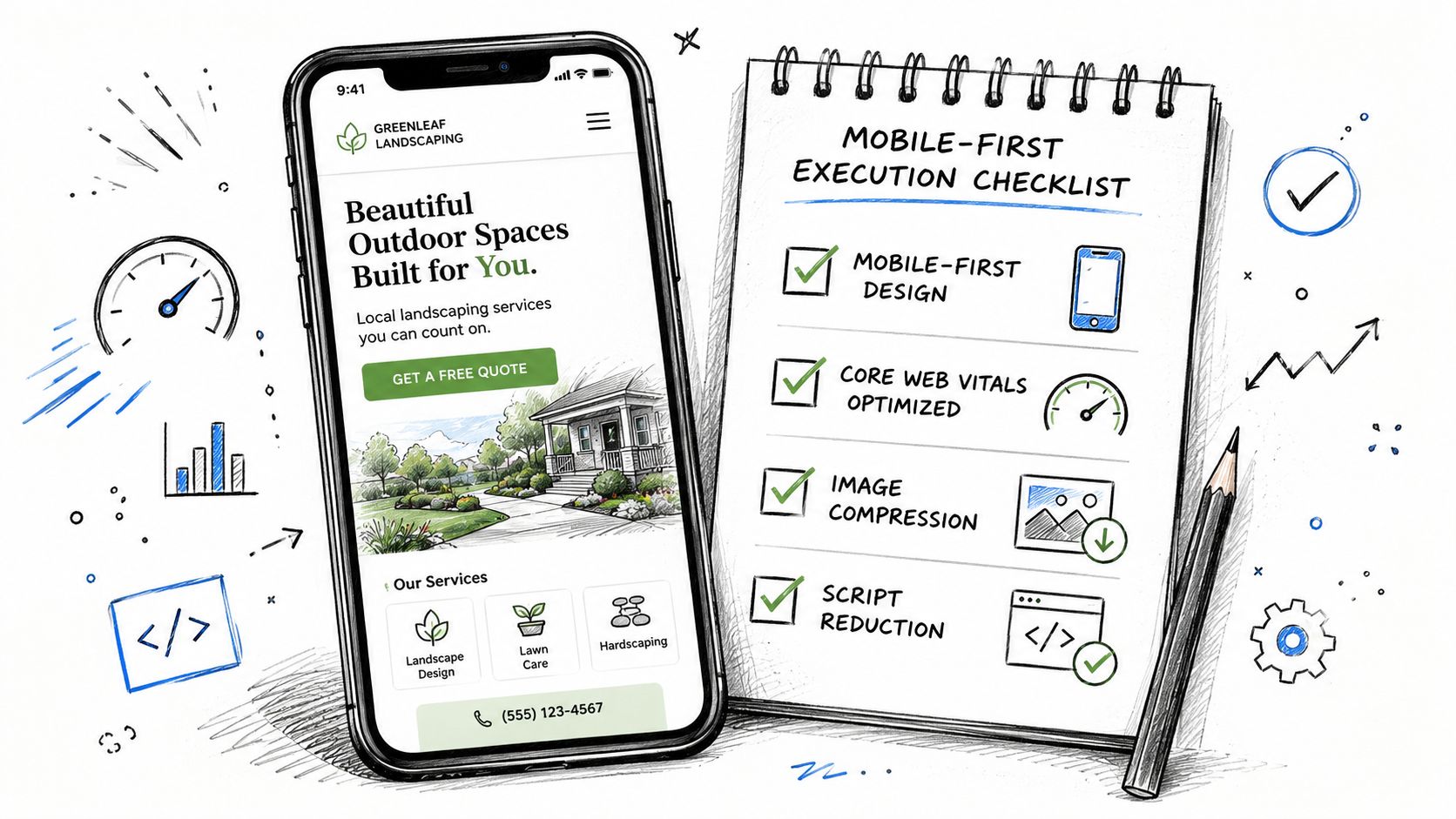
Start with mobile. Google's Australian mobile page-speed benchmark reports that the average mobile landing page fully loads in 22 seconds, while 53% of mobile visitors leave when a page takes longer than 3 seconds. The benchmark is cited in Australian small-business material linked to ACCC small-business resources. Treat those figures as a warning against adding heavy media, render-blocking scripts and unnecessary page elements.
Run this pre-launch check
Compress images: Resize and compress media before upload. Large hero images are common sources of slow pages.
Remove excess scripts: Delete plugins, tracking tags and animation libraries that don't support a clear business requirement.
Check Core Web Vitals: Aim for LCP under 2.5 seconds, INP under 200 milliseconds and CLS under 0.1, as outlined in Australian material citing Google and Deloitte speed research.
Test real mobile paths: Submit every form, tap every phone link and complete the booking process on a phone.
Instrument the journey: Track form submissions, calls, booking completions and the source of qualified enquiries before launch.
Speed is a revenue concern, not a polish issue. The same Google and Deloitte research cited in the Australian material reports that a 0.1-second mobile speed improvement increased retail conversions by 8.4% and average order value by 9.2%. Those findings relate to retail, so don't transfer them directly to professional services, but they support the broader commercial case for measuring and improving speed.
Automation protects the value of every enquiry. Australian benchmark content identifies a strong lead response time as under 5 minutes, with best-in-class response under 60 seconds. Australian lead-response benchmarks support routing new enquiries immediately to the right person, offering a calendar booking option and triggering a confirmation message.
For examples of practical workflow automation, review automated system examples for business operations. A website that captures a lead but leaves it in an unattended inbox is only half-built.
Next Steps to Turn Your Affordable Site Into a Lead System
Australian small-business website adoption remains incomplete. One Australian industry summary reported that 41% of Australian small businesses had a website in 2024, leaving 59% without one, while the gap widened in regional areas to 65% without a site. The Australian website-cost and adoption summary from Rocking Web also refers to earlier reporting that 41.9% of small businesses with 5 to 19 staff had no web presence.
That creates both risk and opportunity. A business without a credible site can lose trust before a conversation starts, but it doesn't need a large digital project to begin. Launch a focused version, measure behaviour and improve the pages that influence qualified enquiries.
Take three actions:
Audit the current path: Visit your site on a phone and try to become a prospect. Can you understand the offer, find proof and book without assistance?
Choose one measurable goal: Set the primary action as a completed enquiry or booked discovery call, then track it properly.
Calculate the cost: Add build, hosting, maintenance, tools, SEO and follow-up time. Divide that investment by qualified opportunities, not raw traffic.
A strong visual identity still matters, but it must support the sales journey. Branding and web design for a coherent business presence should clarify the offer rather than add decoration.
Affordable web design for small businesses works when the website, traffic sources, conversion path and follow-up operate as one system. Review the commercial journey first, then decide what the design needs to do.
Raffine Studio builds conversion-focused websites, funnels, SEO and AI search visibility systems for Australian buyers agencies, brokers and professional services firms. Visit Raffine Studio to review your current website, map its real cost per booked call and discuss a lean redesign built around qualified enquiries.