roofing company seo, local seo roofers, google maps roofing, tradie seo, roofing lead generation
Roofing Company SEO: Local Strategy for Aussie Roofers
by raffiné studio

Roofing searches generated 153,920 annual Google searches for “roofer” in Australia, placing roofing fourth among the country's most in-demand trade queries and representing 9% of online trade enquiries in the relevant dataset, according to Australian roofers industry research. That isn't a vague branding opportunity. It's a measurable market of people looking for a contractor.
The commercial problem is that many roofing websites still treat SEO as a traffic project. They publish a generic services page, add a suburb list, wait for rankings, and overlook what happens after a homeowner calls. Effective roofing company SEO connects local visibility with service-specific pages, fast response systems, clear comparisons, and conversion tracking.
Why Roofing Company SEO Is a Measurable Lead Source
Roofing demand is local enough that suburb-level visibility changes the commercial outcome. The same Australian research recorded 1,427 roofer searches in Traralgon, Victoria, and 1,370 in Nowra, New South Wales, which shows how demand concentrates in individual locations. A business that ranks for a broad term but misses the suburbs it serves has not solved its acquisition problem.
Search behaviour backs that up. A 2026 Australian tradie report says 89% of Australians search Google before hiring a trade service provider, and 64% of those searches include location terms, such as “near me” or a suburb name. It also reports that 73% happen on mobile phones, so a roofing site that hides its phone number, loads slowly, or makes forms awkward is losing leads before SEO gets credit for them. See the Australian tradie search behaviour data for the underlying benchmarks.

The first-page gap is commercial
The Google Maps local pack captures about 60% to 70% of clicks on local service searches, with position one receiving 29%, position two 19%, and position three 14% of total clicks, according to the same Australian local-search report. Organic visibility matters too. Australian SEO benchmarks show that 68% of clicks go to the first five organic results, while page two receives only 0.63% of clicks, as documented by Odin Digital's Australian benchmarks.
That makes “we're somewhere in Google” a weak performance standard. The key questions are simple:
Which service appears? A roof repairs page should rank for repair intent, not send every visitor through the homepage.
Which location appears? A roofer serving Newcastle needs useful coverage signals for Newcastle and the suburbs it covers.
What happens next? A visible call button, short enquiry form, and clear emergency pathway matter as much as the ranking itself.
The biggest missed opportunity is often non-branded service demand. An Australian roofer keyword study identified 64,110 monthly searches across 148 non-suburb roof-service queries, including roof repairs at 3,600 monthly searches with an A$8.90 CPC, roof restoration at 3,600 with an A$7.80 CPC, and commercial roof repairs at 590 with an A$9.10 CPC. The roofer-focused keyword research supports a simple rule. Map each core service to a dedicated page before you build thin suburb pages, and keep the fuller keyword breakdown for later in the article.
Optimising Your Google Business Profile for the Local 3-Pack
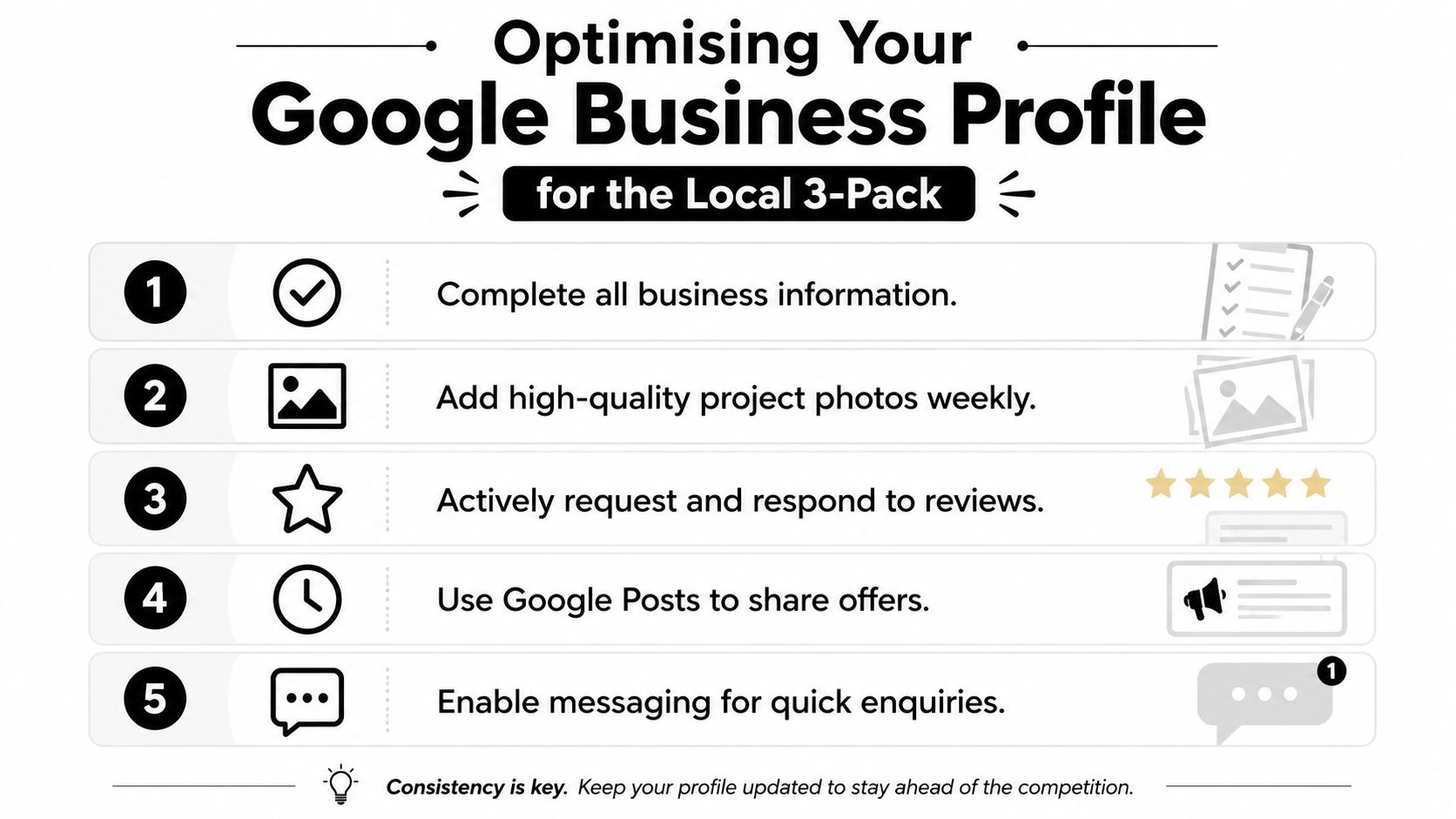
Your Google Business Profile is the asset that connects your roofing company to Maps, local pack results, calls, directions, photos, and reviews. It should be managed as a sales profile, not treated as a directory listing that gets updated once and forgotten.
Australian roofing guidance recommends using the business name, selecting “Roofing Contractor” as the primary category, adding relevant secondary categories such as roof repair and roof replacement, and matching service areas to the locations you cover. The local SEO guidance for roofing businesses also warns against confusing location signals.
Build relevance without creating noise
Start with the fundamentals:
Complete every relevant field. Use the correct business name, phone number, opening hours, website, description, service list, and service coverage.
Choose categories precisely. The primary category should describe the main roofing business. Secondary categories should reflect genuine services, not every possible keyword.
Add evidence of real work. Upload project photos that show repairs, restorations, replacements, materials, crews, and completed results. A photo of a roof in a real local setting carries more trust than a generic stock image.
Make reviews part of job close-out. Ask satisfied customers for honest reviews after work is completed, and respond to every review in a professional, specific way.
Use Posts and Q&A with purpose. Share seasonal availability, storm response information, inspection services, and answers to questions customers ask.
A profile shouldn't claim coverage across every suburb in a metropolitan area if the team can't service those locations reliably. Excessive service-area targeting creates a poor customer experience and weakens the relationship between the listing, website, and actual operations.
Compete for three positions
Competitors won't be beaten by adding the word “roofer” repeatedly. A stronger profile shows consistent relevance across categories, service descriptions, review language, project imagery, website content, and customer experience.
Keep the phone number easy to tap on mobile. Make sure the profile links to the most relevant page, not necessarily the homepage. If a customer searches for roof restoration, sending them to a page that explains restoration, process, evidence, and next steps is more useful than making them hunt through a broad service menu.
Fresh reviews matter commercially even when rankings aren't the only concern. They give homeowners a reason to choose one of the visible businesses over another, especially when reviews mention the team's communication, punctuality, workmanship, and handling of leaks or storm damage.
Mapping the Four Roofing Search Intent Clusters
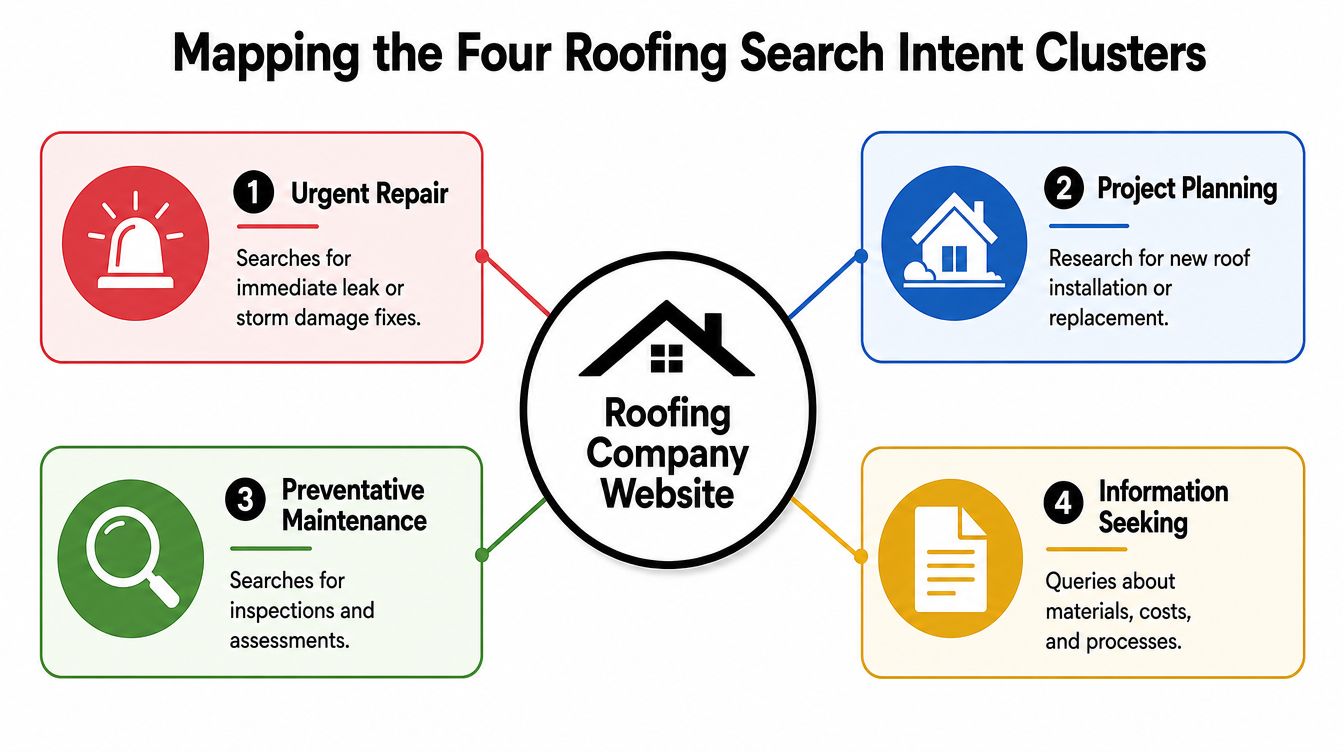
A roofing website that treats every visitor as someone searching for “roofer near me” will usually miss the questions that determine urgency, job type, and readiness to buy. Search intent splits into distinct groups, and each group needs a different page experience.
Emergency and storm searches
Emergency intent is immediate and practical. The visitor wants to know whether someone can attend, what make-safe work involves, whether the team handles storm-related damage, and what information to collect for an insurer.
Australian roofing guidance notes that emergency keywords can spike 25 to 40 times during hail events, while “emergency roofer Sydney” searches can increase 20 times overnight after major storms, as reported by SEO Melbourne's roofing search guide. These figures make a dedicated storm-response page commercially sensible, but the page must be operationally honest. Don't promise twenty-four-hour attendance if the business can't provide it.
The call to action should be direct: call now, request an urgent assessment, or send photos of the damage. Put the phone number above the fold and explain what happens after the enquiry.
Planned restoration and replacement
Planned projects need a slower decision path. Homeowners compare restoration with replacement, ask about material choices, consider disruption, and want to understand the inspection process. A page that only says “we provide quality roof replacements” gives them no reason to trust the business.
Build separate pages for restoration and replacement where both services are offered. Use decision criteria, process stages, material considerations, common warning signs, and a request-an-assessment action.
Material-specific searches
Material-led queries usually reflect research before contact. A visitor comparing Colorbond and tile roofing isn't looking for a generic company introduction. They want a useful explanation of durability, appearance, maintenance, suitability, installation considerations, and likely project variables.
A comparison page can support service pages, but it shouldn't replace them. Link each material discussion to the relevant installation, restoration, or replacement pathway.
Suburb-level searches and preventative work
Location pages should explain actual coverage and local relevance, not swap a suburb name into identical copy. Include service availability, nearby project evidence where appropriate, relevant property types, and a clear way to confirm coverage.
Preventative inspections also deserve their own pathway. Someone searching for a roof inspection or assessment may not have an active leak, but they still need a specific explanation of what the inspection covers and what recommendations they can expect.
For a broader view of how structured content can support visibility beyond conventional results, see Raffine Studio's guide to generative engine optimisation-matters).
Building Service Pages That Answer Real Homeowner Questions
Many roofing service pages miss the point. They lead with company history, repeat generic quality claims, and finish with “contact us”. Homeowners usually want to compare options, understand likely costs, and know what happens next before they pick up the phone.
That gap is bigger than it looks. Propeller's guide for roofers notes that many Australian trade and local-service sites still sit in weak technical and content states, which leaves room for pages that answer real buying questions clearly. The strongest pages do that job without overpromising.
Use a decision-led page structure
A service page should move through the homeowner's decision in order:
Is this the service I need? State the problem, the warning signs, and the situations that usually call for repair, restoration, or replacement.
What does the work involve? Explain inspection, preparation, repairs, installation, clean-up, and handover in plain language.
How much might it cost? Give honest ranges only when they can be defended, or explain the variables that change the price.
Who is qualified to do it? Cover licensing, insurance, warranties, experience, and any limits on the work.
What should I do next? Offer a call, photo-based enquiry, inspection request, or quote pathway.
That structure matters because roofing buyers rarely search in a straight line. Emergency storm damage, restoration versus replacement, and planned upgrades all need different page angles. A flood-damaged roof callout page should read differently from a materials comparison page or a suburb-specific inspection page. If a page asks for a quote before it has answered the obvious questions, it leaks leads.
Support the pages with search data
The point is to prioritise commercial intent, not branded vanity terms.
Service-page planning should also reflect how people search across the rest of the site. Queries around roof repairs, roof restoration, and commercial roof repairs show why these pages need clear pathways to the right service and locality. For page structure and conversion flow, Raffine Studio's website design and SEO guidance is useful because it ties content layout to the next commercial action.
Add relevant LocalBusiness, Service, FAQ, and Organisation schema where the page and implementation support it. Use internal links to connect comparison content with the appropriate service and location pages.
Turning Search Visibility Into Booked Jobs With Speed-to-Lead
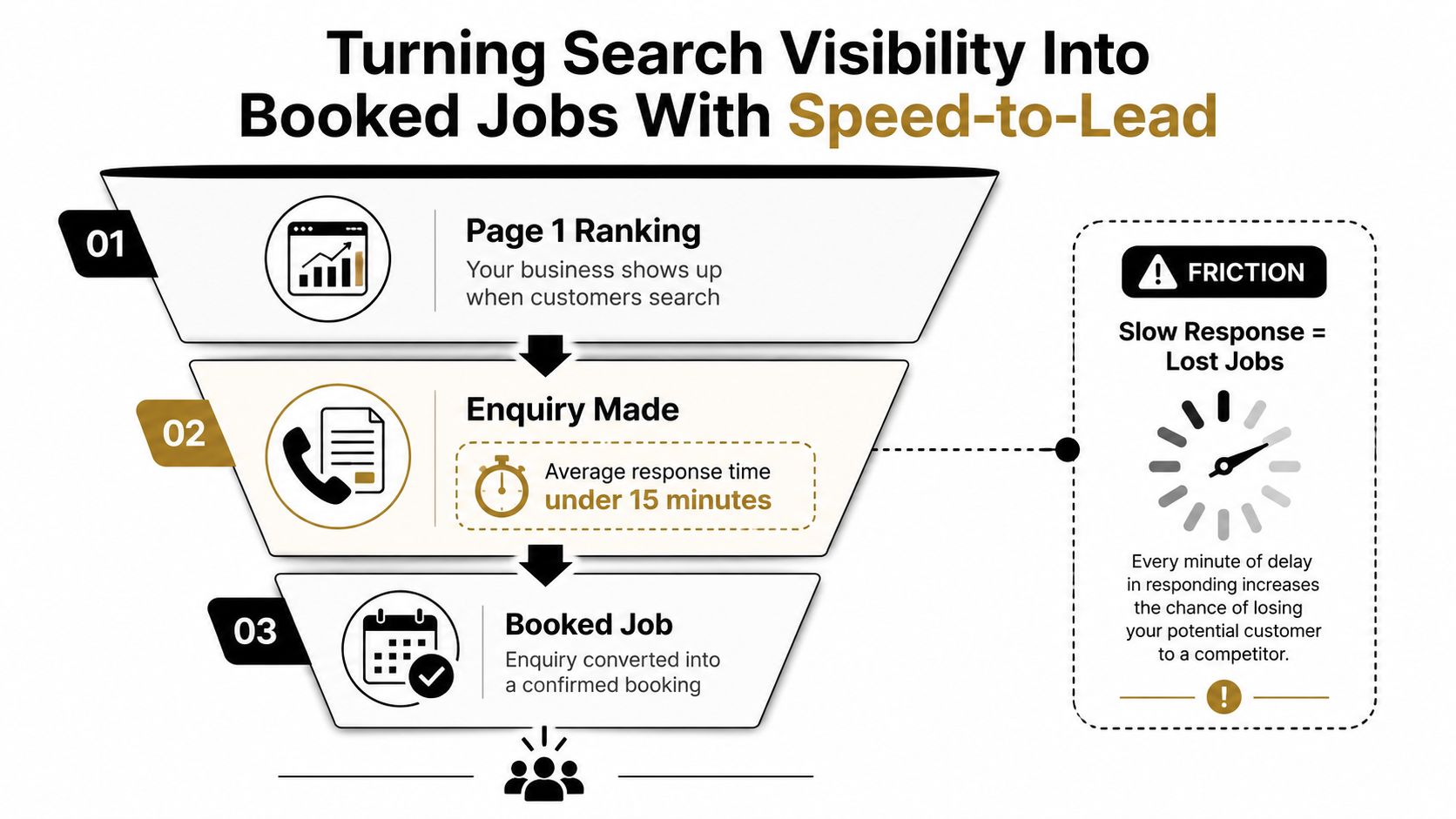
A page-one ranking can't rescue a roofing company that takes hours to respond. Search visibility creates an opportunity, but the enquiry process determines whether the opportunity becomes an inspection, quote, or booked job.
A widely cited lead-response study found that businesses responding within 5 minutes instead of 30 minutes were about 21 times more likely to qualify a lead, as summarised by Echo Studios' speed-to-lead analysis. The practical lesson is simple. Don't send SEO enquiries into an unattended inbox and assume the office will catch up later.
Remove friction from the first action
A conversion-focused roofing page should make the next step obvious:
Emergency visitors: show a prominent tap-to-call option and explain immediate response steps.
Planned-project visitors: offer an inspection or quote request with a short form.
Researchers: provide a useful comparison or assessment guide before asking for details.
Commercial customers: route enquiries to the right person and request property type, access information, and project scope.
The form should ask only for information that helps triage the job. Name, phone, suburb, service required, urgency, and an optional photo upload are usually more useful than a long qualification questionnaire.
Connect the enquiry to follow-up
A sensible workflow sends an immediate acknowledgement, alerts the responsible team member, records the source page and campaign, and creates a follow-up task if nobody makes contact. Calls should be tracked by source where possible, and forms should record the service and location page that generated the enquiry.
automated lead follow-up examples become relevant here. Automation shouldn't replace the roofer's judgement. It should prevent a legitimate enquiry from disappearing between the website, phone, inbox, and CRM.
The video below illustrates the relationship between visibility, response, and conversion.
Measure qualified calls, inspections booked, quotes issued, jobs won, and revenue by source. Impressions and rankings help diagnose performance, but they aren't the commercial finish line.
Your 90-Day Roofing SEO Implementation Plan
A roofing company doesn't need to publish indiscriminately. It needs a prioritised system that fixes the money pages first, strengthens local evidence, and makes every enquiry traceable.
Days 1 to 30 focus on leakage
Start with an audit of the Google Business Profile, website structure, mobile experience, calls to action, tracking, and service coverage. Confirm that the business name, category, phone number, hours, service areas, and website links are accurate.
Then fix the pages closest to revenue:
Repair the contact path. Add tap-to-call buttons, shorten forms, and make emergency options obvious.
Map services to pages. Identify whether repairs, restoration, replacement, commercial work, inspections, and storm response each have a suitable destination.
Request authentic reviews. Build the request into job completion rather than sending occasional mass messages.
Record baseline outcomes. Track calls, forms, inspection requests, and booked work by source.
The first phase is about removing preventable losses, not chasing a large content calendar.
Days 31 to 60 build useful depth
Create or improve the core service pages. Add suburb pages only where the business serves the area and can provide meaningful local information.
Publish comparison content around restoration versus replacement, material decisions, inspection findings, storm response, and cost variables. Link those resources to the pages that generate enquiries. Add appropriate schema, improve page titles and headings, compress project images, and resolve crawl or indexing problems that block important content.
Use Google Business Profile Posts to reinforce current services, seasonal availability, and completed work. Keep the website and profile consistent so customers receive the same information wherever they find the business.
Days 61 to 90 compound what works
Review which service pages attract qualified enquiries, which suburbs produce worthwhile jobs, and where customers abandon the path. Improve pages that receive attention but fail to create calls or forms. Expand content around real questions from the sales team, not topics chosen only because they sound relevant.
Create a repeatable reporting view that separates visibility from commercial outcomes:
Visibility: map-pack presence, organic positions, indexed service pages.
Engagement: calls, form starts, completed enquiries, photo uploads.
Sales: inspections booked, quotes issued, jobs won, and source quality.
Operations: response time, missed calls, follow-up completion, and lead status.
Australian small businesses represented 97.3% of all Australian businesses in June 2025, according to the Australian Small Business and Family Enterprise Ombudsman data portal. For a roofing operator, that context makes a focused local system more practical than trying to imitate a national brand. Start with the services and suburbs that produce profitable work, then expand once the conversion and follow-up process is reliable.
Raffine Studio builds conversion-focused websites, local SEO systems, enquiry funnels, and automated follow-up workflows for Australian service businesses, including roofing companies that need more than rankings. Visit Raffine Studio to review how your website, search visibility, and lead-handling process can work together to produce more qualified enquiries and booked jobs.