website design & seo, conversion optimisation, technical SEO, lead generation, AI search visibility
Website Design & SEO: A Complete Guide for 2026
by raffiné studio
A website can look expensive, rank for valuable searches and still produce very few enquiries. That isn't a contradiction. Website design attracts attention, SEO creates discoverability, but conversion architecture turns interest into commercial action. Treating those disciplines as separate projects is one of the most common reasons Australian professional services firms underperform online.
Google has shaped Australian discovery for years, and AI search is changing how people find and evaluate providers. Your website now needs to satisfy search engines, answer questions clearly, establish trust quickly and give qualified visitors an obvious next step. Traffic is only useful when the site can capture demand and the business can respond to it properly.
Why Beautiful Websites With Good SEO Still Fail to Generate Leads
The popular advice is simple: build a polished website, optimise it for search and wait for enquiries. That advice leaves out the part that determines whether a visitor becomes a prospect.
A law firm may rank for a relevant service. An accounting practice may publish useful articles. A buyers agency may have an impressive portfolio. Yet the visitor still has to decide whether the business understands their problem, whether it's credible, what happens next and how difficult it will be to make contact.
Aesthetic quality helps form an impression, but it doesn't explain an offer. Rankings create opportunities, but they don't remove hesitation. A website needs a deliberate path from search intent to trust to action.
The gap between visibility and commercial action
Most agencies are organised around a single deliverable. A design team focuses on layout and brand expression. An SEO team focuses on rankings, technical improvements and content. A marketing automation provider focuses on forms, CRM workflows or bookings.
Each discipline can perform competently while the overall system fails. The SEO page may attract visitors but send them to a generic contact page. The design may prioritise large imagery while burying the service, location and call to action. The form may collect an enquiry but provide no immediate confirmation, booking option or follow-up process.
Practical rule: Every important landing page should answer three questions quickly: “Is this for me?”, “Why should I trust you?” and “What should I do next?”
The commercial bottleneck often sits between the ranking page and the enquiry mechanism. That's where businesses lose intent. A visitor searches for a specific service, lands on a broad homepage, scans vague claims, struggles to find evidence and leaves without speaking to anyone.
What conversion architecture changes
Conversion architecture gives each page a job. A service page handles high-intent visitors. An educational article builds understanding and directs readers towards a relevant service. A case-led page demonstrates how the business thinks and works. A booking page reduces friction for people who are ready to talk.
The structure should reflect the buyer's decision, not the internal structure of the business. “About”, “Services” and “Contact” may make sense to a team, but they don't always create a persuasive journey for someone comparing providers.
Before commissioning another redesign or increasing SEO spend, inspect the handoff between traffic and action. If qualified visitors arrive but don't enquire, more traffic may make the waste more visible. The right fix may be clearer messaging, stronger proof, a more specific offer, a shorter path or faster follow-up.
The Australian Search Environment and What It Means for Your Website
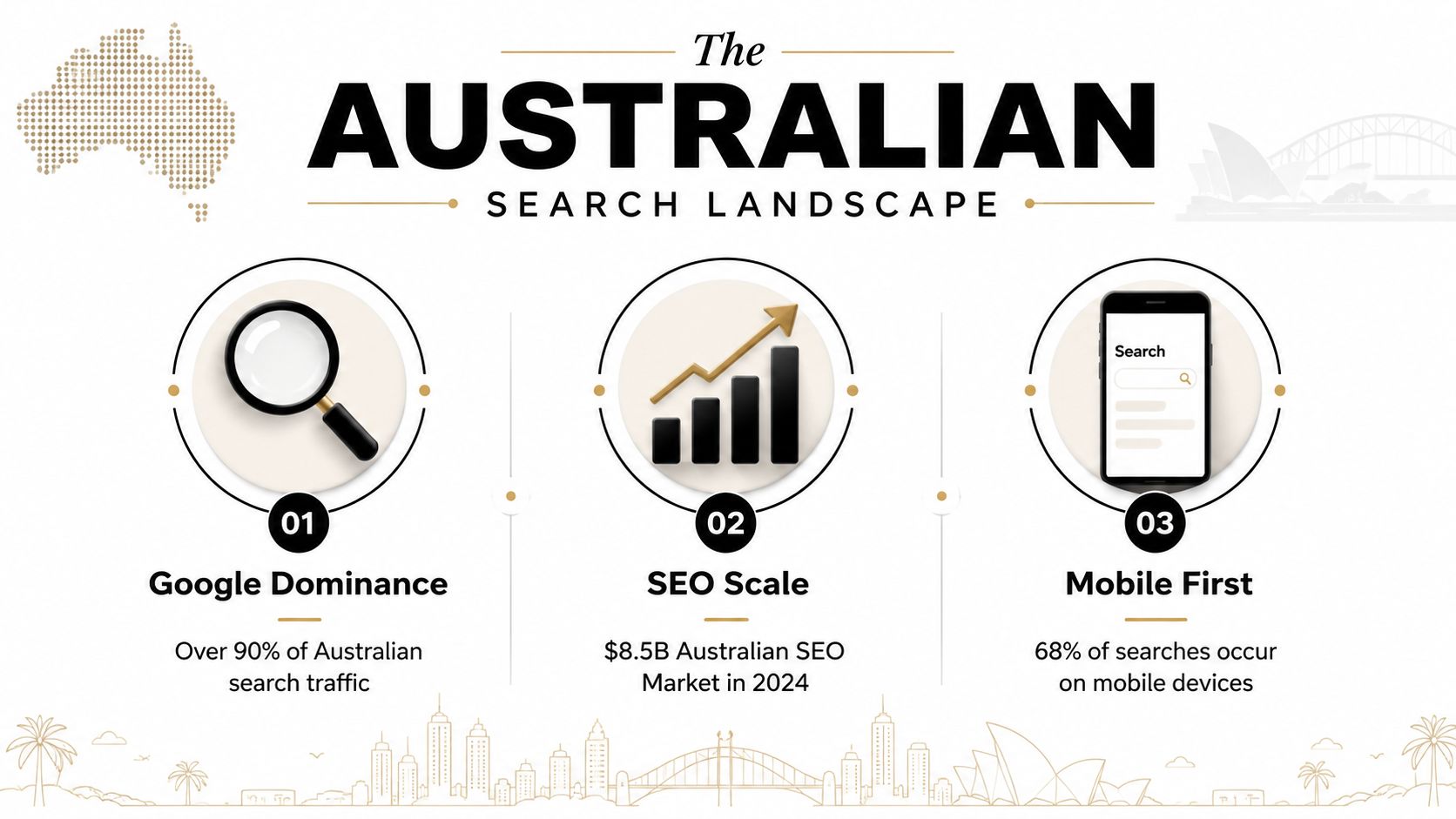
Australian businesses operate in a strongly Google-led search environment. The ACCC consumer survey reported that Google was used by 90% of Australians on smartphones and 92% on computers in its 2021 survey. A later Australian market summary placed Google at 93.95% of search share in July 2024, according to SearchScope's Australian search statistics.
That concentration shapes practical website decisions. Crawlable architecture, mobile usability, relevant page content and strong performance affect how Australian buyers discover providers, compare options and decide whether to enquire. Rankings create the opportunity, but the page still needs a clear commercial path.
Why centralised search changes the priority list
The Australian SEO market reflects that commercial importance. Industry estimates place SEO spending at around A$1.5 billion in 2025, with roughly 12% year-on-year growth, while Google accounted for approximately 93% to 94% of Australian search usage in 2024 to 2026, according to SearchScope's market commentary.
Those figures do not justify chasing rankings without a conversion plan. They show why website design and SEO need to be managed as one lead-generation system. A page can attract qualified visitors yet produce little business if its offer is vague, its proof is buried or its next action is difficult to find. Conversely, a polished website with no search visibility has limited reach.
For an Australian service business, the practical priorities are clear:
Mobile-first layouts: Put the main message, proof and next action within easy reach on a phone.
Specific service pages: Match pages to the services buyers search for instead of placing every offer on one broad page.
Local relevance: Explain where you work and who you serve in natural, useful language.
Search-ready structure: Use meaningful headings, descriptive titles, internal links and accessible content.
Commercial measurement: Track qualified enquiries and booked calls, not rankings alone.
Google's dominance creates opportunity and concentrates risk. A failure in page speed, relevance or click-through can reduce a meaningful share of inbound demand, while strong search visibility is wasted if the destination page cannot turn intent into action.
Technical Foundations That Drive Both Rankings and Conversions
Technical SEO isn't a back-room exercise separate from design. The same infrastructure that helps Google understand and render a website also affects whether a visitor can read the page, interact with a form and trust the experience.
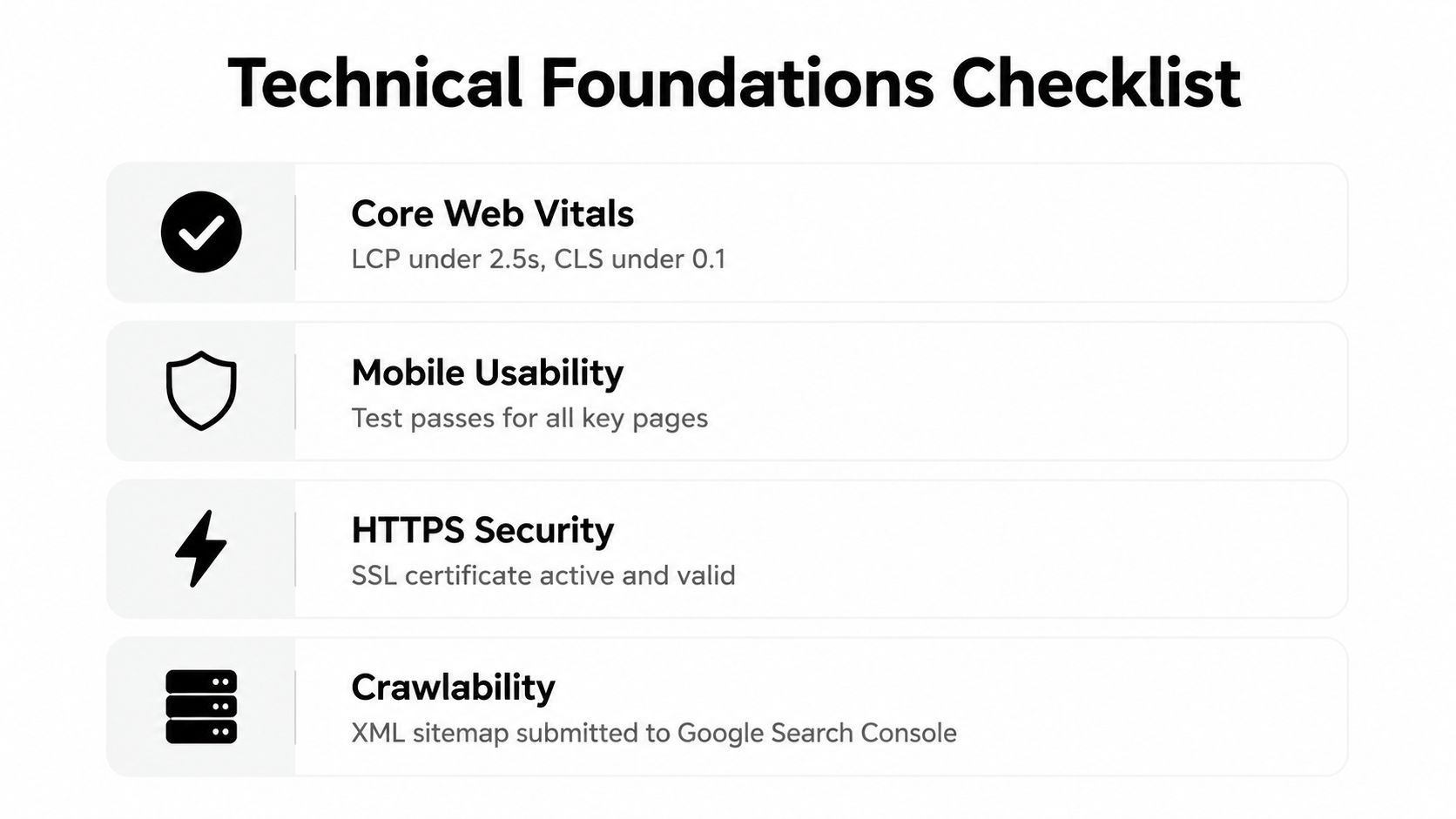
Google Search Console's Core Web Vitals report uses Chrome User Experience Report field data, which means performance decisions should be based on real-user behaviour rather than lab scores alone. Google's Core Web Vitals guidance identifies the “good” thresholds at the 75th percentile of visits as Largest Contentful Paint under 2.5 seconds, Interaction to Next Paint under 200 milliseconds and Cumulative Layout Shift under 0.1.
Fix the foundations in the right order
Start by measuring real-user performance in Search Console and reviewing the pages that matter commercially. A homepage, high-value service page and booking page deserve more attention than an obscure archive page because a weakness on those pages affects both acquisition and conversion.
Then inspect the elements that commonly create friction:
Hero media: Large videos and uncompressed images can delay the main content. Use appropriately sized assets and avoid making a visual flourish carry the entire above-the-fold experience.
Layout stability: Reserve space for images, banners and embedded tools so the form or button doesn't move while someone tries to use it.
Interaction speed: Reduce unnecessary scripts, third-party widgets and heavy animations that delay taps, menus or form fields.
Mobile usability: Check real devices, not only a desktop browser resized to a narrow window.
Crawlability: Keep important pages accessible through internal links, maintain a current XML sitemap and remove avoidable duplication.
Security: Use HTTPS and keep forms, booking tools and integrations maintained.
Australian government websites provide a useful local example of the commercial value of mobile optimisation. Adobe's 2023 assessment of Australia's government websites reported that a focus on mobile design and optimisation improved site speed and performance by 19%, while the overall score rose from 58/100 in 2022 to 68.4/100 in 2023.
That evidence doesn't mean every private business will achieve the same outcome. It does show why mobile performance deserves design and development attention from the beginning, not a quick technical pass after launch.
A technically healthy website still needs a persuasive offer, but a persuasive offer can't compensate for a page that fails to render, shift-free interaction or usable mobile navigation.
Information Architecture That Serves Search Engines and Buyers
Website hierarchy determines more than where pages sit in a menu. It tells Google which topics belong together and helps buyers understand how your services fit their situation.
A professional services firm often starts with an internal view of the business. The navigation mirrors departments, capabilities or delivery stages. Buyers usually arrive with a problem, a service need or a comparison question. Those two structures don't always match.
A better architecture connects discovery content to commercial pages. A guide about preparing for a property purchase should lead naturally to a buyers agency service page. An article about business tax planning should direct readers towards the relevant accounting capability. A construction project page should show the type of work, location, process and next step, rather than sit as an isolated gallery item.
Build a clear route to the decision
Yellow Pages Australia advises that users should be able to reach any page within three clicks, as outlined in its guidance on optimising for search in Australia. Treat that as a usability test, not a rigid law. A complex transaction may need more explanation, but important service and booking pages shouldn't be hidden behind layers of vague labels.
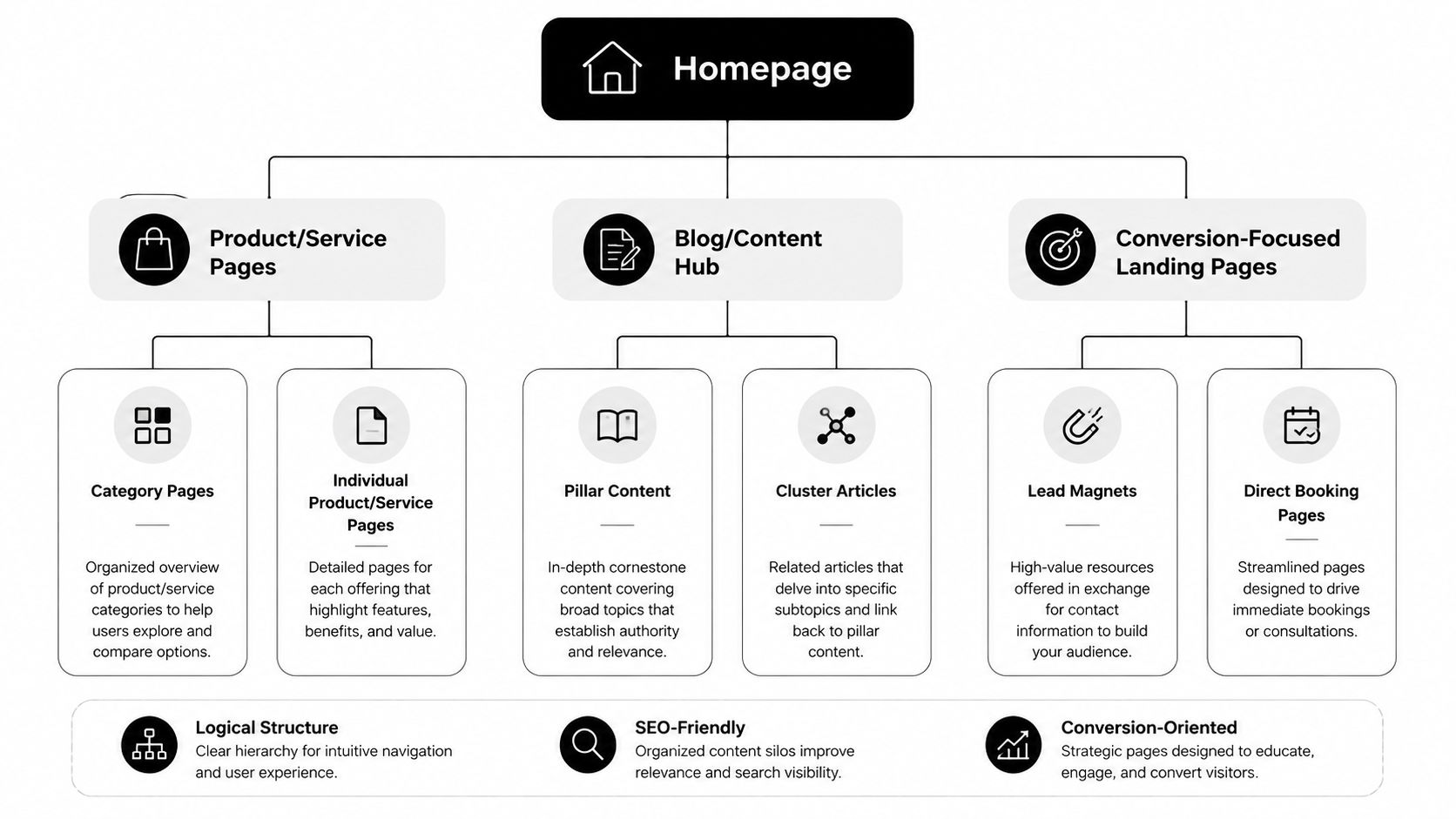
A workable structure usually includes:
A clear homepage: State who the business serves, what it does and where it operates.
Service or capability groups: Organise related offerings under meaningful categories.
Detailed service pages: Give each important intent its own page, with relevant proof and a clear action.
Content hubs: Group educational articles around buyer problems, not publishing dates.
Conversion pages: Use focused landing pages for campaigns, lead magnets and direct bookings.
Internal links should carry meaning. “Read more” says little to a search engine or a buyer. “See how our buyers agency process works” sets an expectation and supports the next decision.
Audit the navigation as if you were a new prospect. Can you identify the right service without knowing the firm's internal terminology? Can you reach proof before being asked to enquire? Can a visitor return to the booking path without restarting the journey?
The best architecture does both jobs at once. It creates a logical crawl path and a logical buying path. When those paths diverge, the website may be technically accessible while commercially confusing.
Content Strategy for Traditional Search and AI Visibility
Traditional SEO often rewards content that targets a defined query and earns visibility in conventional results. AI search adds another requirement. Content needs to be structured clearly enough for systems such as Google AI Overviews, ChatGPT, Gemini and Perplexity to identify the business, its expertise, its location and the direct answer to a user's question.
Google introduced AI Overviews in Australia in late 2024, and Google's announcement about the Australian rollout said its updated design increased traffic to supporting websites compared with the previous design. The implication for businesses isn't to abandon conventional SEO. It's to make pages useful in both environments.
Traditional page versus AI-ready page
A conventional SEO page can focus heavily on a target phrase, supporting terms and a long explanation. That may help relevance, but it can still frustrate a buyer if the answer is buried beneath generic introduction copy.
An AI-ready page makes the core answer easy to identify, then adds the depth a human needs to make a decision:
Content approach | Useful for search understanding | Useful for conversion |
|---|---|---|
Direct service definition | Clarifies what the business does | Helps visitors self-qualify |
Structured questions and answers | Gives systems clear passages to interpret | Resolves objections before contact |
Specific process explanation | Adds topical and commercial context | Reduces uncertainty about engagement |
Evidence and examples | Supports credibility signals | Gives buyers a reason to believe |
Clear summary near the top | Improves extractable meaning | Helps impatient visitors orient themselves |
AI visibility isn't achieved by writing robotic summaries or stuffing FAQs into every page. It comes from clear language, consistent business details, strong subject coverage and genuine evidence.
For example, a medical practice should explain the treatment, who it's suitable for, what an appointment involves and when someone should seek professional advice. A broker should explain the borrowing situation they handle, the information needed and the next step. A law firm should clarify the type of matter, likely process and relevant jurisdiction.
Long-form content still has a role, but length alone isn't a strategy. The page should answer the immediate question first, then earn the reader's attention with useful detail and a commercially relevant path forward.
For a deeper treatment of this shift, see why Generative Engine Optimisation matters for modern search visibility-matters). The strongest content strategy serves both discovery modes without sacrificing the human decision that happens after the click.
Building Conversion Paths That Turn Traffic Into Booked Calls
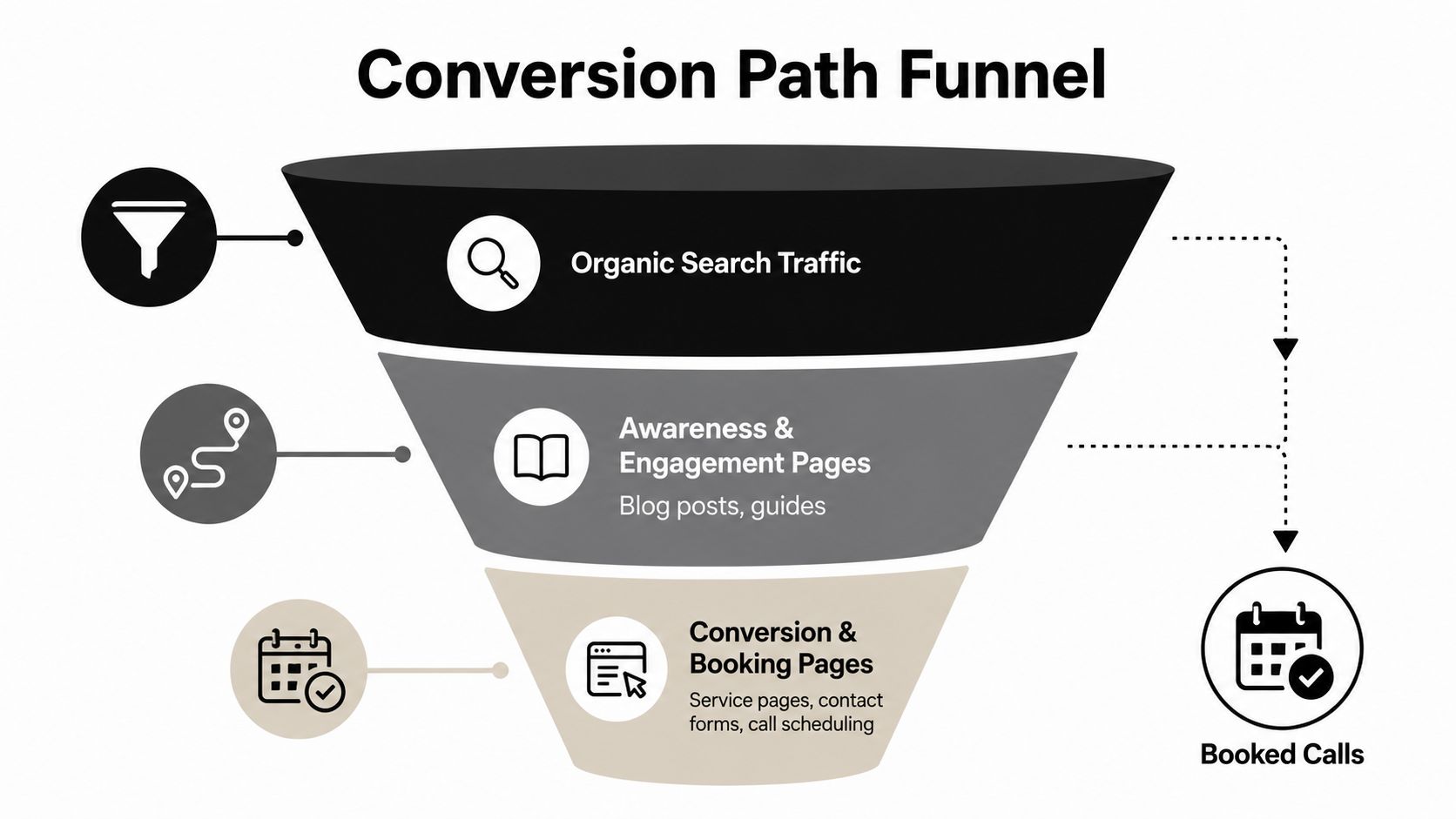
A conversion path is the sequence between a visitor's first meaningful interaction and the action your business wants them to take. For a professional services firm, that may be an enquiry, a qualification form or a booked discovery call.
Start by assigning a role to each page. An article should educate and create a relevant next step. A service page should establish fit and confidence. A booking page should make the action easy. If every page uses the same generic “Contact us” button, the site forces visitors to do too much interpretive work.
A practical conversion audit
Review the journey in this order:
Confirm intent. Does the landing page match the search or referral context? Someone looking for commercial property advice shouldn't land on a generic company overview.
Clarify the offer. Can a visitor understand the service, ideal client and commercial outcome without decoding internal jargon?
Add proof at the point of doubt. Place testimonials, credentials, project evidence, FAQs or process detail close to the claims they support.
Reduce form friction. Ask only for information needed to qualify the enquiry and route the lead properly. More fields aren't automatically better.
Offer an appropriate action. Some visitors need a guide or email conversation. Others are ready to book. Give both groups a relevant option.
Close the loop. Confirm what happens after submission, connect the booking tool and send the lead into the right CRM workflow.
Brand and website decisions should support that path. Branding and web design for commercial clarity is not about adding decoration to a funnel. It's about making the offer recognisable, credible and easy to act on.
Speed matters after submission
Lead capture doesn't end at the form. A Harvard Business Review and MIT lead-response study, cited by Zipzipe's discussion of website conversion, found that responding within five minutes made a business 100 times more likely to make contact and 21 times more likely to qualify the lead than waiting 30 minutes.
That finding makes follow-up part of website design. A form without a notification, routing rule, confirmation message and response owner creates a false sense of performance. The site may be generating enquiries while the business loses opportunities through delay.
Raffine Studio is one option for businesses that need website design, SEO, booking flows, CRM handoff and follow-up considered as one lead-generation system. The alternative is to assemble each layer separately and accept the gaps between them.
Your Integrated Website Design and SEO Action Plan
The right starting point isn't a complete rebuild by default. It's a commercial audit that identifies where the current system loses value.
Review the site through four lenses:
Discovery: Can search engines understand the business, services, locations and subject expertise?
Experience: Can visitors use the important pages quickly on mobile and desktop?
Decision: Does each page help the right buyer build confidence?
Follow-up: Does every enquiry reach a person or workflow that can respond promptly?
Prioritise changes by commercial consequence. A slow booking page, unclear service offer or broken form deserves attention before a minor blog formatting issue. A high-value service page with strong impressions but weak clicks may need a better title and description. A page with traffic but no meaningful action may need a sharper offer, stronger proof or a more relevant next step.
Choosing between optimisation and redesign
Incremental improvements make sense when the current platform is stable, the content is salvageable and the information architecture broadly reflects the business. Redesign becomes more defensible when the structure is confusing, the platform prevents necessary integrations, the brand no longer fits the market or technical limitations block performance work.
Protect existing search equity during a rebuild. Map important URLs, review redirects, preserve useful content, check internal links and monitor indexing after launch. A visually better website that loses valuable pages creates an avoidable commercial setback.
Measurement should focus on the quality of demand. Track organic entry pages, service-page engagement, form completions, booked calls, lead source, response time and qualified pipeline. Rankings and traffic provide context, but they don't tell you whether the website is producing the conversations the business wants.
Automation can support this system when it's designed around the buyer experience. Review practical automated system examples for lead handling and follow-up, then decide which tasks should be handled by a CRM, booking platform, chatbot or human team member.
The position is simple: website design and SEO shouldn't be separate projects when the business goal is qualified lead generation. Search visibility brings the right people into the system. Design and content help them decide. Booking, CRM and follow-up turn intent into a commercial conversation.
Raffine Studio builds conversion-focused websites and funnel systems that connect SEO, AI search visibility, booking, CRM handoff and lead follow-up for Australian service businesses. If your site attracts attention but isn't producing enough qualified conversations, visit Raffine Studio to review the gap between your traffic and your pipeline.