website design prices, web design cost Australia, website pricing guide, conversion website cost, agency web design rates
Website Design Prices in Australia: What Businesses Actually
by raffiné studio

Most Australian small businesses pay AUD $2,000–$6,000 for a professionally designed website in 2026. A conversion-focused build with booking flows, CRM integration and SEO typically runs AUD $8,000–$25,000+.
That answer is more useful than the popular advice that website design is a commodity with a standard market price. It isn't. A site that displays your services, captures enquiries, books calls, sends lead data to your CRM and supports search visibility is performing a different commercial job from a low-cost brochure site.
Australian businesses often compare quotes as though the only difference is colour, layout or the number of pages. The difference is whether the website remains a passive online brochure or becomes part of the sales process. For a law firm, buyers agency, broker, medical practice or B2B consultancy, that distinction affects the quality of enquiries, the speed of follow-up and the amount of manual work your team carries after someone submits a form.
Why Most Website Design Price Comparisons Mislead Australian Businesses
The first mistake is treating website design prices like a shelf price. A business owner sees one quote for a few thousand dollars and another for considerably more, then assumes the higher quote reflects better styling. That comparison ignores the work behind the commercial result.
Independent Australian pricing guides describe a broad ladder. Basic brochure sites may start around AUD $500–$1,775, custom business websites commonly sit around AUD $3,000–$15,000, and ecommerce projects typically begin near AUD $8,000, with complex integrations exceeding AUD $50,000, according to Bark's Australian website design pricing guide. Another Australian guide places brochure sites at approximately AUD $2,500–$10,000 and large bespoke websites above AUD $30,000, reinforcing that scope drives the quote more than visual polish.
A $1,500 template build and a $15,000 conversion-focused website aren't competing products. One may give you a credible online presence. The other may include discovery, information architecture, copy hierarchy, SEO foundations, booking logic, analytics and CRM handoff. Comparing them only by page count is like comparing a display-home brochure with an operating investment property.
The quote is only the first cost
A website has an ownership cost after launch. Hosting, security, content updates, analytics, accessibility work, maintenance and conversion optimisation all affect what the asset costs your business over time. Australian price guides commonly focus on upfront ranges, but the more commercially useful question is how the site will be operated across its working life, as discussed in this Australian website cost analysis.
The cheapest quote can become expensive when:
The content is unusable: Your team must rewrite vague service pages after launch.
SEO starts late: The build has no useful page structure, metadata or internal linking plan.
Leads disappear: Form submissions aren't routed properly or followed up quickly.
Updates become risky: Plugin conflicts, security issues or broken layouts require emergency work.
Your team can't measure performance: Analytics events don't distinguish visits from meaningful enquiries.
Commercial rule: Price the website according to the business job it must perform, not the number of screens a provider promises to design.
If the site only needs to confirm your phone number and service area, a modest build may be sensible. If it needs to generate qualified discovery calls, support Google and AI search visibility, and reduce lead leakage, a low-cost brochure benchmark is the wrong reference point.
Australian Website Design Prices by Provider Type and Scope
Australian website design prices vary by the provider's labour model, strategic involvement and technical responsibility. A GoDaddy AU guide places brochure websites built by a designer around AUD $2,500–$10,000, with designer labour billed at approximately AUD $20–$64+ per hour. Infrastructure is a smaller part of the equation, with .com.au domain registration around AUD $20–$50 per year and hosting as low as AUD $6.95–$29.95 per month, as outlined in GoDaddy Australia's website cost guide.
A separate 2026 Australian guide reports freelance designers commonly charge A$50–A$150 per hour, while agency rates sit around A$80–A$200 per hour. It lists Sydney at approximately A$120 per hour, Brisbane at A$90, Melbourne agencies at A$150–A$200, and Perth and Adelaide at A$100–A$150, in Spark Interact's Australian pricing guide.
Those hourly figures don't tell you what the finished website will achieve. They do help explain why a project involving research, copy, design, development, integration testing and analytics costs more than a template adjustment.
A practical comparison
Provider Type | Typical Price Range (AUD) | Best Suited For | Key Limitations |
|---|---|---|---|
DIY or template provider | A few hundred annually or a modest one-off setup | Very simple brochure presence | Limited strategic input, differentiation and conversion planning |
Freelancer | Around AUD $1,000–$10,000 | Small projects with clear scope | Capacity, specialist coverage and long-term support can be limited |
Boutique studio | Around AUD $5,000–$15,000 | Established service businesses needing strategy and custom design | Less suitable for highly complex enterprise systems |
Agency | Around AUD $5,000–$50,000+ | Multi-service websites, integrations and ongoing optimisation | Higher coordination overhead and broader process |
Bespoke digital project | Above AUD $30,000 | Large, complex or highly integrated websites | Requires stronger internal decision-making and project governance |
The broad Australian market bands support this tiered view. A 2026 pricing overview places professional sites for many small businesses at AUD $2,000–$6,000, 6–10 page sites around AUD $5,000–$10,000+, and professional web design more broadly at AUD $5,000–$25,000+, depending on complexity and provider experience, as summarised by What's The Damage.
A Sydney firm isn't automatically worth more because it operates in Sydney. The premium is justified when you receive clearer positioning, stronger conversion architecture, reliable delivery and a system your team can use. Before choosing a provider, review what WordPress website design in Sydney should cover beyond a theme and a contact form.
What Is Actually Included at Each Price Band
Two proposals can use identical language while offering very different deliverables. “Responsive design”, “SEO-ready” and “custom development” sound reassuring, but they don't explain who writes the copy, which pages are included, how tracking works or what happens when your existing content is migrated.

Entry-level work
An entry-level project generally suits a business that needs a clean presence rather than a full acquisition system. It may include a pre-designed template, a small set of pages, basic contact functionality and a content management system.
That can be the right decision for a sole operator, a new local business or a company validating an offer. It becomes a poor decision when the business expects the site to rank for several services, qualify prospects or support a sales team.
Common exclusions include:
Strategic discovery: No customer research, offer clarification or competitor review.
Conversion copywriting: You provide the words, often without messaging guidance.
Technical SEO: Basic titles may be present, but page architecture and search intent mapping aren't.
Analytics configuration: A tracking code may be installed without meaningful enquiry events.
Migration and redirects: Existing search equity can be put at risk during a rebuild.
Mid-market work
The mid-market band should provide more than visual customisation. Expect a considered sitemap, service-page structure, mobile optimisation, lead capture, basic SEO foundations and CMS training. The exact scope still needs to be documented, because “custom” can mean a customised homepage placed over an otherwise standard template.
Ask whether the quote includes UX decisions, form logic, content support, image treatment, performance testing, accessibility checks and post-launch fixes. Read this guide to affordable web design for small businesses with the same discipline. Affordable should mean focused scope, not omitted essentials.
Premium work
Premium projects justify their price through commercial depth. They may include bespoke UX and UI, multiple page templates, conversion copy, advanced SEO, analytics event tracking, booking flows, CRM integration, accessibility planning, content migration and structured testing.
Before accepting a quote, request a line-by-line answer to these questions:
Who owns the copy and content structure?
Which integrations will be configured and tested?
What counts as a conversion event?
Are redirects, analytics and search foundations included?
What happens after launch?
Which licences and ongoing services will the business pay for?
A polished design without these answers isn't a complete commercial proposal.
When Design Becomes Pipeline Infrastructure
A brochure website answers questions. A pipeline website helps qualified prospects decide, act and enter the sales process with less friction. That distinction matters because a lead-generation business is buying an acquisition asset, not just a set of attractive pages.
The build becomes pipeline infrastructure when its working parts support a measurable commercial path:
Booking flows turn interest into a scheduled conversation instead of an abandoned form.
CRM handoff gives the sales team structured lead information rather than an email buried in an inbox.
Analytics events distinguish completed bookings and qualified enquiries from superficial engagement.
Lead qualification collects the information your team needs before committing time to a call.
SEO and AI search foundations help service pages communicate clearly to conventional search engines and assistants such as ChatGPT, Gemini and Perplexity.
Follow-up automation gives prospects a relevant next step when they are not ready to book immediately.
Each component requires planning, implementation and testing. A project that includes booking flows, CRM handoff, tracking and automation can therefore reach the AUD $8,000–$25,000+ range. That spend is justified when the system improves the path from search or referral to sales conversation, rather than merely adding technical features.
The financial test is direct. A website earns its keep when it contributes to qualified opportunities, improves attribution or reduces manual handling. A design-only price comparison ignores all three outcomes and can make a cheaper brochure site look better value than it is.
A buyers agency might guide visitors from suburb-specific search pages to a qualification form and appraisal booking. A professional services firm might route a matter type to the right adviser, capture urgency and trigger a consultation workflow. A mortgage broker may need a clear path from educational content to a structured enquiry instead of a generic contact page.
Raffine Studio connects website design, funnels, search visibility, booking and follow-up into this type of acquisition system. Review these examples of automated booking and CRM handoff systems before deciding which mechanisms belong in the first release.
The following video shows how website activity can connect to commercial outcomes.
How to Budget for a Conversion-Focused Website
Don't start with a competitor's quote. Start with the economics of your own sales process.
The first question is how many qualified leads the website needs to support each month. A professional services firm seeking 40 qualified leads has a different requirement from a local trades business seeking 15. Those targets don't automatically determine a price, but they expose whether a brochure site is likely to be adequate.
Work backwards from customer value
Use this sequence:
Set the lead target. Define the number of qualified enquiries or booked calls the business can handle.
Estimate customer lifetime value. Include the commercial value of a retained client, repeat engagement or referral potential.
Map the sales process. Identify qualification, booking, CRM handoff and follow-up requirements.
Choose the minimum viable infrastructure. Pay for the mechanisms that remove the largest sources of friction.
Review the budget against capacity. Don't build an elaborate system if the team can't respond to the opportunities it creates.
Business Profile | Monthly Lead Target | Avg. Customer LTV | Recommended Budget Range | Key Infrastructure Required |
|---|---|---|---|---|
Local trades or home services | 15 | Define internally | AUD $4,000–$8,000 | Service pages, local SEO structure, reviews, calls and enquiry tracking |
Professional services firm | 40 | Define internally | AUD $8,000–$25,000+ | Service architecture, qualification, booking, CRM handoff and analytics |
Buyers agency or broker | Define by capacity | Define internally | AUD $8,000–$25,000+ | Landing pages, lead qualification, booking workflow and follow-up |
B2B consultancy | Define by sales cycle | Define internally | AUD $5,000–$25,000+ | Case-led messaging, capability structure, enquiry routing and attribution |
The budget ranges reflect Australian market guidance, not a promise of performance. A 2026 Australian pricing guide notes that the cost of a website system rises when booking, CRM and integration requirements sit beyond a standard brochure build, while recent AU coverage also identifies a gap between upfront build prices and the ongoing cost of running a revenue-focused site.
Budget test: If one additional qualified client would materially change the economics of the project, measure the website against that opportunity, not against the cheapest available template.
Your sales capacity matters as much as your traffic. A complex funnel won't fix an offer nobody understands, and a basic site may be enough while the business is still validating its market. Spend more when the website supports a proven service, a clear acquisition target and a sales team ready to act on captured demand.
The Real Cost of Owning a Website Over Twelve Months
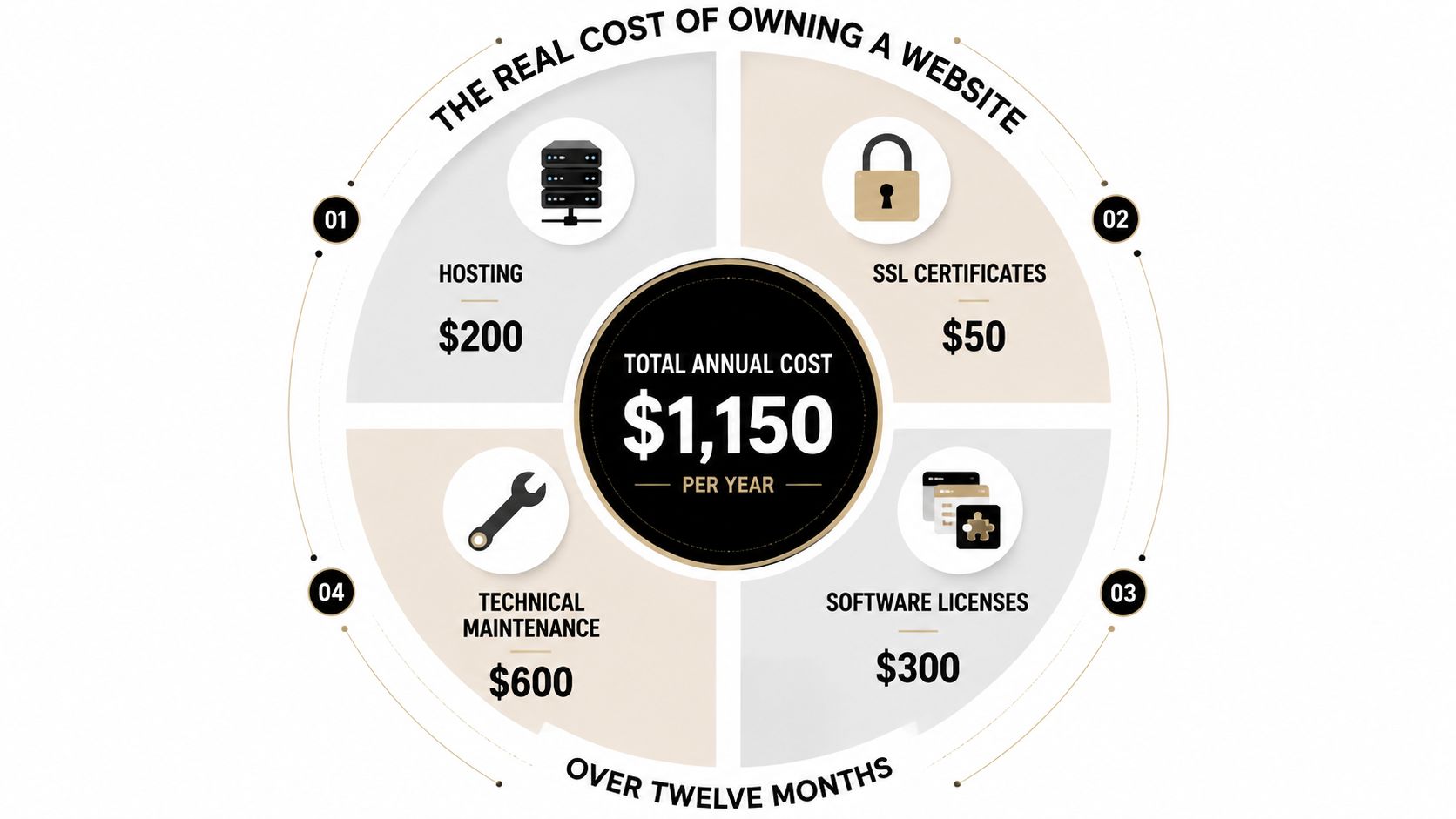
The build invoice doesn't describe ownership. A website also needs hosting, security, software, maintenance, content changes, analytics review and, for a lead-generation business, ongoing conversion work.
Australian infrastructure costs can be relatively modest. GoDaddy AU lists .com.au domains around AUD $20–$50 per year and hosting from AUD $6.95–$29.95 per month, but those fees don't cover the labour required to keep a business-critical website accurate, secure and commercially useful. The larger budget usually sits in strategy, content, development, revisions and ongoing operational support.
What to include in the ownership model
A sensible twelve-month review should separate fixed platform costs from professional labour:
Hosting and domain: The services that keep the site available.
Security and backups: Updates, monitoring and recovery planning.
CMS and plugin maintenance: Compatibility checks and controlled changes.
Content operations: New service pages, edits, case studies and regulatory updates.
Analytics: Checking whether enquiries and bookings are being recorded correctly.
Conversion optimisation: Reviewing friction and testing improvements over time.
A low upfront quote can carry unpredictable obligations. Plugin conflicts may require technical intervention. An internal team may spend hours rewriting pages. A poorly planned migration may force corrective SEO work. None of those costs appear in a headline build price.
Compare ownership, not just launch
The right comparison is the 24-month total cost and the pipeline contribution during that period. A lower-priced site with recurring emergency fixes may be less attractive than a higher-priced build with dependable maintenance and clear reporting.
Don't accept unexamined examples that assign precise annual totals to hosting, SSL, software and maintenance. The actual amount depends on the platform, licence model, support agreement and level of optimisation. Ask each provider for a written operating model that identifies what your team owns, what the provider manages and what triggers additional charges.
The business question is simple: will this website remain useful after launch, or will it become another neglected system your staff work around?
Industry-Specific Pricing Considerations for Australian Service Businesses
A website's price depends on the conversion mechanics of the sector, not its page count. A buyers agency needs a different acquisition path from an accountant, and a B2B engineering firm needs different proof from a local trades business.
For property businesses, the scope may include listing displays, suburb-level landing page architecture, appraisal or consultation booking and lead qualification. Those requirements can place buyers agency and broker builds around AUD $12,000–$20,000, based on the Australian market guidance supplied for this sector. The value lies in helping a prospect move from location research to a relevant conversation, not in adding decorative property galleries.
Professional services firms need trust and risk management built into the experience. Law firms, accountants and financial advisers may require credential presentation, secure document pathways and carefully managed disclaimers. The supplied Australian benchmark indicates these requirements can add AUD $3,000–$5,000 to a base build, depending on the scope.
B2B consultancies and engineering firms often need fewer generic pages and more commercial evidence. Case study frameworks, capability matrices, sector-specific proof and RFP response pathways can take more planning than a larger but shallow brochure site.
Trades and home services businesses can often convert with a simpler build around AUD $4,000–$8,000, provided local SEO structure, review aggregation, clear service areas and prominent contact paths are included. The site doesn't need enterprise complexity. It does need to make the next action obvious.
Industry Sector | Typical Price Range (AUD) | Key Conversion Drivers |
|---|---|---|
Buyers agencies and property brokers | AUD $12,000–$20,000 | Suburb pages, listings, qualification and appraisal booking |
Law, accounting and financial services | Base build plus AUD $3,000–$5,000 for added requirements | Trust signals, secure pathways and compliance-ready messaging |
B2B consultancies and engineering firms | Scope-dependent, commonly mid-market to premium | Case studies, capability depth, proof and RFP pathways |
Trades and home services | AUD $4,000–$8,000 | Local SEO, reviews, service areas and direct enquiries |
Medical and healthcare businesses | Scope-dependent | Service clarity, booking, patient confidence and accessible information |
These are planning ranges, not universal quotes. A site with fewer pages can cost more when each page carries a complex decision path. Conversely, a larger site can remain efficient when its content model is clear and reusable.
Raffine Studio builds conversion-focused websites and funnel systems for Australian buyers agencies, brokers, professional services firms and B2B businesses, connecting SEO, AI search visibility, booking, CRM handoff and follow-up. Visit Raffine Studio to review how your website design price should relate to qualified enquiries, booked calls and the cost of operating the system after launch.