ai search optimization, geo, ai seo, ai visibility, australian seo
AI Search Optimization: A 2026 Guide for Agents
by raffiné studio
A prospective client asks ChatGPT which buyers agent understands a particular Sydney suburb. Another asks Perplexity to compare mortgage brokers before visiting a single website. A law firm may still rank well for a valuable service term, yet never appear when an AI assistant recommends firms for a specific legal problem.
That is the commercial reality behind AI search optimization. Your website still needs strong Google visibility, but rankings alone no longer describe how Australian buyers discover, assess and shortlist professional service providers. AI-generated answers now sit between the question and the provider, often shaping trust before the first enquiry.
How Australian Buyers Changed How They Search
A Sydney buyers agent can begin with familiar Google searches, referrals and property portals. By afternoon, prospective clients may be asking ChatGPT which buyers agents specialise in western Sydney units, or using an AI summary to compare local expertise before opening a search result.
The same behaviour appears in Melbourne mortgage broking. A buyer may ask an assistant to explain pre-approval, compare broker services and identify someone who works with a complicated income profile. A Brisbane business owner might ask which accounting firm handles ATO reviews for hospitality businesses. These are commercially meaningful questions expressed in natural language, with the answer often shaping who makes the shortlist.
Google launched AI Overviews in Australia on 29 October 2024, placing generated summaries directly in search results. Broader search behaviour has shifted too. Google and Ipsos reported in January 2025 that 49% of Australians had used a generative AI tool in the previous year, compared with 38% in 2023. 74% of those users said they used AI tools at work for writing, brainstorming, problem solving and digesting complex information. Australian search behaviour and usage data shows why professional service firms should treat AI discovery as a budget and pipeline issue.
AI influences shortlists before contact
YouGov research referenced in 2026 found that 72% of Australian online searchers use AI assistants such as ChatGPT, Copilot or Gemini as part of their search process, while only 16% say AI is their first starting point. The Australian AI search findings points to the commercial distinction: AI does not need to replace Google to influence a buyer. It only needs to shape the shortlist.
Discovery now spans conversational answers, review platforms, LinkedIn, industry directories, Reddit discussions and video content. AI systems can combine these signals into a recommendation that feels more useful than ten search links. The firms that appear consistently across those sources build recognition before a prospect reaches the enquiry form.
Commercial rule: Optimise for the moment a buyer asks, “Who should I speak to?” not only the moment they type a keyword into Google.
Australian service firms still build pages around traditional ranking assumptions. They target “buyers agent Sydney”, “mortgage broker Melbourne” or “commercial lawyer Perth”, then judge success by position and organic sessions. Those fundamentals remain useful, but they do not show whether an AI system can connect the brand to the right service, client problem and proof of expertise.
The acquisition system needs all three parts working together. The website earns visibility, the brand entity earns recognition, the service page creates a decision path, and the CRM supports timely follow-up. That is the standard for AI search optimisation when the goal is qualified pipeline rather than generic traffic.
What AI Search Optimization Means
AI search optimization is the discipline of making your business, expertise and services easy for AI answer engines to retrieve, understand, cite and recommend. It covers Google AI Overviews, ChatGPT, Perplexity, Gemini and other systems that combine multiple sources into a direct answer.
Classic SEO and AI search optimization overlap, but their immediate objectives differ. Classic SEO helps a page compete for a ranked position and earn a click. AI search optimization helps an answer engine identify a reliable statement, connect it to the correct business entity and use it in a generated response.
The commercial distinction is straightforward. A ranked page can send a visitor to your website. A cited business can enter the buyer's shortlist before that visitor decides which provider to investigate.
Classic SEO and AI search optimization compared
Dimension | Classic SEO | AI Search Optimization |
|---|---|---|
Primary goal | Rank a relevant URL for a search query | Earn accurate mentions, citations and recommendations in AI answers |
Core unit | Page and keyword intent | Brand entity, service relationship and extractable answer |
Content shape | Comprehensive page designed to win a click | Clear, self-contained answers that can be selected and synthesised |
Important signals | Crawlability, relevance, links, technical quality and user experience | Entity clarity, author authority, structured data, corroboration and semantic relevance |
Typical measurement | Rankings, sessions, clicks and enquiries | Citations, branded mentions, assistant referrals, citation accuracy and assisted pipeline |
Commercial role | Feeds the link | Feeds the answer |
Conventional SEO remains part of the job. Google still provides a major entry point, and strong technical foundations support both search surfaces. Build one search strategy that serves rankings and AI answers, rather than funding disconnected SEO and GEO projects.
For a deeper explanation of how this fits into the broader search discipline, read the next evolution of SEO and why Generative Engine Optimisation matters-matters).
The answer must lead
AI systems need to understand what a page covers and which statements belong to the business. Vague brand language delays that interpretation. A service page should state immediately who the firm serves, where it operates and which problem it solves, giving the reader and the machine a clear starting point.
For a buyers agency, separate suburb expertise, acquisition strategy, auction support and off-market work. For a law firm, name the jurisdiction, practice area, client type and relevant limitations. Clarity creates usable evidence. That evidence supports accurate recommendations and gives high-value service firms a better chance of becoming the provider a prospect contacts.
Why Most AI Search Advice Stops at the Page Level
Most AI search advice starts and ends with the page. Add an FAQ. Install FAQPage schema. Use shorter sentences. Put a few statistics into the copy. Those actions can improve extractability, but they don't solve the harder question: does the wider web confirm that this business is what the page claims it is?
An AI assistant deciding whether to recommend a buyers agent in Adelaide or a tax lawyer in Perth may need more than a polished service page. It needs confidence that the business is real, active, relevant to the location and associated with the claimed expertise. That confidence can come from consistent business details, professional profiles, reviews, directory listings, LinkedIn activity and credible third-party mentions.
A page isn't the same as an entity
A website can describe a business as “the leading commercial property adviser” without providing strong corroboration. If the business name, address, phone number, ABN, qualifications or service descriptions differ across external profiles, the assistant has an ambiguous entity to interpret.
The Australian Digital Transformation Agency offers a useful illustration of the principle. Its AI Search beta currently generates responses only from content published on digital.gov.au, which creates a tightly controlled source environment. The Digital Transformation Agency update on AI Search shows why page-level authority, clear information boundaries and machine-readable content matter when a system must select and attribute a source.
Commercial websites rarely operate inside such a controlled corpus. Their authority is distributed across the web.
What strengthens the trust graph
Check whether these sources tell the same story:
Business identity: Your name, address, phone number and ABN should be consistent wherever they appear.
Professional credentials: Qualifications, licences, registrations and memberships need to be current and clearly attributed.
Service relationships: Directory profiles and social accounts should describe the same core services as the website.
External corroboration: Reviews, industry mentions, interviews and relevant professional profiles should support your areas of expertise.
Local relevance: Location references should be specific enough to distinguish your business from similarly named providers.
The Australian guidance on AI search optimisation and structured data reinforces the technical side, including Organization, LocalBusiness, Service, FAQPage and Article schema. But schema can't manufacture reputation. It labels the information you provide. It doesn't make an unsubstantiated claim trustworthy.
Practical rule: Treat your website, Google Business Profile, LinkedIn page, directories and reviews as one entity profile. If each channel tells a different story, an AI system has to guess.
That is why cheap “AI SEO packages” focused only on FAQs and schema are incomplete. AI visibility is an authority-distribution problem as much as a content-formatting problem. Fixing the page without fixing the entity may leave the commercial outcome unchanged.
The Practical Playbook for AI Search Optimization
Start with the pages closest to revenue. Don't publish a large library of generic articles while your core service pages fail to explain who you help, what you do and why a buyer should trust you.
Build answer-led topic clusters
Create a small set of cornerstone service pages supported by pages that answer the questions buyers ask before making contact. A Sydney buyers agency might organise content around:
Acquisition strategy: How buyers agents assess off-market opportunities.
Local expertise: What changes when buying in specific Sydney suburbs.
Process clarity: How inspections, negotiation and due diligence are managed.
Commercial objections: Whether buyers agent fees are justified for a particular purchase.
Decision support: Buyers agent versus managing the search independently.
Each page should have a clear purpose and a logical internal link to the next decision stage. Don't create near-duplicate suburb pages that swap place names while repeating the same copy. That approach gives readers little value and makes the entity less distinctive.
For advice on connecting content, information architecture and organic visibility, see website design and SEO for lead generation.
Make every important answer promptable
Write the first sentence under a heading as if it might be lifted into an answer. Then add context, qualifications and supporting evidence.
Weak opening:
Our experienced team provides tailored solutions for buyers navigating the property market.
Stronger opening:
A buyers agent helps clients identify suitable properties, assess risk, negotiate terms and manage the purchase process, with the exact scope depending on the agreed service.
The second version gives an answer engine clear concepts to connect. It also gives a human reader a quick way to decide whether the page is relevant.
Use:
Question-based headings: Match the language buyers use in ChatGPT and Google.
Self-contained statements: Make each answer understandable without the surrounding paragraph.
Comparison tables: Clarify distinctions between services, fees, processes or client types.
Short checklists: Package practical information into extractable units.
Visible HTML content: Keep core answers in the page rather than hiding them in images, tabs or downloadable files.
Add structured data that reflects reality
Use JSON-LD to help systems identify the organisation, service, article, author and frequently asked questions. Depending on the page, relevant types may include Organization, LocalBusiness, Service, FAQPage, Article and Review.
Don't mark up content that isn't visible or claims that the page doesn't support. Schema should describe the business accurately, including the relationship between the organisation and its services. It must support the content, not act as a decorative technical patch.
Build evidence, not filler
Professional service firms have useful first-party knowledge that generic content rarely includes. Turn it into public evidence:
Explain how your team handles a recurring client problem.
Publish a practical comparison with clear decision criteria.
Document a process, including where clients commonly make mistakes.
Add named authors and relevant credentials.
Reference Australian regulations, local conditions and sector terminology carefully.
Use genuine case material only when the client, facts and permissions support publication.
The most citable page is usually not the longest page. It is the page with the clearest answer and the strongest reason to believe it.
Finally, connect informational pages to transactional pages. A guide about buying an investment property should lead to the relevant buyers agency service. A legal explanation should offer a clear next step for the applicable practice area. AI search visibility creates commercial value only when the website can convert the resulting attention.
What to Adjust for Your Service Business Model
An AI assistant needs different evidence from different professional service businesses. A buyers agency must prove local and transactional relevance. A law firm must demonstrate jurisdictional precision. A finance broker needs to explain regulated services without making the page sound like a generic comparison site.
Service Model | Primary Focus Area | Schema Priority | Content Format |
|---|---|---|---|
Buyers agency | Suburb expertise, acquisition process and local credibility | LocalBusiness, Organization, Service, Review | Suburb guides, process pages, property decision checklists |
Mortgage or finance broker | Lending process, eligibility explanations and compliance clarity | Organization, LocalBusiness, Service, FAQPage | Product comparison frameworks, pre-approval guides, objection-led FAQs |
Law firm | Jurisdiction, practice area accuracy and professional authority | Organization, LegalService where appropriate, Article, FAQPage | Practice area explanations, legal process guides, carefully sourced commentary |
B2B consultancy | Depth of thinking, sector knowledge and primary-source expertise | Organization, Service, Article, Person | Frameworks, white papers, original analysis and executive resources |
Buyers agencies need place-based specificity
A buyers agent should make suburb and client fit obvious. Explain the difference between on-market and off-market work, identify the types of property and buyer you serve, and show how your process handles inspections, negotiation and due diligence.
Avoid claiming broad market leadership. A precise statement about the suburbs, property types and purchase situations you understand is more useful than a sweeping slogan.
Brokers need clarity without overclaiming
Mortgage and finance broker websites should explain terms such as LMI, pre-approval, lender policy and refinancing in plain language. The content should distinguish general education from personal financial advice and keep product claims accurate.
Your lender relationships, qualifications and service scope should match across the website, professional profiles and directories. If an AI assistant summarises your services incorrectly, the resulting lead may be poorly qualified or create an unnecessary compliance issue.
Law firms need jurisdictional discipline
A law firm should name the relevant state or territory, practice area and client situation. Explain the process without presenting general information as specific legal advice, and cite legislation or precedents only when the references are accurate and current.
General legal content can attract attention, but decision-stage pages need to make the next step clear. A potential client should know whether to request a consultation, provide documents or ask an initial question.
B2B consultancies need primary-source depth
B2B firms shouldn't rely on broad “business growth” articles. Publish frameworks, original analysis, practical diagnostics and detailed explanations of how a decision gets made. A strong author profile matters because buyers need to connect the insight to a real person with relevant experience.
For firms whose visual identity and website fail to communicate that authority, professional website design for service businesses should support the same positioning as the content.
Across all models, keep Google Business Profile, LinkedIn, industry directories and review sites aligned. Test target questions in ChatGPT, Gemini and Perplexity, then check whether the business name, service, location and credentials are represented accurately.
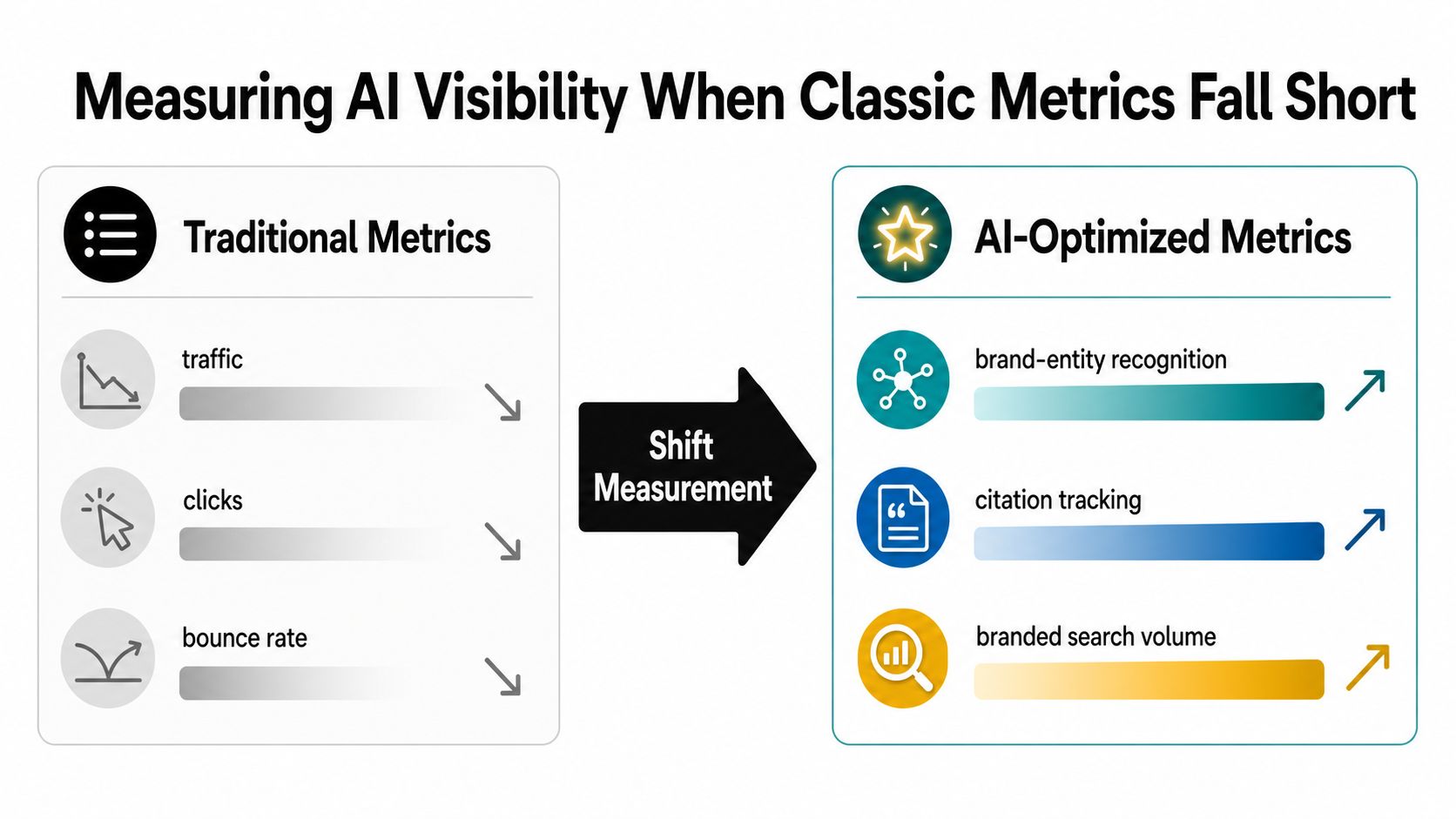
Measuring AI Visibility When Classic Metrics Fall Short
Classic analytics can tell you whether someone arrived from Google. They often can't tell you that a prospect saw your firm recommended in an AI answer, remembered the name, searched for it directly and then booked a call.
Australian measurement is becoming more complex as AI answer surfaces expand. An Australian benchmark analysed 116,918 SERPs and more than 1.1 million organic results across 18 industries and 6 Australian cities in May 2026. The Australian state of AI search benchmark demonstrates that local AI search visibility can be assessed systematically rather than inferred from overseas commentary.
The commercial response is to build an instrumentation layer around the entity and the pipeline.
Track what assistants say
Run a consistent set of buyer questions across relevant platforms and record:
Citation presence: Does the assistant mention or cite your business?
Competitive share: Which firms appear when the question names your service and location?
Answer accuracy: Are your services, suburbs, qualifications and contact details correct?
Context quality: Does the recommendation match the client you want?
Change over time: Does your visibility improve, decline or vary by platform?
The objective isn't to force a favourable answer. It is to identify gaps between your intended positioning and the information an assistant can verify.
Connect visibility to enquiries
Use branded query monitoring for searches such as “recommended Sydney buyers agent” or “mortgage broker Melbourne expert”. Add a lead-source question to enquiry forms and booking flows, with options that include ChatGPT, Gemini, Perplexity, Google and referral. Keep the answer optional, but make it easy for prospects to tell you how they found the business.
Use dedicated landing pages or campaign parameters where appropriate, then compare the source information with CRM outcomes. The relevant question is not whether AI produced a session. It is whether AI-assisted discovery contributed to a qualified conversation.
Google AI Overviews also create a direct commercial reason to measure more than rankings. Australian search commentary reports that when AI summaries appear, the top organic result's click-through rate can fall by around 30% to 40%, according to Australian reporting on AI Overviews and SEO impact. A visible citation may therefore support brand demand even when the traditional click doesn't occur.
Measure pipeline speed as well as source
Visibility and conversion belong in the same dashboard. Track qualified enquiries, booked calls, show-up rates, sales opportunities and revenue attribution alongside citations and branded demand.
Lead handling matters because attention can disappear after the enquiry. Australian lead-response research cites an average small business follow-up time of 42 hours, while responding within 5 minutes makes a business about 21 times more likely to qualify a lead than waiting 30 minutes. The Australian lead follow-up benchmark supports a simple conclusion: AI search optimisation without rapid follow-up leaves value on the table.
A 90-Day Plan to Build AI Search Visibility
A practical rollout should improve the entity, the pages and the handoff to sales in a deliberate sequence. Don't commission a large content programme before you know whether the business is represented accurately across the web.
Days 1 to 14
Audit your business identity across the website, Google Business Profile, LinkedIn, directories and review platforms. Correct inconsistent name, address, phone, ABN, credentials and service descriptions. Record how ChatGPT, Gemini, Perplexity and Google represent the business for your priority questions.
Days 15 to 30
Rewrite three cornerstone service pages. Each page should state the audience, service, location and next step near the top, then answer the questions that influence a buyer's decision. Add appropriate Organization, LocalBusiness, Service, Article and FAQPage markup, but only where the visible content supports it.
Days 31 to 60
Publish evidence-led supporting content. Use genuine case material, comparison pages, process guides, regulatory explanations and original observations. Distribute the useful parts through LinkedIn, relevant industry directories and community discussions without turning every contribution into an advertisement.
Days 61 to 90
Instrument referral-source questions, review AI mentions weekly and compare citation accuracy against competitors. Keep the formats that produce useful visibility and qualified enquiries. Drop content that earns attention but doesn't support a service decision.
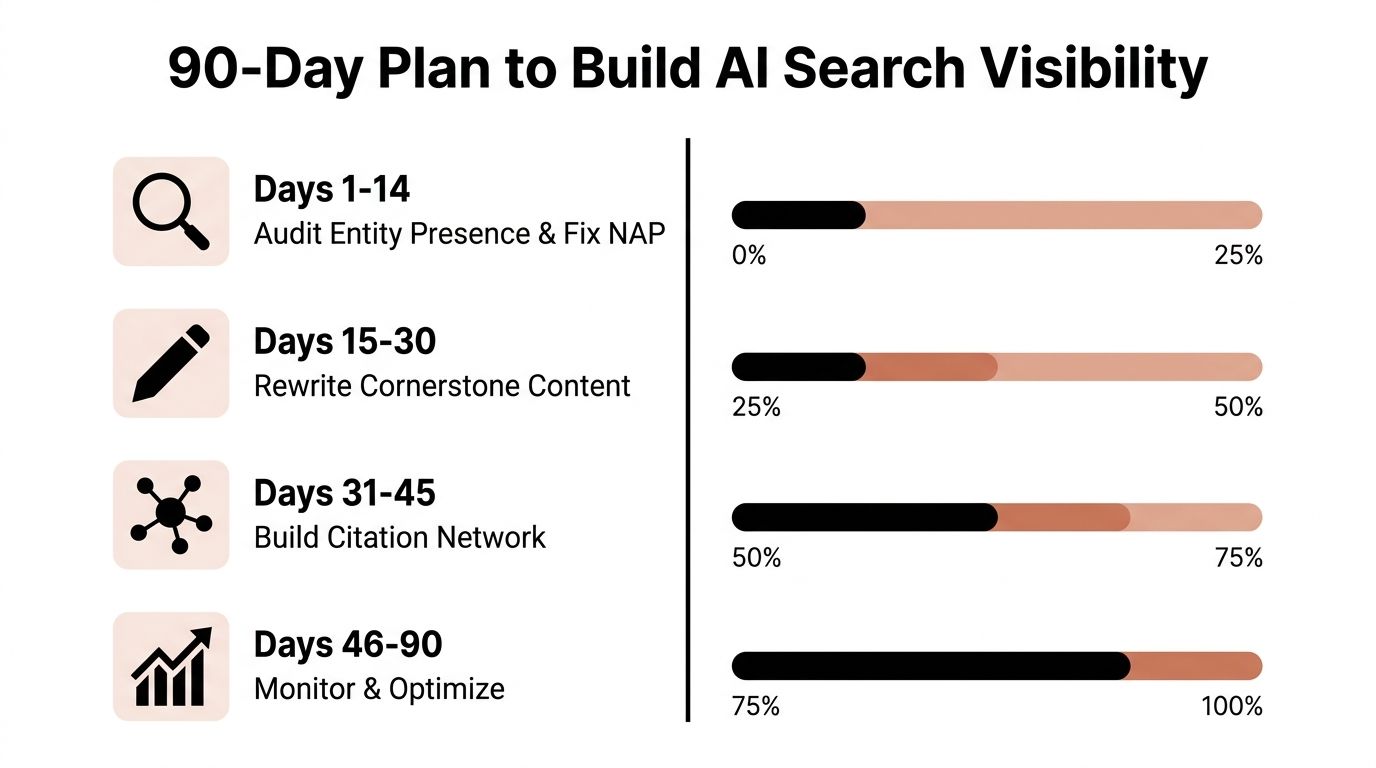
This sequence works because it treats AI search as part of the acquisition system, not a publishing exercise. The website earns visibility, the entity earns trust, the service page creates a decision path and the CRM makes sure an interested prospect receives a timely response.
The implementation can be managed internally, supported by specialist SEO tools or delivered by a partner. Raffine Studio works across conversion-focused websites, search visibility, AI search optimisation, booking flows, CRM handoff and automated follow-up for Australian buyers agencies, brokers and professional services firms.
Review your highest-value service pages, test how AI assistants describe your business and connect the findings to enquiry and booking data. If your website needs stronger entity clarity, AI search visibility and a conversion path that turns discovery into qualified conversations, visit Raffine Studio to discuss the right combination of website, SEO, GEO and lead follow-up work for your business.