conversion focused web design, lead generation, website design, buyers agents, professional services
Conversion Focused Web Design That Books More Calls
by raffiné studio

Traffic can look healthy while the pipeline remains weak. People arrive from Google, social posts or referrals, browse a few pages, and then disappear. The form receives occasional submissions, but booked discovery calls stay flat because the website never makes the next step clear, credible or easy to complete.
Conversion focused web design fixes that gap. It aligns your offer, page structure, proof, calls to action, technical performance and follow-up around a commercial outcome. For a buyers agency, that might be a qualified property search consultation. For a broker, it may be a finance assessment. For a law firm or accountant, it may be an attended discovery call that leads to a signed engagement.
The Australian online retail market illustrates why completed actions matter. The Australian Bureau of Statistics recorded A$4.411 billion in seasonally adjusted online retail sales in December 2024, up 4.2% from November and 12.7% from December 2023, with non-food sales contributing A$3.080 billion and food sales A$1.331 billion. While professional services don't transact in exactly the same way, the commercial principle is shared: websites influence a substantial volume of decisions, and performance should be judged by actions and revenue contribution, not visual appeal alone. The Australian Bureau of Statistics retail data provides useful context for treating digital journeys as commercial infrastructure.
What Conversion Focused Web Design Means
A polished website can still lose a prospective client between the landing page and the calendar. The warning signs are predictable: the homepage talks about the firm instead of the client's problem, service pages list capabilities without showing the outcome, testimonials are isolated on another page, and the booking path ends at a generic contact form.
Conversion focused web design is the deliberate alignment of messaging, layout, page sequence, technical performance and follow-up so the right visitor can move from arrival to a valuable commercial action. That action may be a completed booking, an attended discovery call, a qualified application or a signed mandate. For Australian service businesses, the work must also account for regional connectivity, search visibility in AI-generated answers, and automation that keeps trust intact rather than making buyers feel processed.

The booked call is the unit of value
Traffic, pageviews and time-on-page help diagnose behaviour, but they are not the commercial outcome a director needs. A visitor can read three pages without understanding how to engage. A form submission that receives no response has not created meaningful pipeline.
The website should answer four questions quickly:
Who is this for? Name the audience, location, industry or situation.
What changes after engagement? Describe the practical or commercial outcome.
Why should I trust this firm? Place relevant proof beside the claim it supports.
What happens next? Explain the booking, assessment or enquiry process in plain language.
Traffic-first design often stops after identifying the audience. Brand-first design can communicate personality and polish while leaving the action unclear. A conversion-led page connects intent to a specific next step. For example, a buyers agent's suburb page can end with a “Discuss your buying brief” prompt that opens the booking calendar and records the source, rather than sending a qualified visitor to a dead-end contact form.
Design for the whole pipeline
Australian business digitisation data shows why an online presence alone does not create acquisition. The Australian Communications and Media Authority reported that 94% of Australian SMEs were connected to the internet, while 64% had a website, and only 14% believed they were taking full advantage of online business activity. These figures are historical, but they separate access from effective use. ACMA's report on Australian SMEs in the digital economy supports a practical conclusion: the website should operate as part of the sales system, not as a static brochure.
Connect each page to relevant search intent, give the visitor a credible reason to act, keep forms and calendars usable on mobile and slower regional connections, record source data, and route follow-up to a real person. Automated reminders can reduce missed calls when they confirm the purpose, timing and preparation without pretending to be a human adviser. A new colour palette will not repair a vague offer, and faster loading will not replace missing proof. Start with the commercial path, then use design to make that path obvious.
The Core Principles That Drive Qualified Enquiries
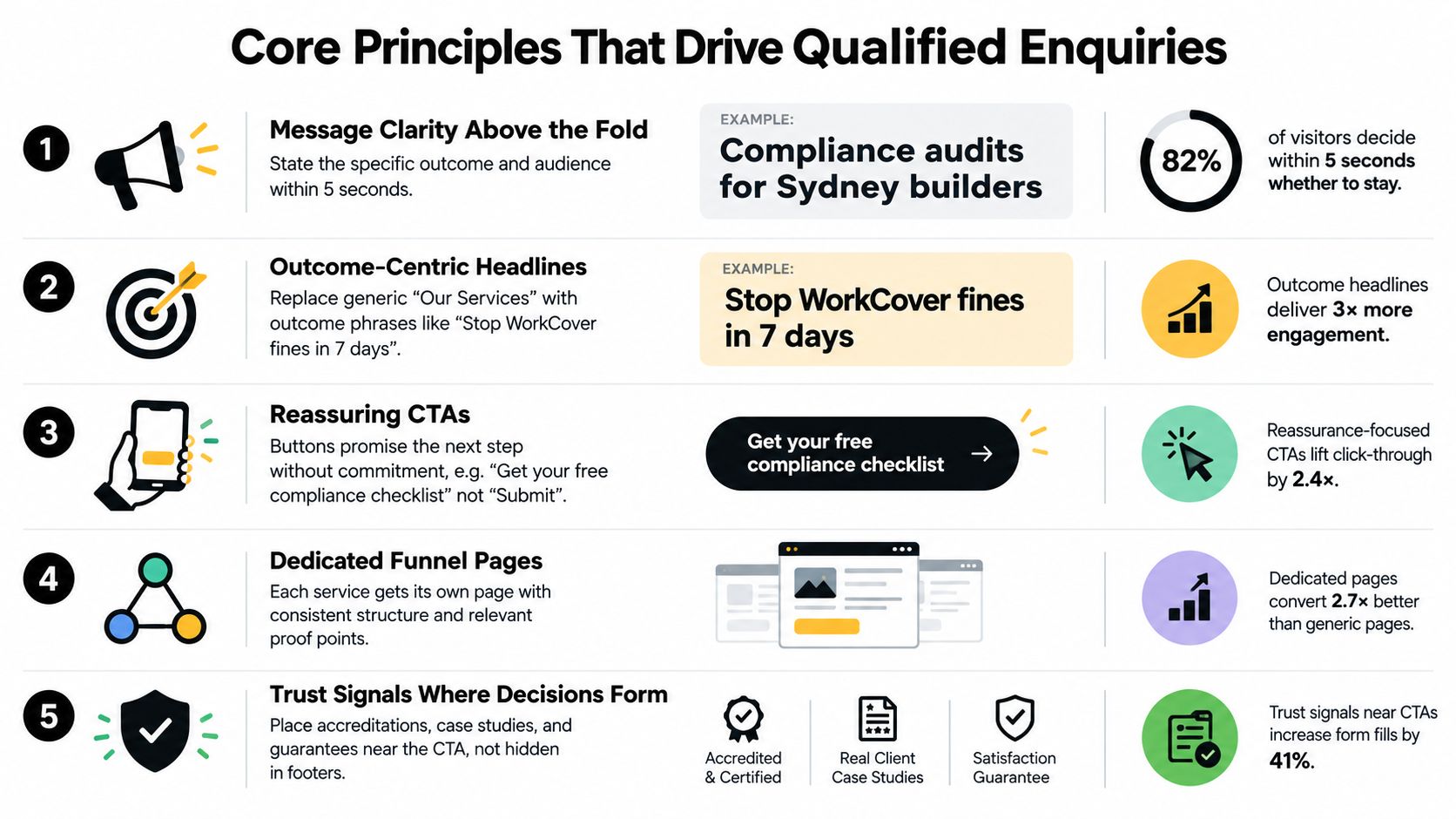
Qualified enquiries don't come from decorative elements alone. They come from removing uncertainty for the right buyer while making poor-fit visitors more likely to self-select out.
Start with clarity, not cleverness
The first screen should identify the audience, the problem and the useful outcome. “Strategic solutions for your future” tells a prospective client almost nothing. “Property search and negotiation for buyers purchasing in Sydney's inner west” gives the right visitor a reason to continue.
The primary CTA should match the level of commitment the visitor is ready to make. “Book a discovery call” works when the page has established the offer and credibility. “Check whether we can help” may suit an earlier-stage visitor. “Submit” is weak because it describes an interface action rather than a benefit or next step.
Treat friction as a commercial variable
Every unnecessary field, slow asset, confusing label and broken mobile interaction creates an opportunity for abandonment. The Australian Digital Inclusion Index reports that 20.6% of Australians are excluded or highly excluded, while 19.4% compromise on internet speed or data allowance to control costs. Outside capital cities, the proportion compromising on speed or data rises to 21.7%. The 2025 Australian Digital Inclusion Index findings make a strong case for a low-bandwidth design baseline.
Use responsive images, defer non-critical scripts, reserve space for media and avoid making the first meaningful content wait for chat widgets or tracking tools. Test the primary action on mobile connections and regional devices, not just on a fast office network. Performance isn't merely a technical score. It affects whether a buyer sees the offer before leaving.
Put relevant proof beside the risk
A generic testimonial carousel at the bottom of the homepage carries less weight than a specific client story beside the claim that creates doubt. A buyers agency should show property-search outcomes and relevant locations. A broker should address the type of lending scenario the visitor has. A professional services firm should make practitioner experience and matter relevance easy to verify.
Trust also needs to appear where the decision happens. If the form asks for financial information, explain why. If a calendar booking leads to a consultation, state its purpose, duration and what the prospect should prepare. The visitor shouldn't have to hunt through an About page to answer a question raised beside the CTA.
Qualify without making the good prospects work too hard
Short forms aren't automatically better. A form asking only for a name and email may increase volume while giving the team no way to route or prepare the enquiry. A longer form can improve lead relevance when every field has a clear purpose, but it should explain what happens after submission and preserve entered information if an error occurs.
Useful qualification cues include:
Service area: State the suburbs, states or regions you cover.
Engagement fit: Explain the type of client, matter or project you can accept.
Situation: Ask only for information that helps route the conversation.
Commercial boundaries: Where appropriate, clarify minimum scope or engagement conditions.
Alternative path: Keep a phone option available for visitors who can't use the form or calendar.
Building Site Architecture, Messaging, and Funnel Pages
A high-performing service website doesn't send every visitor through the same generic homepage. It gives each audience a relevant entry point, then provides enough context to make the next action feel sensible.
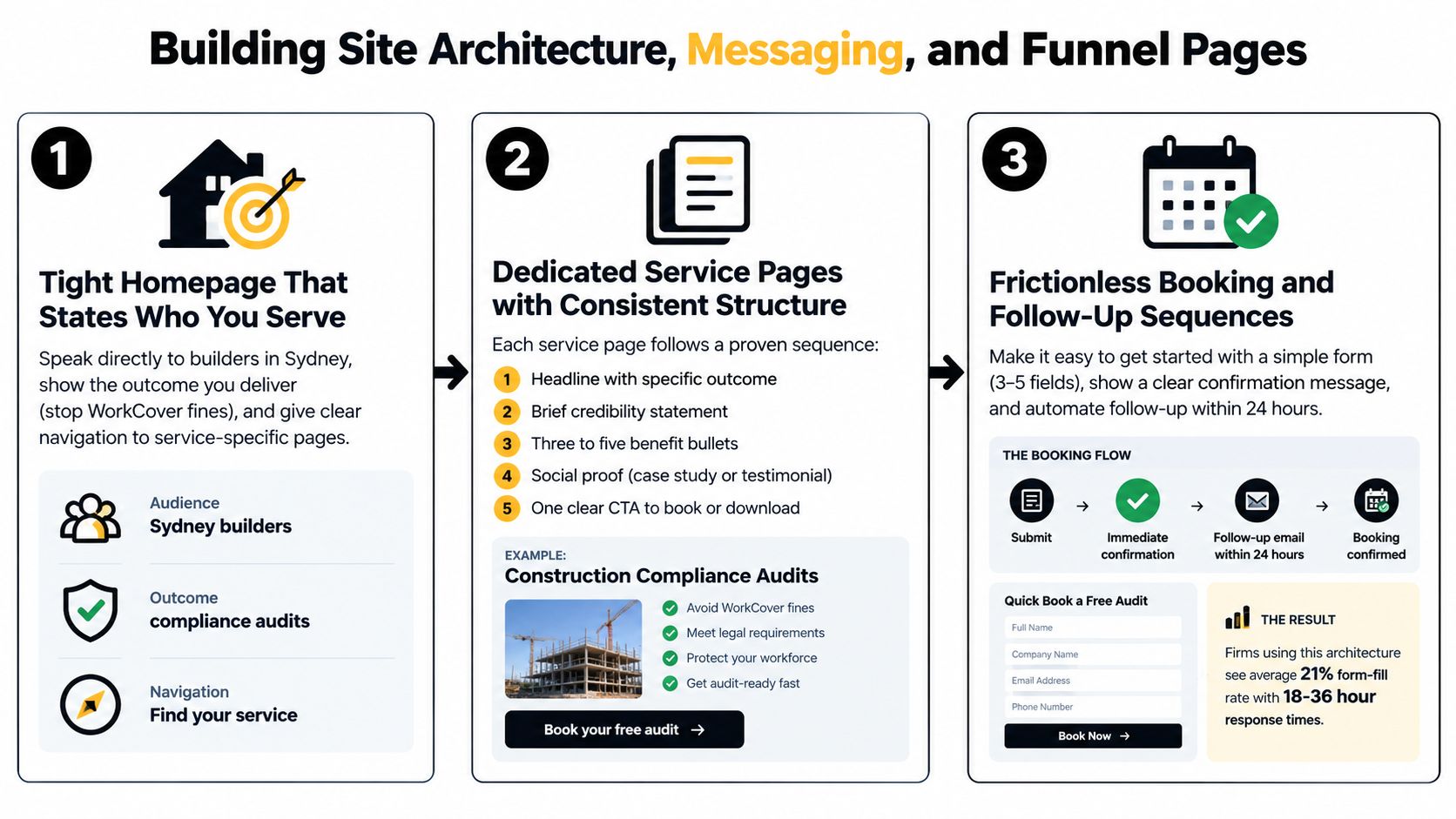
Start with a homepage that states who the business serves, what outcome it delivers and where the visitor should go next. The navigation should support that decision rather than give every internal page equal prominence. A construction firm may route visitors to commercial builds, remedial work or development projects. A buyers agency may direct visitors to suburb or buyer-type pages. A professional services firm may organise around practice areas and client situations.
Give each high-intent visitor a proper landing page
A useful funnel page should answer two questions immediately:
Am I in the right place?
What happens if I continue?
Consider three different entry points:
A buyers agent suburb page: Speak to the local buying conditions, property type, search process and evidence relevant to that area. The CTA can invite the visitor to discuss their target suburbs, budget and timing.
A broker loan-scenario page: Address a defined situation, such as refinancing, investment lending or complex income. Route the enquiry to the right adviser and ask only the information needed to prepare.
A practice-area page: For a law firm, accountant or consultant, explain the matter type, likely process, relevant practitioner experience and suitable next step.
Each page needs its own proof, FAQs and objection handling. Copying one generic service template across every audience creates pages that rank broadly but persuade weakly.
Use supporting pages to reinforce the decision
About pages, case studies and insights should support the conversion path rather than compete with it. A case study can answer “have they solved a situation like mine?” An About page can reduce personal and professional risk. An article can clarify a complex issue before the visitor is ready to book.
The problem starts when these pages become dead ends. Add contextual links to the relevant service page, repeat the appropriate CTA and make the next step visible without forcing the visitor back to the navigation. Avoid orphan pages that attract search traffic but offer no route into a commercial conversation.
For a deeper explanation of how these journeys are planned, see Raffine's guide to funnel building. The useful test is simple: follow a visitor from an organic landing page to a booking confirmation and record every point where they must guess what to do.
Write the page before designing the layout
The offer sentence should come before the wireframe. State the audience, problem, outcome and next action in one clear proposition, then build the hierarchy around it.
Don't begin with a hero video, slider or animation. Those elements can support a strong message, but they can't create one. If two CTAs compete, remove one or assign it a clearly different role. A service page should have a primary action that stays consistent from the first screen through the proof and final booking prompt.
SEO, AI Search, and Social to Site Integration
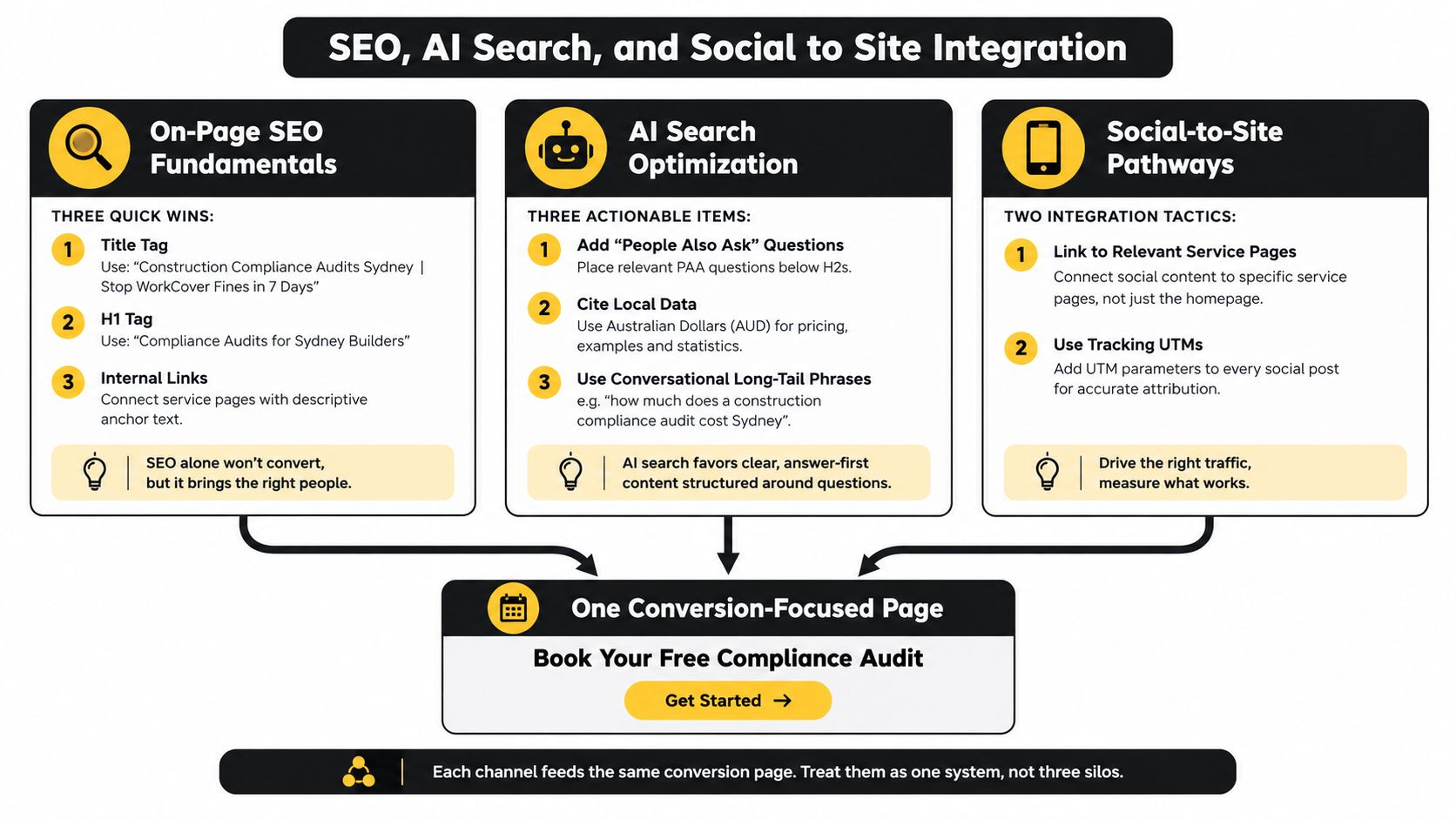
SEO, AI search visibility and social content are acquisition channels feeding the same conversion system. They shouldn't send visitors to a homepage that forces everyone to start again. Each source should land on a page that matches the language, promise and proof used before the click.
Build pages around intent
For a buyers agency, useful clusters may include buyer representation, suburb-specific searches and property purchase situations. For a broker, they may include mortgage scenarios, refinancing and investor lending. For a professional services firm, they may centre on matter types, industries and commercial risks.
A practical on-page structure includes:
A descriptive title: Match the service, audience and location without stuffing keywords.
One clear H1: State the specific offer in language a prospective client uses.
Answer-shaped sections: Address questions about suitability, process, costs, timing and outcomes.
Service schema and organisation details: Help search systems interpret the page and business.
Internal links: Connect educational content to relevant service and booking pages with descriptive anchor text.
Local context: Make service areas, practitioner locations and operating coverage explicit.
The page still needs to persuade after it earns visibility. SEO can bring the right visitor, but it doesn't explain why your firm is appropriate or what the conversation involves.
Make AI discovery trustworthy
The Australian Communications and Media Authority's research found that 56% of Australians were using AI in 2025, up from 45% in 2024, and that finding answers to search queries was the leading use at 30%. The same research found that 70% wanted control over how their data was used to train AI, while 64% wanted stronger AI safeguards. auDA's Digital Lives of Australians research points to a trust requirement that many AI-search strategies overlook.
Write clear answers, identify authors and organisations, support factual claims with reliable sources and make commercial boundaries visible. If a chatbot collects information, tell visitors what happens to that information and provide a human route. Professional services firms shouldn't hide automation when the visitor is sharing sensitive circumstances or evaluating credibility.
This practical guide to AI search optimisation is relevant when the objective is visibility that leads to a trustworthy conversation, rather than mentions without commercial context.
Make social traffic feel expected
A LinkedIn post about a commercial property issue should link to the relevant buyer or advisory page, not automatically to the homepage. Instagram content about a suburb should lead to the suburb service page. Facebook or paid campaign creative should use the same promise as the landing page.
Add campaign parameters consistently, preserve them through forms and booking tools, and record the original source in the CRM. If retargeting pixels are used, privacy design must be part of the funnel. The Office of the Australian Information Commissioner says privacy policies and collection notices should explain third-party tracking pixels, and organisations should generally seek express opt-in consent when a pixel is likely to collect or disclose sensitive information. OAIC guidance on tracking pixels and privacy obligations should inform the placement of marketing scripts on enquiry and booking journeys.
How the Playbook Changes for Buyers Agents, Brokers, and Professional Services
These sectors share a long consideration period, a trust-heavy decision and a valuable first conversation. Their websites shouldn't use the same conversion pattern, because the visitor's questions and acceptable level of commitment differ.
Buyers agents need relevance at a local and personal level. A suburb page should reflect the buyer's search area, property type and decision stage. The qualification path can ask about target suburbs, budget, timing and purchase intent. Proof should show the type of purchase and client situation, not just a star rating. “Discuss your buying brief” is more appropriate than a generic “Contact us” when the service begins with a detailed search conversation.
Mortgage and finance brokers need to reduce uncertainty around scenario fit. Service pages can be organised around refinancing, investment, self-employed income or other relevant situations. A short enquiry form should route the lead to the appropriate adviser and avoid collecting information before the page explains why it is needed. Trust signals should make licensing, advice scope and the consultation process easy to understand.
Professional services firms often need a deeper education path. A law firm, accounting practice or consultant may use matter-type pages, practitioner profiles and useful resources before asking for a meeting. A gated checklist or briefing can feed a permission-based nurture sequence, while the main CTA can invite a confidential discussion rather than promise an immediate solution.
Element | Buyers Agents | Mortgage/Finance Brokers | Professional Services |
|---|---|---|---|
Primary audience signal | Target suburb, property type and buyer situation | Loan scenario, borrower type and adviser fit | Matter type, industry and client risk |
Useful qualification | Budget, timing, target suburbs and purchase brief | State, lending situation and purpose of enquiry | Matter context, urgency and organisation type |
Strongest proof | Local purchase outcomes, relevant testimonials and process clarity | Scenario experience, adviser credentials and transparent explanation | Practitioner profiles, relevant matters and authoritative resources |
Primary CTA | Discuss your buying brief | Review your lending situation | Book a confidential consultation |
Funnel depth | Local landing page to qualification to call | Scenario page to routing form to adviser | Education or practice page to resource or consultation |
Content cadence | Suburb, buyer and market education | Lending scenario and finance education | Practice-area insight, guidance and practitioner expertise |
Accessibility applies across all three. The Australian Human Rights Commission states that online information and services are covered by the Disability Discrimination Act 1992, with professional services, financial services and real estate among the relevant sectors. Its guidance recommends at least WCAG Level AA conformance. The Commission's web accessibility guidance is a useful baseline for keyboard access, readable structure, contrast, text alternatives and form recovery.
Booking Automation, CRM, and Attribution That Close the Loop
A submitted form is only an opportunity. Conversion becomes commercially meaningful when the right person receives a timely response, books the call and attends it.
Start with the booking experience. Connect the calendar to Google Workspace or Microsoft 365, apply buffer rules, account for adviser availability and route enquiries through round-robin allocation where several people handle discovery calls. Show the meeting purpose, duration, timezone and confirmation status in text. Regional prospects should not have to interpret a calendar that hides the timezone or offers appointments the team can't honour.
Make every interaction one record
The CRM should receive the form submission, booking event, campaign parameters, landing page and assigned team member. If the form and calendar create separate records, staff may call a lead without knowing what they asked about or where they came from.
Useful fields include:
Original source: Organic, paid search, social, referral or AI-referred visit.
Campaign and page: The content or landing page that began the conversation.
Qualification state: New, suitable, unsuitable, booked, attended or closed.
Owner and next action: The person responsible and the date by which they act.
Consent record: What the visitor agreed to receive and when.
Follow-up automation should confirm the submission, explain the next step and give the prospect a way to correct or cancel the booking. ACMA requires commercial electronic messages to have consent, identify the sender, include contact details and provide an easy unsubscribe method. Businesses must action an unsubscribe request within five working days, and the mechanism must remain functional for at least 30 days after the message is sent. ACMA's guidance on avoiding spam should shape CRM suppression rules and form consent language.
Report attended calls, not vanity metrics
GA4 can record service-page views, CTA clicks, form starts, qualified submissions, booking-page views and confirmation events. The team should also import attendance and qualification outcomes from the CRM. Where consent and browser changes affect measurement, review server-side or first-party options with care rather than assuming every conversion is visible.
Examples of automated systems can help teams think through the handoff between website, calendar, CRM and follow-up. The weekly dashboard only needs to answer practical questions: which pages create suitable enquiries, where do visitors abandon, which sources create attended calls, and what should the team fix next?
Attribution should credit the journey rather than blindly rewarding the last click. A visitor may discover a firm through search, read an article, return from LinkedIn and book after a reminder email. The reporting model should preserve that sequence so marketing spend is judged against qualified pipeline and booked revenue, not raw form volume.
Your Next Step and a Simple Conversion Audit Checklist
Set aside a focused working session and inspect the live journey as if you were a prospective client. Don't begin with the homepage colour or the latest design trend. Begin with the path from first visit to attended call.
The practical audit
Test the first screen: Can a suitable visitor identify the audience, outcome and next action without scrolling?
Follow one service journey: Start on a search or social landing page and note every point where the next step becomes unclear.
Book from a mobile device: Check the CTA, form, calendar, timezone, confirmation and reminder experience.
Review the form: Remove fields that don't qualify, route or prepare the lead. Keep useful context and clear error recovery.
Check regional performance: Test page weight and interaction on a constrained connection. The site should show the value proposition before non-essential scripts finish loading.
Inspect proof placement: Move relevant testimonials, credentials and process evidence beside the claims that create risk.
Verify CRM handoff: Confirm source, campaign, landing page, consent, owner and status arrive in one record.
Review attribution: Separate organic, paid, social, referral and AI-referred traffic, then connect each source to booking and attendance.
Rank the work commercially: Fix the issue most likely to improve qualified and attended conversations before polishing low-impact visual details.
Accessibility belongs in this audit too. In an Australian study, 65.4% of respondents reported leaving a website because of accessibility problems, while only 21.4% of surveyed organisations said they met WCAG 2.0 Level AA. The Australian accessibility research supports testing keyboard completion, focus states, field labels, contrast, error messages and booking controls as conversion issues, not just compliance tasks.
A useful audit ends with a short list of changes, owners and measures. Track qualified form completion, booked calls, attendance, lead source and downstream outcome. That gives the team a basis for improving the funnel instead of guessing which design detail deserves attention.
Raffine Studio builds conversion-focused websites, funnel pages, SEO and AI search visibility systems that connect traffic with qualification, booking, CRM follow-up and attended discovery calls. If your buyers agency, brokerage or professional services firm is generating visits but losing opportunities before the conversation, visit Raffine Studio to review the path and plan the right changes.