funnel building, sales funnel, lead generation, conversion optimisation, discovery calls
What Is Funnel Building and How It Turns Clicks Into Calls
by raffiné studio

Funnel building is the deliberate design of a sequenced path that moves a visitor from a first click to a qualified, booked conversation. For an Australian service business, it connects the page that earns attention with the message, form, calendar, CRM and follow-up process that turns interest into a sales opportunity.
You may recognise the pattern. Google Ads spend is steady, sessions look healthy in GA4, and your social posts are generating engagement. Yet the calendar remains empty, or enquiries arrive without enough context for anyone to act quickly.
That gap is where funnel building earns its place. It isn't just a landing page, an email sequence or a collection of marketing tools. It's the designed system between traffic and booked calls, including the points where prospects hesitate, abandon a mobile form, or submit an enquiry that nobody answers promptly.
For buyers agencies, law firms, brokers and professional services businesses, three failures appear repeatedly:
Traffic lands on browsing pages: A generic homepage gives visitors too many directions and no clear reason to take the next step.
Response is slow or disconnected: A form, phone call, email or social message enters a different inbox, and the prospect waits while intent fades.
Mobile friction blocks action: Long forms, slow pages and awkward calendar widgets make a promising visit difficult to complete.
Australian benchmark data shows the commercial pressure clearly. Average ecommerce conversion rates sit around 1.78% to 1.9%, while stronger pages can reach 3.2% to 4.5% or higher, depending on category and traffic source, according to Australian ecommerce conversion benchmarks. The lesson for service businesses isn't to copy ecommerce mechanics. It's to stop assuming that more traffic will solve a weak path to enquiry.
Why Your Website Traffic Is Not Turning Into Booked Calls
A Sydney buyers agency can attract the right search traffic, present polished branding and still struggle to fill its calendar. The failure often appears after the click. A visitor reaches a general homepage, cannot identify a relevant offer quickly, then leaves before considering a conversation.
Professional services firms see the same pattern. Someone searching for commercial property advice or a dispute solicitor may arrive on a broad services page with several possible directions and no clear next action. Rising sessions and impressions show activity, not whether a qualified visitor can reach the right adviser.
Commercial rule: Judge a funnel by the quality and consistency of the conversations it creates, not by how busy the analytics dashboard looks.
The device split matters. Desktop visitors convert at a materially higher rate than mobile visitors in the ecommerce benchmarks reported by the same source. That gap does not predict results for a law firm or buyers agency, but it highlights a practical risk: a form, page or calendar that works on a large screen may create enough friction on a phone to stop an enquiry. Review tap targets, page speed, form length and calendar usability on the devices that generate your traffic. The Australian benchmark data on conversion and device performance provides the underlying device ranges.
A conversion-focused website needs to answer three questions immediately:
Is this service relevant to me?
Why should I trust this firm?
What happens if I enquire now?
The booking path must make the answer easy to act on. A clear page cannot compensate for a slow response after form submission, and an efficient calendar cannot fix a page attracting the wrong audience. Speed-to-lead belongs inside the funnel. Set an owner for every enquiry, route submissions to the right person and make the next step clear while intent is still high.
A useful audit starts with the first mobile visit. Can a prospect understand the offer, verify the firm and book without pinching, hunting or repeating information? Good SEO and web design work together, because visibility without a useful next step creates activity without pipeline.
This is what funnel building looks like in practice. It removes avoidable uncertainty between the first visit, the enquiry and the booked discovery call.
The Four Stages That Make Up a Real Funnel
A working funnel has four connected stages: awareness, consideration, conversion and post-conversion. These stages aren't separate campaigns. They form one journey, and each stage has a specific job.
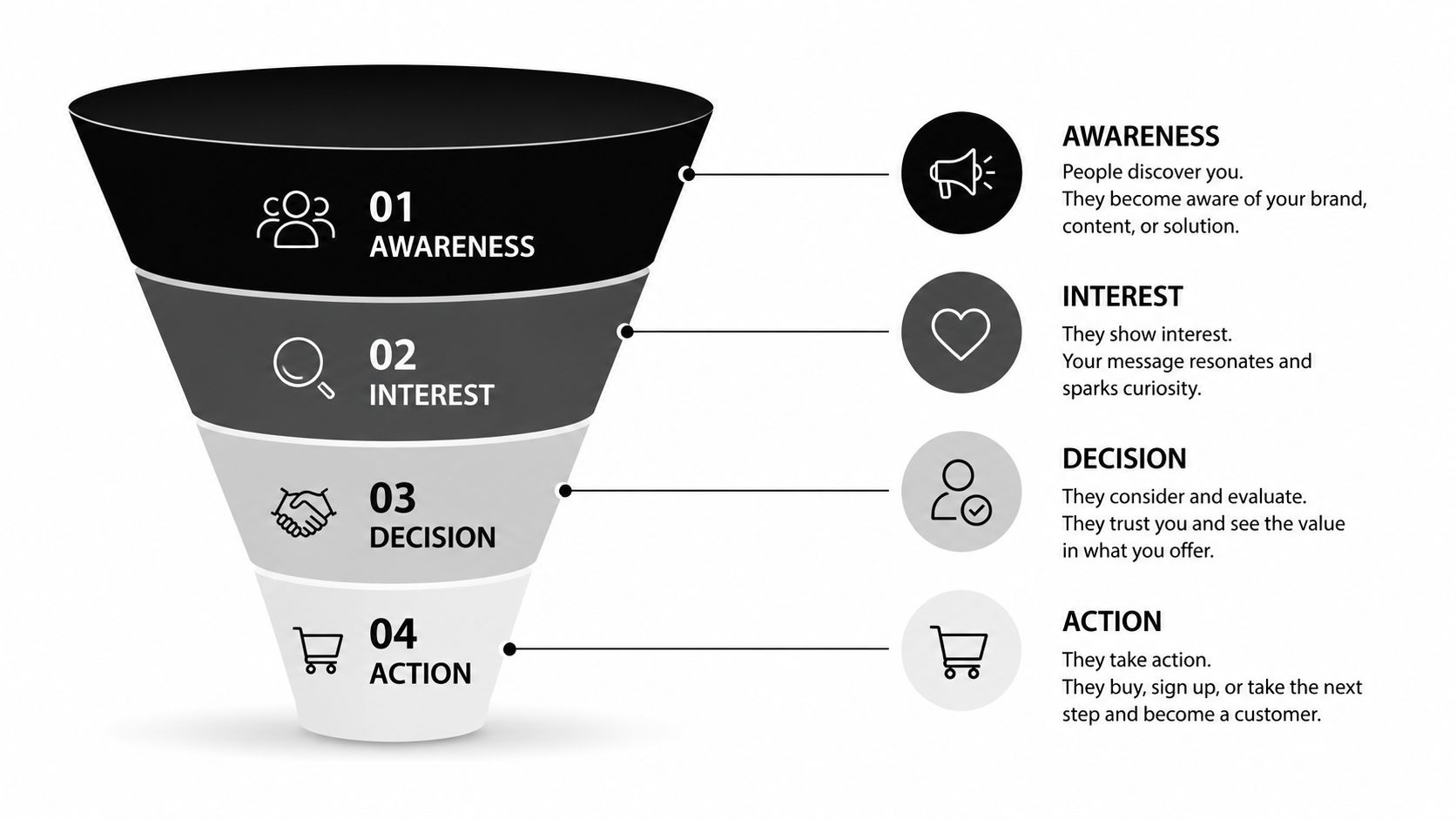
Awareness earns the first click
A search ad, organic result, LinkedIn post or referral introduces the business to someone with a problem. For a buyers agency, the entry point might be a search about purchasing an investment property in Sydney. For a law firm, it could be a query about a particular legal issue.
The message at this stage should match the prospect's concern. A broad promise such as “trusted property advice” may sound credible, but it doesn't create a strong reason to continue. A more relevant entry point names the service, audience or situation the visitor already has in mind.
Consideration creates confidence
The visitor needs evidence that the business understands their situation. A buyers agency might use a service-specific page, market explanation, process overview and relevant client evidence. A law firm may need to explain the type of matter it handles, who the service suits and what an initial conversation involves.
This stage is where businesses often overuse content without giving it a destination. Every article, case study or guide should support a sensible next action, whether that's a consultation, an eligibility check or a more focused service page.
Conversion makes the next step easy
The conversion stage turns intent into an enquiry or booking. The page should present one primary action, explain what happens next and make the form or calendar usable on the visitor's device.
For a professional services firm, that could mean a short qualification form followed by a booking calendar. For a buyers agency, it may be a discovery call with questions about location, property goals and timing. The information should help the team prepare, not create an interrogation before trust has been established.
Post-conversion protects the opportunity
A booking isn't the end of the funnel. Confirmation messages, reminders, calendar details and internal task creation help the prospect arrive prepared and help the team respond with context.
If the visitor receives no confirmation, the firm misses the chance to reinforce the decision. If the booking isn't recorded in the CRM, the team loses visibility. If the prospect cancels and no follow-up exists, a completed conversion can still disappear from the pipeline.
Landing Pages Versus Homepages Where Funnels Actually Convert
A homepage is a useful front door for a business. It usually isn't the right destination for every campaign.
Paid search traffic arrives with a defined question or intent. Sending that visitor to a homepage forces them to interpret the business, locate the relevant service and decide what to do next. A dedicated landing path removes much of that work by aligning the headline, proof, offer and call to action with the original search.
Australian lead-generation guidance places focused landing pages at around 5% to 15% enquiry rates from paid search traffic, while mixed-traffic websites commonly sit around 2% to 5%, as reported in this Australian small-business conversion guidance. These are benchmark ranges, not guaranteed outcomes. They do support a practical conclusion: a page built around one offer usually gives high-intent visitors a clearer route than a general homepage.
A separate landing-page benchmark reports a median conversion rate of 2.35%, with the top 10% reaching 11.45% or higher across industries. The Australian landing-page conversion benchmarks reinforce why page structure, relevance and friction deserve attention before increasing media spend.
Metric | Homepage | Dedicated Landing Path |
|---|---|---|
Primary purpose | Introduce the business and support exploration | Move one audience towards one action |
Navigation | Broad, with several possible routes | Narrow, with a deliberate next step |
Message | General brand and service positioning | Matched to a search, ad or content intent |
Call to action | Often competing with other links | One primary booking or enquiry action |
Qualification | Usually limited or unclear | Designed around sales-relevant questions |
Testing | Harder to isolate campaign performance | Easier to measure by source and offer |
A conversion-focused landing path needs more than a short form. It should include a specific offer, a clear explanation of the process, relevant trust signals close to the booking action and fields that sales uses.
For a service business, the right number of fields depends on the qualification problem. Asking for every possible detail can reduce completion, but collecting nothing can fill the calendar with unsuitable conversations. A useful sales funnel landing page template should help the team decide what the next conversation requires, rather than copying a visual layout.
The Tooling Stack Behind a Working Funnel
A funnel stack should behave like one operating system. The website attracts and informs, the landing page focuses intent, the form captures context, the scheduler creates a commitment, the CRM records the opportunity and automation keeps the response moving.
The tools themselves aren't the strategy. A lean buyers agency may use a CMS, Google Analytics, a form platform, Calendly or another scheduling tool, a CRM such as HubSpot, and SMS or email automation. A larger law firm may need more detailed routing, permissions and matter-based qualification. The right stack depends on the sales process, not on how many subscriptions a software vendor can sell.
What each layer owns
Tool / Layer | Funnel Stage Owned | What Breaks When Missing |
|---|---|---|
Website CMS and analytics | Awareness and measurement | Content, traffic sources and user actions become difficult to interpret |
Dedicated landing page | Consideration and conversion | Campaign visitors receive a generic experience |
Lead capture form | Qualification | The team can't collect enough context to prioritise or prepare |
Scheduling tool | Conversion | Prospects must wait for a manual reply before choosing a time |
CRM | Pipeline visibility | Enquiries remain scattered across inboxes and personal notes |
Marketing automation | Post-conversion and nurture | Follow-up depends on memory and availability |
Chat or callback widget | Mobile intent capture | Visitors who won't complete a form have no alternative path |
The two failure modes seen most often are simple. First, the booking tool creates an appointment but doesn't write it back to the CRM. The calendar looks active, but the pipeline is incomplete. Second, the CRM receives the lead but nobody checks it with urgency. A technically connected funnel still fails if human ownership is unclear.
System test: Follow one enquiry from the first campaign click through to the CRM record, booking confirmation, internal alert and post-call follow-up. Any manual guess in that chain is a likely drop-off point.
Automation should support judgement, not replace it. A short form can collect service type, location, timing and the central problem. The CRM can route the lead to the right person, send an immediate acknowledgement and create a task. The adviser still needs to qualify the opportunity properly.
For examples of how connected workflows can operate, review these automated system examples. Raffine Studio offers website, funnel architecture, booking automation and CRM handoff work for service businesses that need these layers connected rather than managed as isolated projects.
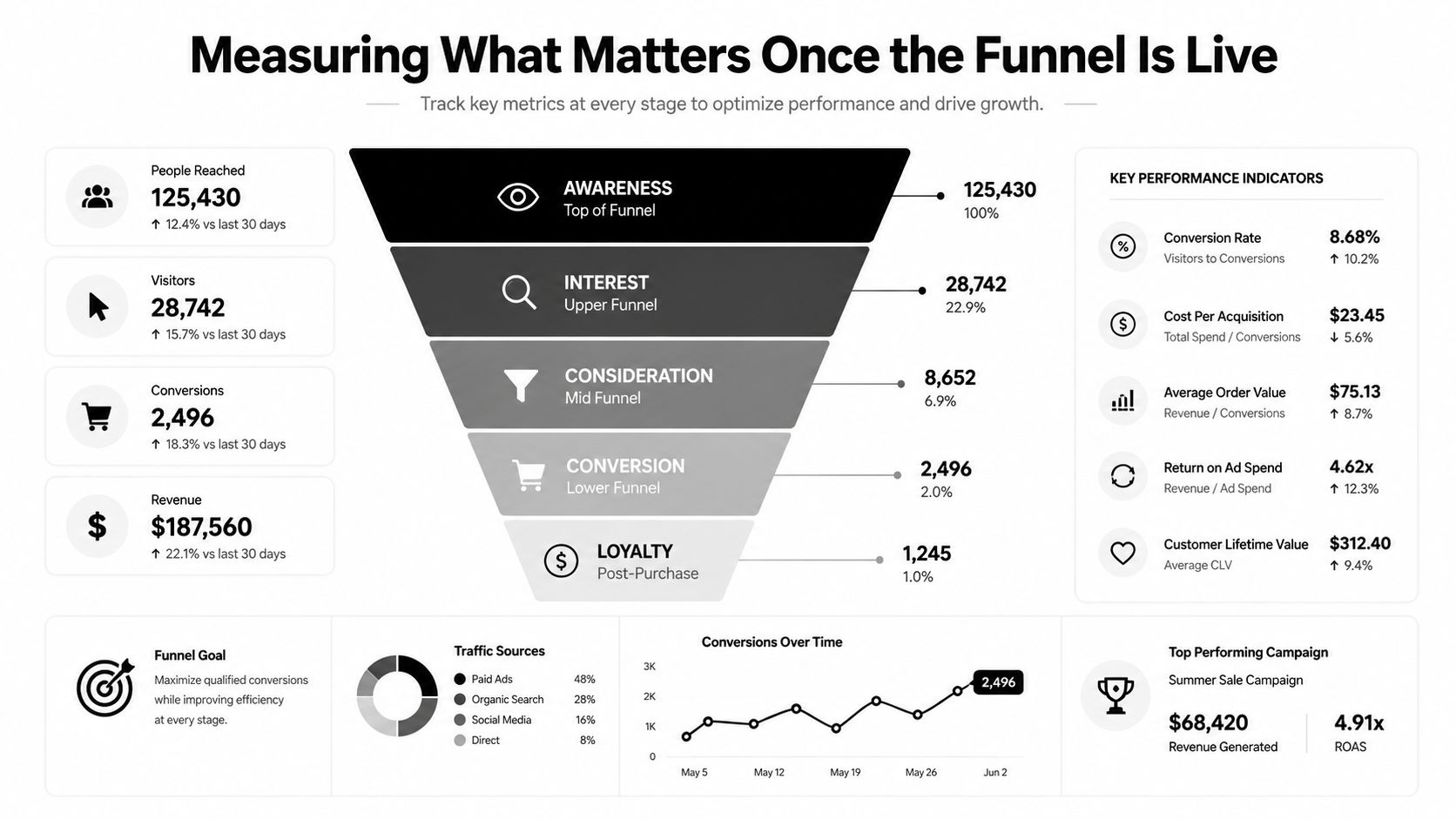
Measuring What Matters Once the Funnel Is Live
A funnel isn't live when the page is published. It's live when the business can see where prospects enter, where they hesitate, how quickly the team responds and whether the resulting calls become credible opportunities.
The measurement model should follow the commercial journey:
Click-to-lead rate: Shows whether the landing path turns relevant visits into enquiries.
Qualified enquiry rate: Separates genuine opportunities from low-fit submissions.
Form completion by device: Identifies whether mobile visitors encounter more friction.
Time-to-first-touch: Measures how quickly a person receives a useful response.
Booked-call show rate: Tests the quality of the booking and reminder experience.
Lead-to-client close rate: Connects marketing activity to sales outcomes.
Source attribution: Shows which campaigns contribute to conversations, not only visits.
Raw sessions and impressions can help diagnose reach, but they don't tell a director whether the campaign is filling the calendar. A high click volume may indicate strong creative and weak page alignment. A healthy enquiry count may conceal slow response, poor fit or a weak show rate.
Australian speed-to-lead reporting associates a response within 5 minutes with a 21x higher likelihood to qualify and a 100x higher likelihood to connect compared with waiting 30 minutes. The same source states that after the first hour, conversion odds fall by more than 80%. These benchmarks are cited in the Australian speed-to-lead analysis. They shouldn't be treated as a universal forecast, but they make the operational point clear: response time belongs inside funnel design.
Mobile performance needs its own view. Australian reporting places desktop conversion around 3.2% and mobile around 1.8%, while broader Australian CRO coverage reports that 90% to 97% of landing-page visitors don't submit a form. Those figures are available in this Australian conversion optimisation analysis. A funnel therefore needs more than a form. It needs persuasion, trust, alternatives such as callback or chat, and a booking path that works on a small screen.
A Practical Funnel Audit Checklist for Service Businesses
You don't need a new campaign to find funnel problems. Start by testing the journey as a prospect, using a real mobile device and a separate browser session. Record what you see, how long each step takes and whether the enquiry reaches the person responsible for sales.
Test the traffic and page match
Ask:
Does the campaign promise match the landing-page headline? Raffine commonly finds paid traffic sent to a generic homepage, where the visitor must search for the service they already specified.
Can a visitor identify the audience and outcome quickly? A buyers agency page should make its buying role clear. A law firm should identify the matter or client type it serves.
Is there one primary action? Multiple competing buttons create choice without direction.
Does the page prove relevance before asking for contact details? Use process detail, credentials, reviews or service-specific evidence near the decision point.
Australian service-business websites average around 2.3% conversion, while stronger performers can reach 5% to 10%, according to Australian website performance benchmarks. The same source notes that mobile users abandon websites taking longer than 3 seconds to load. Treat speed as part of the offer experience, not a technical clean-up task.
Check the conversion path on mobile
Open the form on a phone and ask:
Can the visitor complete it comfortably with one hand? Long fields, tiny controls and unclear error messages create avoidable abandonment.
Does the calendar load inside the page without awkward scrolling? A booking widget that pushes the action below several screens adds friction.
Can someone choose a callback or message option? Some high-intent visitors won't submit a long form, but will accept a quick response.
Does the confirmation explain what happens next? A thank-you page should set expectations, not end the relationship.
Follow the lead through the system
Submit a test enquiry and verify:
The CRM creates a complete record: If it only arrives in a shared inbox, ownership may be unclear.
The booking writes back to the pipeline: A calendar appointment that isn't visible to the sales team creates reporting gaps.
The response protocol starts immediately: Confirm the enquiry, notify the right person and create a follow-up task.
The lead receives relevant nurture: Prospects who aren't ready for a call need useful next steps, not repeated generic reminders.
The source remains attached: Campaign, page and device information should remain available when the adviser reviews the opportunity.
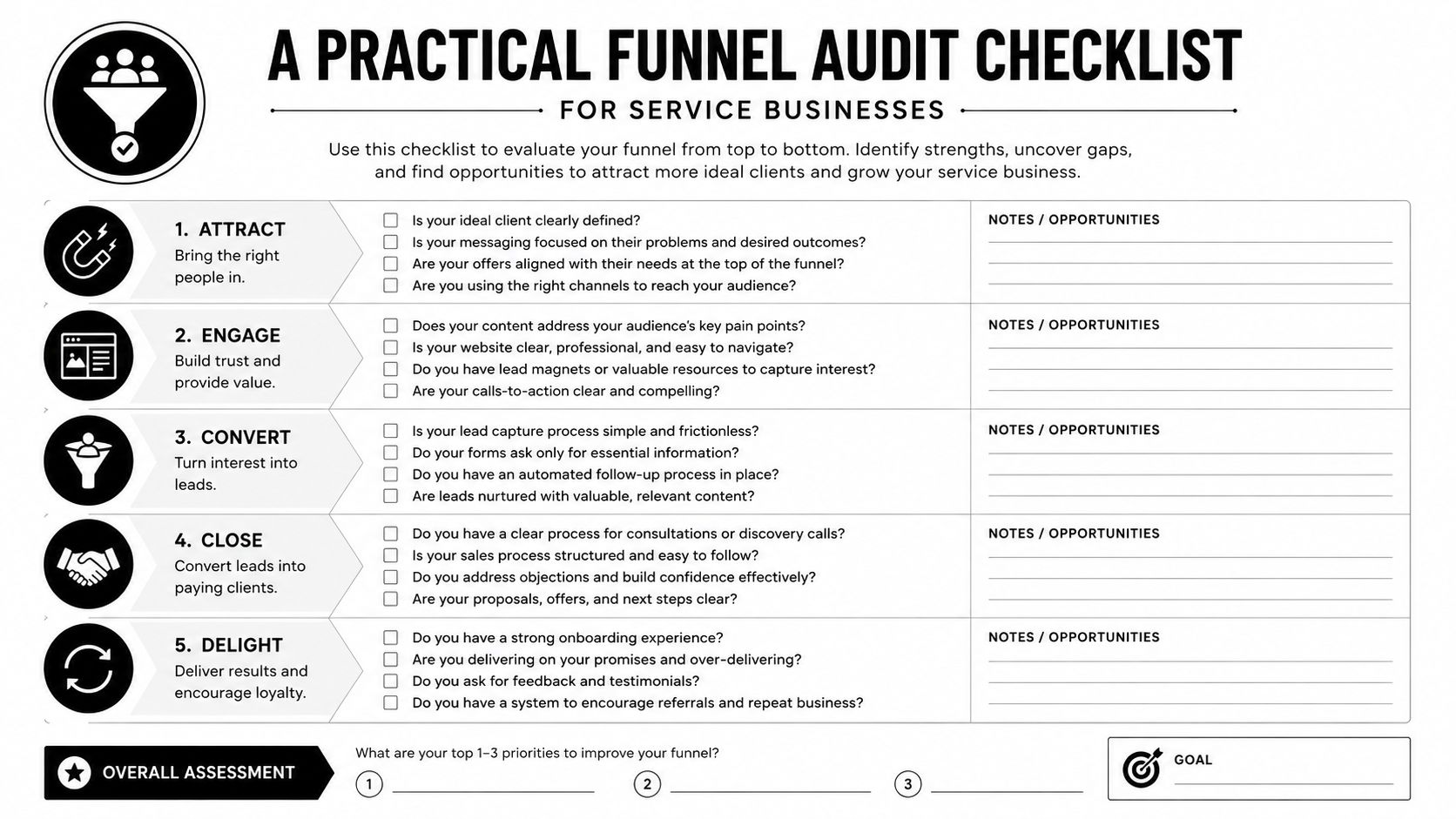
Audit priority: Fix the break closest to the booked call first. More traffic won't compensate for a calendar that is hard to use or a lead that nobody contacts.
Finish the audit by ranking issues according to commercial effect. A slow mobile page, unclear offer, broken CRM write-back and delayed response usually deserve attention before cosmetic design changes. Once the critical path works, test messaging, proof, form questions, reminders and source-specific landing pages in a controlled order.
Turning the Funnel Into a Steady Stream of Discovery Calls
The funnel earns its keep when it produces a dependable flow of suitable discovery calls, not when it wins a design review. That requires a weekly operating rhythm in which the team reviews a small set of numbers and connects each movement to a specific action.
Start with the landing-page conversion rate. If clicks remain stable but enquiries fall, inspect the page promise, offer alignment and form experience before changing the ad budget. If enquiries increase but qualification worsens, review the targeting and the questions used to route prospects.
Next, check the time between enquiry and first response. If the delay grows, the remedy may be a clearer ownership rule, an instant acknowledgement, an SMS trigger or a CRM task rather than more advertising. A funnel that creates enquiries faster than the team can handle them needs capacity planning as much as copy changes.
Use the calendar as the main operating signal
A useful weekly review asks:
Which landing paths produced qualified enquiries? Keep source and offer data attached to each record.
Where did mobile visitors stop? Compare form starts, completions and bookings by device.
How quickly did the team respond? Review the actual first-touch time, not the intended service standard.
Which booked calls were attended? A falling show rate may point to weak qualification, unclear expectations or missing reminders.
Which sources created real opportunities? A campaign that generates sessions but no credible conversations may need a new message or destination page.
A common plateau occurs when lead volume holds but the show rate drops. That pattern usually points downstream. The business may be accepting poor-fit bookings, failing to explain the call, or sending reminders that don't reinforce the prospect's reason for booking.
The funnel should also remain connected to search visibility. A service page that answers a clear commercial question can support Google discovery and improve the likelihood that AI search systems understand the business, its audience and its offer. Visibility still matters, but it must lead to a page and process that can handle intent.
This is living infrastructure. Test the headline, offer, form, calendar, reminder sequence and follow-up based on what the pipeline shows. Don't wait for a quarterly redesign to fix a booking path that is losing prospects today.
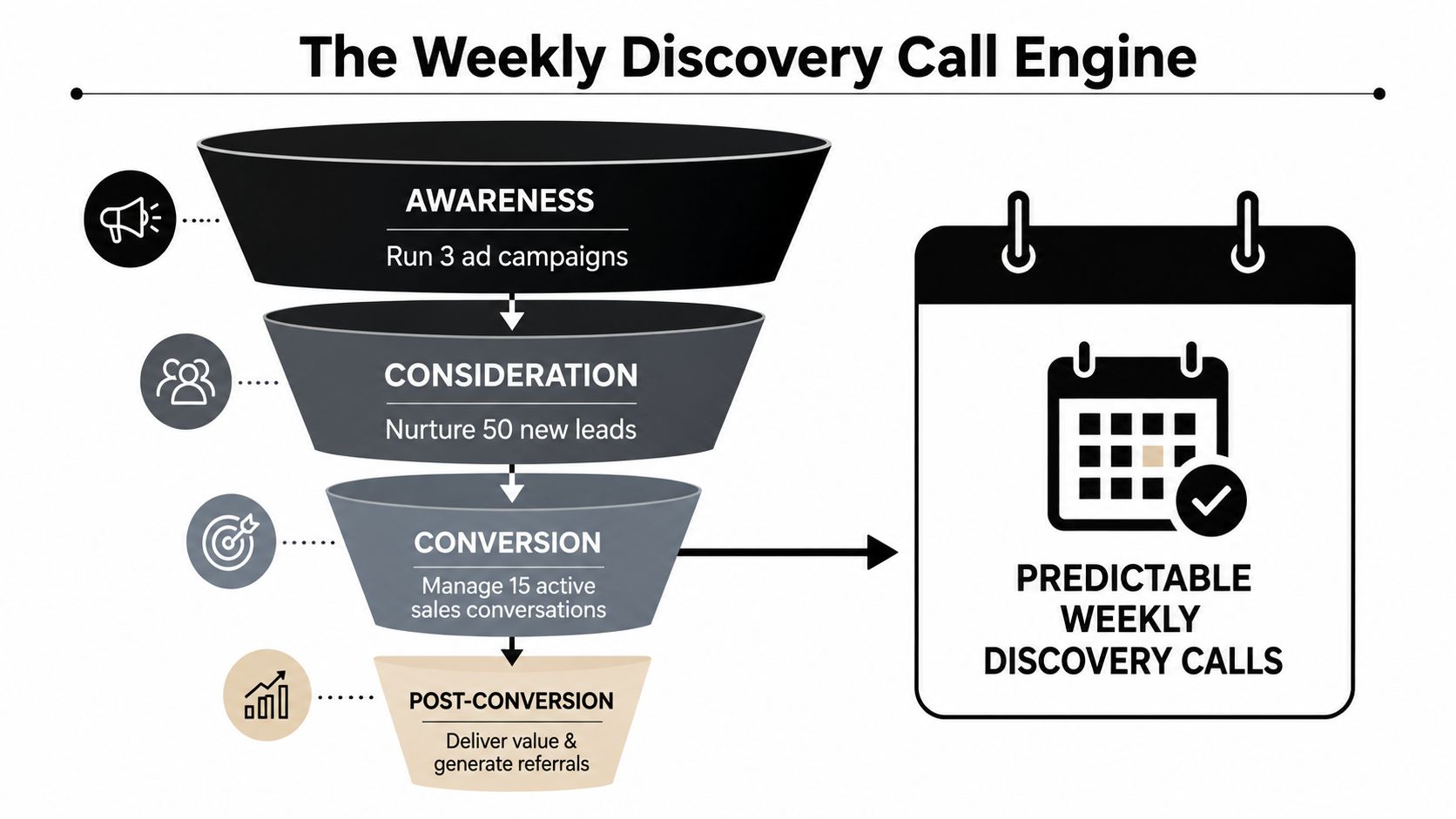
The following visual gives a useful way to think about the weekly relationship between funnel stages and discovery calls.
Raffine Studio builds conversion-focused websites, dedicated funnel paths, booking workflows and CRM follow-up systems for Australian buyers agencies, brokers and professional services firms. If your traffic isn't becoming qualified discovery calls, visit Raffine Studio to review the gaps between visibility, conversion and response.