cost of web design, web design pricing, website cost Australia, web design ROI, website budget
Cost of Web Design in Australia: What to Budget
by raffiné studio

A brochure-style website in Australia typically costs $2,500–$10,000, a small-to-medium eCommerce site usually sits around $8,500–$20,000+, and bespoke conversion-focused builds can start above $30,000. Those figures describe the launch project, not the full cost of owning a website or the commercial return it needs to produce.
The popular advice is to ask, “How much does a website cost?” That's the wrong first question for a law firm, buyers agency, accounting practice, broker or B2B consultancy. The better question is, “What will this website need to do over the next 12 months, and what should it contribute to the pipeline?”
A low-cost brochure site can be entirely reasonable if you need a credible online presence and your referrals already generate most enquiries. It's a poor investment if you expect the site to attract qualified search traffic, explain a complex service, capture leads, book calls, hand enquiries to a CRM and support follow-up.
Why Web Design Cost Is Not a Single Number
Website pricing reflects scope, functionality, delivery method and commercial intent, not page count alone. A ten-page site may be a straightforward brochure build, or a conversion system with custom user experience, copywriting, SEO foundations, booking flows, CRM connections and automation. The sitemap can look similar while the planning, implementation and testing requirements differ substantially.
A professionally designed brochure site commonly falls between $2,500 and $10,000 in Australia. Small-to-medium eCommerce sites are often priced around $8,500 to $20,000+, while large bespoke websites can start above $30,000, according to Australian web design pricing guidance. Treat these figures as market orientation, not a budget, until the brief defines the required outcome.
Three different investments
A brochure site establishes credibility. It gives prospects a place to confirm who you are, what you do and how to contact you. For a small professional practice with reliable referral activity, that role may justify a modest investment.
A lead-generation website carries a higher commercial burden. It must clarify the offer, address objections, create relevant paths for different audiences and move visitors towards an enquiry or booked conversation. Landing pages, search strategy, analytics, booking software and lead follow-up can all form part of the required system.
A custom eCommerce or application-based build adds operational complexity. Product logic, checkout behaviour, accounts, payments, inventory, permissions, data and third-party systems increase the cost of planning, implementation and testing.
Commercial rule: Confirm that vendors are pricing the same business outcome before comparing their quotes.
Launch price versus ownership cost
The first invoice rarely represents the full investment. After launch, a website may require maintenance, speed monitoring, content updates, analytics review, SEO work, CRM upkeep and conversion testing. Australian care plans commonly add AUD $150–$1,200+ per month, on top of build fees, as outlined in Australian website ownership cost guidance.
That ongoing cost should be assessed across the first twelve months. A cheaper build can consume staff time through weak enquiries, incomplete forms and manual lead transfers. A higher upfront investment can make commercial sense when the site improves qualification, speeds follow-up and supports more valuable conversations.
Set the budget according to the website's role in acquisition. Price a digital business card accordingly. If the site is expected to contribute to pipeline, fund the strategy, content, integrations and measurement required to produce that result. The relevant comparison is not the launch quote alone, but the 12-month cost of ownership against the pipeline outcome it is expected to support.
The Four Drivers That Determine Your Web Design Price
Four variables usually move a project from a basic build into a serious commercial investment: scope, integration depth, content requirements and design customisation. Page count still matters, but it's only one part of the calculation.
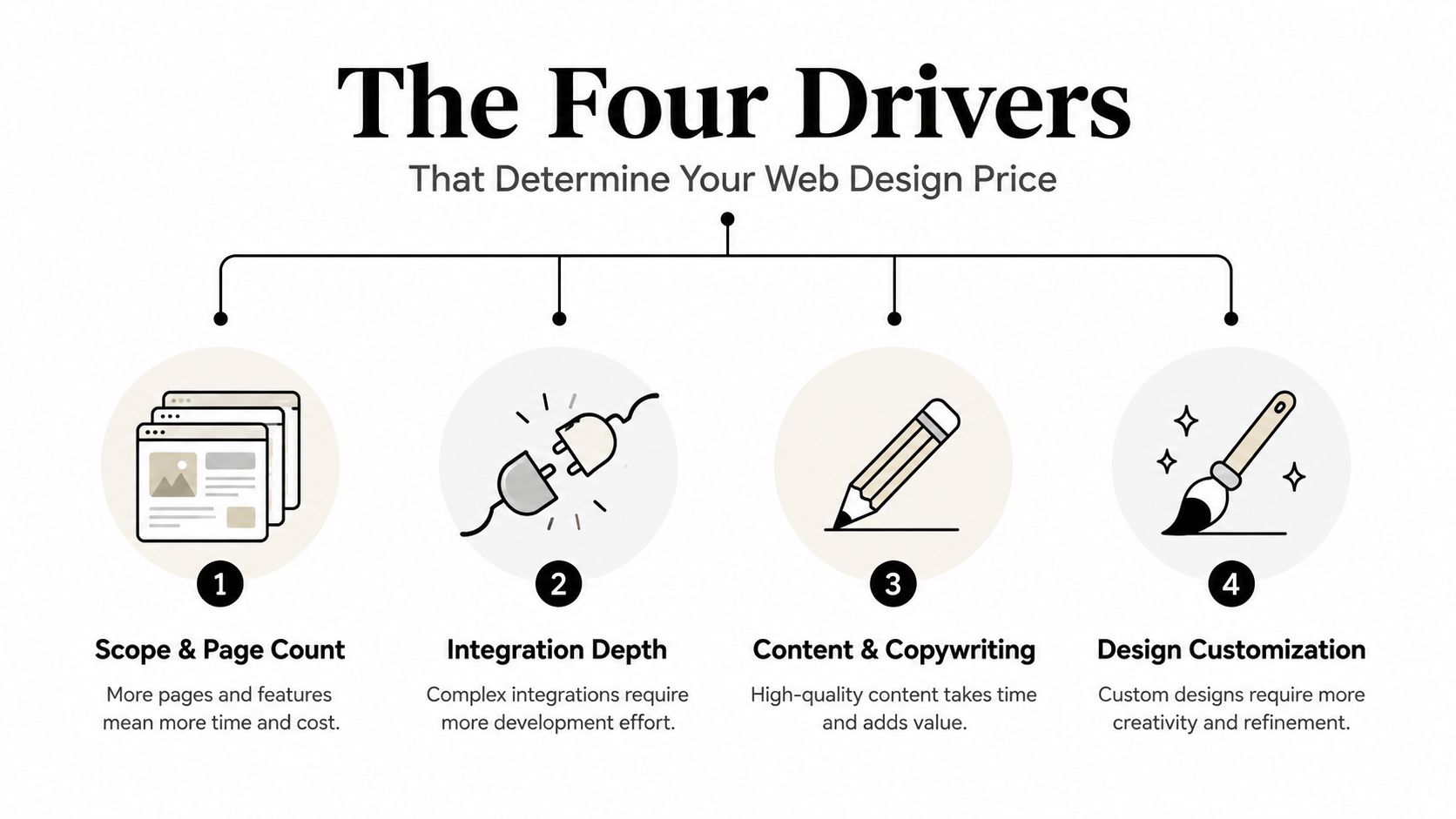
Scope and page count
A simple service business may need a home page, service pages, about page, contact page and a small insights section. A multi-location firm, property business or specialist consultancy may need audience-specific pages, industry pages, location pages, resource hubs and campaign landing pages.
Australian market guidance places an SME website with 6–15 pages, custom design, copy and SEO setup at around AUD $6,000–$15,000. Conversion-focused architecture, CRO, SEO foundations and automation-ready delivery can move the project into the AUD $12,000–$30,000 range, as described by Australian website development cost benchmarks.
The reason isn't the page total alone. Each additional page may require research, messaging, layout decisions, internal links, responsive design, technical implementation and quality assurance.
Integration depth
A contact form is not the same as a lead system. A service firm may need:
Booking workflows: Visitors choose an appropriate meeting type and schedule without an email exchange.
CRM handoff: Enquiry details enter the right pipeline with useful source and service information.
Automation: Prospects receive confirmation, reminders or a relevant next step.
Analytics: The business can distinguish a qualified enquiry from a low-intent form submission.
A ten-page website with these dependencies costs more than a ten-page brochure site because more systems must work together, and someone must test the handoffs.
Content and copywriting
Professional services firms often underestimate content. The website needs more than polished sentences. It needs positioning, proof, service explanations, objection handling, calls to action and search-aligned structure.
If the business provides the copy, the project may move faster, but internal teams still need to make decisions and approve content. If the agency researches and writes it, the cost reflects interviews, commercial strategy, subject-matter review and revisions.
Template or custom delivery
Templates reduce the amount of design and development work required at the starting point. Custom delivery gives the team more control over information architecture, visual identity, interaction design and conversion paths.
Specialist Australian development work is commonly benchmarked at $100–$250 per hour, while broader small-business project estimates often sit between $3,000 and $9,000. More complex content-rich builds can reach $8,000–$18,000, according to Australian web development pricing benchmarks.
The practical test is simple. Use a template when your requirements fit the template. Choose custom work when the customer journey, brand or integration requirements make compromise more expensive than the build.
Australian Web Design Pricing Tiers Compared
Australian service businesses should price a website by its commercial job, not by the visual polish of its homepage. A brochure site may establish credibility. A conversion-focused system must also attract qualified visitors, explain services, capture enquiries and support follow-up across the next 12 months.
Three pricing tiers make the trade-offs clearer:
Starter or brochure site: Suitable for a focused business that needs core pages, a clear contact path and basic content management. It typically includes responsive design, a basic CMS and essential setup. Allow $2,500–$10,000 for a brochure-style build, with delivery often taking 1–3 weeks under Australian pricing guidance.
Growth-focused lead-generation site: Built for firms relying on organic search, campaign traffic and structured lead capture. The scope can include multiple services, audiences or locations, custom UX, strategic copy, SEO foundations, landing pages, booking flows, analytics and CRM handoff. Allow $6,000–$15,000 for custom design, copy and SEO, or $12,000–$30,000 when CRO and automation-ready architecture are included. Many small-business builds take 1–3 weeks, although scope determines the schedule.
Complex custom build: Appropriate for advanced eCommerce, bespoke applications, integrated platforms, multiple audiences or demanding operational workflows. It may require custom functionality, complex data flows, specialist development, extensive QA and ongoing support. Pricing starts at $20,000+, with large bespoke sites starting above $30,000. More complex builds commonly take 4–8 weeks, depending on requirements.
The lower-priced tier is not automatically poor value. It is appropriate when the brief is narrow and the website has limited responsibility for pipeline generation. A growth site costs more because research, messaging, conversion paths, integrations and measurement must work together. A complex build carries further cost because failures can affect internal operations as well as customer experience.
For platform decisions, how WordPress website design affects pricing in Sydney helps buyers assess CMS costs, content management and future flexibility.
Request a proposal that separates strategy, design, development, content, SEO, integrations, testing and post-launch support. Compare the 12-month ownership and pipeline contribution, not just the launch fee.
The Hidden 12-Month Cost of Website Ownership
A launch quote measures the build. It does not measure the cost of keeping the website accurate, secure, measurable and capable of generating pipeline over the following year.
Ownership may include hosting, security updates, content changes, analytics monitoring, CRM upkeep, technical fixes and conversion testing. Professional services firms may also need new service pages, campaign landing pages, search optimisation, booking changes and follow-up workflow updates. These activities determine whether the site remains a commercial asset or becomes an outdated brochure.
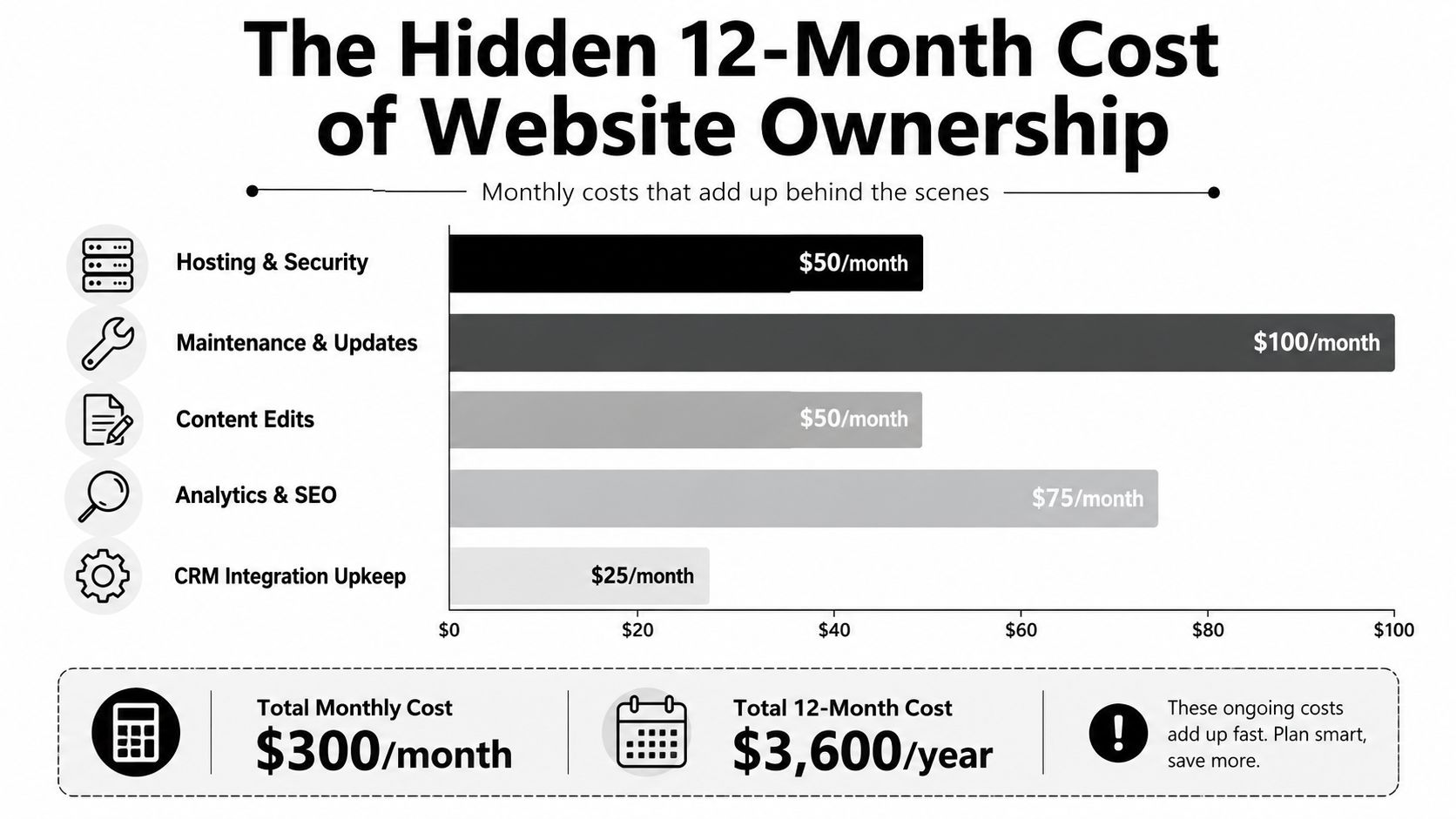
Build a 12-month ownership view
Start with the initial build fee, then price the work required to keep performance on track. Australian guidance places ongoing care plans at approximately AUD $150–$1,200+ per month, while professional project pricing commonly spans AUD $3,000–$25,000+ before advanced custom requirements, according to Australian website cost and maintenance guidance.
Include these cost lines:
Technical care: Hosting, updates, backups, security monitoring and issue resolution.
Content operations: Service changes, staff updates, new insights and campaign pages.
Measurement: Analytics checks, attribution, form tracking and reporting.
Pipeline maintenance: Booking workflows, CRM fields, notifications and follow-up sequences.
Conversion work: Testing page structure, calls to action, forms and qualification steps.
A website can stay online while its commercial performance declines. Incorrect service information, broken forms and untracked enquiries create missed opportunities that will not appear on a hosting invoice. Review ownership costs against pipeline contribution, not only uptime.
The first-year budget can be materially higher
One Australian 2026 pricing guide states that total first-year spend for a small-business website can exceed A$35,000 once development, hosting, maintenance, integrations, compliance and content are included. It estimates initial development at A$5,000 to A$25,000, as reported in professional web design cost guidance for Australian small businesses.
That range is not a universal budget. It shows why a low launch fee can hide a higher ownership commitment. Before approving a proposal, confirm who owns the site after launch, what support is included, how changes are priced and which conversion metrics will be reviewed.
The video below walks through a real example of first-year website ownership costs in Australia and provides context for the 12-month model.
How to Measure Web Design ROI for Service Businesses
A website's return isn't determined by how many pages it contains or how modern the interface looks. Those elements matter only when they help the right prospects understand the offer, trust the firm and take a commercially useful next step.
For a law firm, that step may be a qualified consultation request. For a buyers agency, it may be a discovery call. For a broker, it may be a completed enquiry with enough information to assess fit. The measurement model needs to follow the sales process.
Track the pipeline, not vanity metrics
Set a baseline before the project starts. You should know how enquiries currently arrive, which services they relate to, how many are qualified and how much manual work the team spends handling them.
Useful measures include:
Qualified enquiries: Count enquiries that match your service, geography, budget or client criteria.
Booked calls: Track appointments rather than treating form submissions as the final result.
Conversion rate: Compare relevant landing pages with the general website experience. An Australian benchmark places the median landing-page conversion rate at 6.6% across industries, while another source describes 5%+ as good and 10%+ as excellent, as outlined in Australian conversion rate benchmarks.
Lead quality: Record whether enquiries progress into suitable opportunities, not merely whether forms were completed.
Follow-up effort: Identify how much time staff spend copying data, replying manually and chasing incomplete prospects.
For eCommerce businesses, the context differs. Australian benchmarks commonly place average eCommerce conversion around 1.5%–2.5%, while another Australian source describes 2.0%–3.0% as a good rate across devices and traffic sources, according to Australian eCommerce conversion benchmarks.
Decide whether the investment is justified
A more expensive build can be rational when it improves lead quality, captures demand more effectively or removes manual handling. A cheap build can be irrational when it produces vague enquiries and gives the sales team no useful context.
The proposal should specify what will be measured, where the data will live and who will review it. For firms combining search visibility with conversion work, website design and SEO strategy should be evaluated as one acquisition system rather than two disconnected line items.
The right ROI question is not “Did we get a nicer website?” It's “Did the website help the business create better commercial conversations?”
A Practical Framework to Estimate Your Web Design Budget
You can estimate a sensible budget before speaking with an agency. The objective isn't to produce a perfect quote. It's to understand the level of strategic, creative and technical work your business needs.
Start with the commercial job
Write down the primary business outcome in plain language. “Look more professional” is too vague to guide a budget. “Generate qualified discovery calls for our commercial property advisory service” gives the project a clear direction.
Then answer these questions:
Define commercial goals. Decide whether the site must support referrals, organic acquisition, paid campaigns, bookings, eCommerce or a combination.
Calculate current lead volume. Review where enquiries come from, which pages or channels influence them and where the sales team loses time.
Set growth targets. Identify the quality and type of opportunity the website needs to support. Don't set targets without defining what counts as a qualified lead.
List essential integrations. Include booking tools, CRM handoff, analytics, email marketing, calculators, property feeds or other operational dependencies.
Allocate for ongoing costs. Reserve budget for maintenance, content, SEO, analytics, testing and workflow upkeep rather than stopping expenditure at launch.
Match the budget to the consequence of failure
A referral-led consultancy may be comfortable with a focused brochure site. A buyers agency relying on inbound enquiries needs stronger landing pages, qualification and booking logic. A B2B firm with a long sales cycle may need detailed service content, proof, lead magnets and CRM attribution.
Australian guides place custom business websites with integrations in the AUD $6,000–$40,000+ range, as discussed in Australian web design cost analysis for 2026. The range is wide because the business problem determines the required system.
Affordable web design for small businesses can be a useful starting point when funds are limited, but affordability should come from disciplined scope, not from removing the elements responsible for enquiries and measurement.
Budget test: If the site fails to generate or manage the opportunities you need, the saving was only a deferred cost.
Common Budgeting Mistakes and What to Do Next
The first mistake is choosing the lowest quote without comparing deliverables. A cheaper proposal may exclude copy, SEO setup, analytics, content migration, integrations or post-launch support. You're not saving money if your team has to rebuild those elements later.
The second is budgeting for launch but not ownership. A website that supports acquisition needs someone responsible for updates, measurement and improvement. Put those responsibilities and costs into the original business case.
Four decisions that protect the investment
Lowest price: Choose based on the commercial scope, not the headline fee.
No conversion goal: Define the action a qualified prospect should take.
Unclear content ownership: Decide who researches, writes, supplies proof and approves pages.
One-off thinking: Treat the website as part of the path from traffic to enquiry, booking, follow-up and sales.
A professional services firm can have a polished website and still create a weak pipeline. The usual problem isn't visual quality. It's unclear positioning, poor pathways, weak qualification or disconnected follow-up.
Review your current website as a sales asset. Identify where visitors lose confidence, where enquiries become unqualified and where the team handles work manually that a better system could support.
Raffine Studio designs conversion-focused websites, SEO and AI search visibility systems, landing pages, booking flows and CRM follow-up for Australian professional services firms. Visit Raffine Studio to assess whether your next website should be a brochure site or a measurable lead-generation system.