web design agency, choose web agency, website redesign, conversion optimisation, AI search visibility
How to Choose a Web Design Agency for Growth
by raffiné studio

A polished portfolio is not proof that an agency can grow your business. It proves the agency can present polished work. Those are different capabilities.
When you're deciding how to choose a web design agency, assess the website as a commercial system. It should attract the right audience, explain why your business is credible, create a clear next step, capture the enquiry, pass it to the right person or system, and show you what happened afterwards.
That standard matters because Australian businesses are already well connected. The Australian Bureau of Statistics reports that more than 91% of Australian businesses said their internet connection met most or all of their business needs in 2024–25, compared with 88% in 2021–22. Yet only 32% received orders online, while 51% used social media for their online presence. Connectivity isn't the competitive advantage anymore. Integration, conversion and accountability are.
Why Most Agency Selection Processes Fail
Most businesses still select an agency backwards. They browse portfolios, shortlist the sites with the strongest visual style, compare quotes and choose the team that appears easiest to work with.
That process rewards presentation rather than capability. A website can have excellent typography, animation and photography while leaving visitors unsure what the business does, who it helps or what they should do next. For a law firm, buyers agency, accounting practice or finance broker, that failure affects the pipeline, not just the brand impression.
A portfolio shows taste, not commercial competence
Treat a portfolio as evidence of design ability, not evidence of business performance. Ask the agency to explain the commercial problem behind a relevant project:
Audience: Who was the site designed to persuade?
Decision path: What did visitors need to understand before making contact?
Conversion: Which actions were treated as meaningful?
Implementation: How were forms, booking tools, analytics and CRM systems connected?
Ownership: Who on the proposed team delivered the work?
A mature agency won't only show screenshots. It will walk you through the information architecture, content decisions, mobile experience, technical constraints and post-launch responsibilities.
Practical rule: If an agency can explain the look of a website but can't explain how the site supports enquiries, bookings or sales conversations, keep looking.
Professional services firms often inherit disconnected digital assets. Social posts send people to a generic homepage. Search traffic lands on thin service pages. Enquiries arrive by email without source information. Booking tools sit outside the website with no clear handoff to the team responsible for follow-up.
The result is a digital brochure rather than a lead-generation channel. It may create awareness, but it doesn't give the business a reliable way to understand demand or improve the path from first visit to qualified conversation.
Reframe the website as an operating asset
The right agency should begin with the customer journey, not the homepage. It should ask what a prospective client knows when they arrive, what objections they have, what evidence they need, and what action represents genuine intent.
That might be a consultation booking for a solicitor, a valuation request for a buyers agent, an assessment call for an accountant or an enquiry about a commercial project for a construction company. Those actions need different page structures, forms, qualification questions and follow-up processes.
Before you compare agencies, write down the primary job of the website in one sentence:
“The primary job of our website is to help [audience] take [commercial action].”
Then reject proposals that focus mainly on page counts, visual concepts or launch dates. Those details matter, but they don't define whether the website will support growth.
Evaluating Commercial and Conversion Capabilities
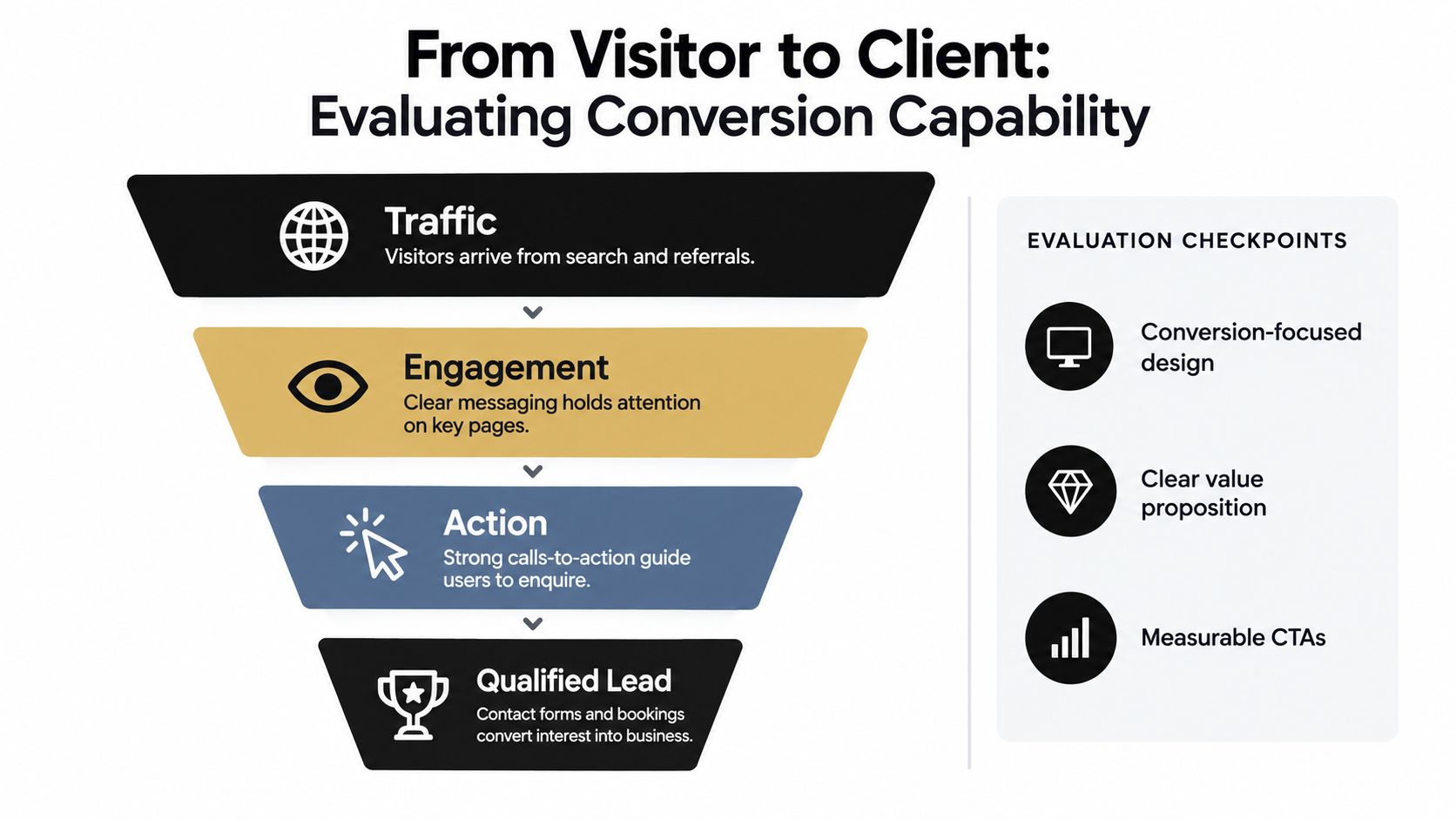
A suitable agency should map the route from traffic to revenue before designing the interface. That route needs a relevant entry point, a clear value proposition, persuasive proof, a low-friction action and a reliable follow-up process. If a proposal cannot explain how these elements work together, it is a design exercise rather than a commercial plan.
Australian businesses often mistake an online presence for an integrated digital channel. The ABS business technology data shows that internet access is widespread, while online ordering and social presence remain less universal. The commercial test is whether the website connects search, social activity, enquiry handling and sales operations, with clean data passing between each stage.
Ask for the architecture behind the pages
A capable agency should show how it will connect:
Search intent to landing pages: Someone searching for “commercial property buyers agent Sydney” should reach a page built for that need, not a vague services page.
Social content to relevant actions: A post about a specific client problem should lead to a page that explains the solution and offers a sensible next step.
Forms to qualification: Forms should collect enough context for a useful response without creating unnecessary effort or capturing data the business does not need.
Bookings to internal workflow: A scheduled call should create a clear record, notify the right person and trigger appropriate follow-up.
Analytics to decisions: Events should distinguish an engaged visit from a qualified enquiry or booked consultation, with ownership and access defined from the start.
Ask the agency to identify the conversion events it will configure before work begins. Useful measures include qualified enquiries, booked consultations, conversion rate, cost per lead and lead-source attribution. Page views and launch completion can be reported, but they provide weak evidence of commercial performance on their own.
The funnel should reflect the audience. A buyers agency may need separate pathways for sellers, investors and owner-occupiers. A professional services firm may need practice-area pages with different calls to action. A B2B company may need a technical resource journey before a prospect is ready to speak with sales. Require the agency to explain these differences rather than applying one template to every business.
Test the proposal with practical questions
Use discovery to test whether the agency can design an operating system, not just attractive pages:
What action should a visitor take on each important page?
How will you distinguish a general enquiry from a sales-ready lead?
Which CRM, booking or email systems can you integrate, and what information will pass between them?
How will social and search campaigns connect to specific landing pages?
Who owns the analytics account, event configuration and reporting data?
How will the team review lead quality rather than only website activity?
Demand specific answers. “We'll add analytics” is not a plan. The proposal should identify the events, naming conventions, reporting destination, data access, ownership and review process. Data governance belongs in the commercial evaluation because unreliable attribution leads to poor budget decisions.
The agency must also define the content needed to support conversion. Strong design cannot compensate for unclear positioning, generic service descriptions or weak evidence. For high-value services, pages should help prospects compare expertise, understand eligibility, assess trust and decide whether booking a conversation is worthwhile.
Assessing AI Search Visibility and Data Security
Traditional SEO remains relevant, but it no longer describes the entire discovery environment. Australian users may receive an answer directly in a search interface, with fewer reasons to visit a conventional result. ABC reporting on AI summaries in Australian search states that by the second half of 2025, more than one-third of Australian searches produced an AI summary, while click-through rates for pages shown in AI Overviews reportedly fell by 15–70%.
That changes the agency brief. Ask how the team will make your business understandable and accurately represented in AI-generated answers, not just how it will pursue rankings.

Evaluate visibility beyond the click
An agency should be able to assess:
Entity clarity: Is it obvious what your business does, where it operates and who it serves?
Structured content: Are services, locations, people, credentials and eligibility explained consistently?
Authoritative evidence: Does the site support important claims with clear, verifiable information?
Content usefulness: Do pages answer the questions prospects ask before contacting a professional?
Brand accuracy: Does the agency have a method for checking how your business is represented in AI answers?
Referral quality: Can it distinguish a meaningful enquiry from a casual visit or unqualified mention?
The aim isn't to appear in an answer at any cost. The aim is to be represented accurately enough that the right prospect understands your relevance and can move into a credible conversion path.
Request an AI-visibility audit as part of the proposal. The agency should explain how it will monitor brand mentions, update factual content and assess referral quality as search interfaces change. Raffine's AI search optimisation guide is a useful example of the type of subject matter an agency should be able to discuss in practical terms.
Make lead handling part of design quality
AI visibility is only half the overlooked risk. The other half is what happens to information after someone submits a form or books a call.
The auDA 2025 Digital Lives of Australians research found that only 20% of small businesses had a cybersecurity policy or staff training, while 81% considered cybersecurity skills at least somewhat important now or in the future. The same research found that 58% of Australian consumers remained concerned about online privacy and data security.
Ask for a written data-flow review covering:
Storage: Where form, booking and CRM data is stored.
Access: Which staff, contractors and tools can view it.
Transfers: Whether integrations send information overseas.
Consent: How consent and tracking preferences are recorded.
Retention: How information is removed, exported or retained.
Incident handling: Who is responsible if a connected tool or form is misconfigured.
Automation can improve speed to lead, but every additional integration creates another place where information can be exposed or mishandled. A professional agency should make the data path visible before it recommends automation.
Enforcing Accessibility and Technical Standards
Accessibility isn't a decorative enhancement to add after the design is approved. It affects whether people can read your content, operate your forms, book an appointment and understand errors.
Deque reports that 21.4% of Australians, approximately 5.5 million people, have a disability, and Australian accessibility practice commonly uses the Web Content Accessibility Guidelines as a benchmark. The Australian Attorney-General's Department accessibility guidance describes practical expectations including operation across desktop, tablet and mobile devices, zooming to 400% without text spilling off the screen, keyboard navigation and screen-reader compatibility.
Put acceptance criteria into the contract
Don't accept a proposal that says only “WCAG compliant”. Require the agency to state which standard it targets, how it will test it and how defects will be resolved.
The Australian Human Rights Commission guidance on equal access to digital goods and services recommends integrating accessibility into digital procurement, addressing it throughout design, development and testing, testing with people who use assistive technologies, and documenting how standards are met. It also recommends WCAG 2.2 Level AA acceptance criteria across all relevant pages, rather than limiting checks to an automated scan of the homepage.
Your contract should cover:
Keyboard operation: Menus, forms, dialogs and booking flows work without a mouse.
Focus visibility: Users can see where keyboard focus sits.
Structure: Headings, landmarks and reading order make sense.
Form labels: Every control has a useful label and understandable error message.
Contrast: Normal text meets the minimum 4.5:1 colour-contrast ratio described in Western Australian accessibility guidance.
Media: Relevant video includes captions or transcripts.
Images: Meaningful non-text content has descriptive alternative text.
Zoom and mobile: Key pages remain usable at high zoom and across relevant devices.
Test the conversion paths, not just the template
A homepage may pass a basic scan while an enquiry form remains impossible to complete with a keyboard. A service page may look readable while a booking screen hides its error message from a screen reader.
Ask to see test records for the actual templates and journeys that matter to your business. That includes service pages, campaign landing pages, contact forms, application forms and appointment-booking screens. Require both automated tools and human review, including testing with people who use assistive technologies where appropriate.
Accessibility also needs a maintenance plan. Staff can damage an initially sound implementation by uploading images without alternative text, creating poorly structured headings or publishing low-contrast content. The agency should explain how your team will be trained, what content rules will be documented and who will remediate problems after launch.
For a deeper technical evaluation, use a technical SEO agency assessment that considers structure, performance, accessibility and search foundations together. These areas overlap. Poor heading structure, inaccessible forms and weak page architecture can affect both usability and discoverability.
Comparing Proposals Using a Procurement Scorecard
A proposal should reveal how an agency works when nobody is watching. Beautiful sales slides tell you very little about content migration, testing discipline, analytics ownership or defect handling.
Send every shortlisted agency the same requirements and score the responses before personalities and presentation quality influence the decision. Require a written delivery method covering discovery, information architecture, content migration, responsive implementation, analytics, quality assurance, launch and post-launch optimisation.
Use comparable categories
Evaluation Category | Superficial Proposal | Mature Proposal |
|---|---|---|
Discovery | A short meeting followed by a page list | Stakeholder input, audience needs, commercial objectives and documented requirements |
Information architecture | Sitemap treated as a formality | User journeys, service hierarchy, search intent and conversion paths |
Content | Client supplies copy without a clear process | Content audit, migration rules, editorial responsibilities and content QA |
Design | Visual concepts judged mainly by preference | Responsive design system linked to audience tasks and calls to action |
Integrations | “CRM and booking integration available” | Named systems, data fields, permissions, failure handling and ownership |
Accessibility | Generic claim of compliance | WCAG 2.2 Level AA criteria, human testing and remediation process |
Analytics | Basic tracking added near launch | Events, attribution, dashboards, account ownership and reporting cadence |
Quality assurance | “Tested across devices” | Defined browser and device coverage, regression checks and user acceptance testing |
Launch | A date with no operational detail | Redirects, backups, deployment checks, rollback planning and ownership |
Post-launch | Support described as “available” | Defect severity, response times, maintenance scope and optimisation process |
Score delivery maturity, not just price
A low quote can hide exclusions for copywriting, accessibility testing, integrations, analytics configuration or post-launch fixes. A higher quote may include discovery and technical work that prevents expensive rework. Compare what each proposal delivers, not the total at the bottom of the page.
Ask each agency to disclose:
Team allocation: Who designs, writes, develops and manages the project?
Assumptions: What must the client provide, and by when?
Exclusions: Which features, content or integrations are outside scope?
Change control: How will scope changes affect time and fees?
Ownership: Who owns the domain, accounts, content, designs and code?
Maintenance: What happens when the CMS, integrations or accessibility requirements change?
A proposal that makes difficult work invisible is not a cheaper proposal. It is an incomplete one.
Include a live presentation for finalists, but don't let confidence replace evidence. Ask the team to respond to a realistic scenario, such as a delayed content handoff, a form integration failure or an accessibility defect discovered before launch. Their response will show whether they have a controlled process or are improvising around the sale.
Onboarding and Measuring Post-Launch Success
Signing the contract doesn't complete the selection process. It starts the period where the agency must turn its promises into a functioning commercial asset.
Begin with a baseline. Record the existing sources of enquiries, current conversion events, booking activity, lead quality, important landing pages and known technical problems. Don't create targets that the analytics setup can't measure. If the business can't identify where leads originate or what action they took, the post-launch report won't support a useful decision.
Set the measurement system before launch
Agree on the events that matter to your business:
Qualified enquiry: A contact that meets your agreed fit criteria.
Booked consultation: A completed booking, not merely a booking-page visit.
Lead source: The channel, campaign or page that introduced the prospect.
Conversion rate: The proportion of relevant visitors who complete the defined action.
Lead quality: Whether the enquiry represents a realistic commercial opportunity.
Your agency should configure these events, document them and show where the data will be reported. It should also explain how CRM records, booking data and website events relate to each other. Attribution will never answer every commercial question, but an undocumented setup leaves you unable to judge performance at all.
Treat launch as the first optimisation cycle
The first post-launch review should examine real behaviour, form completions, booking friction, search visibility, page engagement and lead quality. It should also include a check of accessibility after staff begin publishing content.
Set a regular review cadence and define what happens when the data shows a problem. A strong agency may recommend rewriting a service page, changing a call to action, adjusting qualification fields, improving a booking flow, fixing technical issues or updating content that is being misrepresented in AI-generated answers.
Your website should become more useful as your team learns which prospects convert, which questions delay decisions and which sources produce commercially relevant enquiries. Choose an agency that will keep improving that system rather than treating launch as the finish line.
Raffine Studio designs conversion-focused websites, funnel journeys, SEO and AI search visibility systems, with booking, CRM handoff, follow-up automation and measurement built around qualified enquiries. Review your current website against the standards above, then visit Raffine Studio to discuss whether your digital channel is ready to support the next stage of growth.