technical SEO agency, technical SEO, crawlability, Core Web Vitals, site architecture
What a Technical SEO Agency Actually Does for Your Site
by raffiné studio
A site can look polished, load acceptably and still be commercially invisible. That's the trap many Australian service businesses fall into after a redesign. The homepage looks modern, the branding feels credible, and the contact form works when someone tests it. Yet qualified visitors aren't finding the pages that should turn searches into enquiries.
A technical SEO agency investigates the infrastructure beneath the visual layer. It checks whether search engines and AI systems can crawl, render, understand and prioritise the pages that support your revenue. For Australian firms competing in a concentrated search market, that work protects more than rankings. It protects lead flow, booking paths and the value of the website itself.
Why Your Site Looks Fine but Isn't Getting Enquiries
A building company in Melbourne redesigned its website last year. The new version was cleaner, faster and easier to use on a phone. The director expected more quote requests. Instead, enquiries flattened while paid advertising became more expensive.
Nothing appeared broken from the front end. The forms submitted correctly. The phone number was visible. The pages looked professional. A technical review, however, would likely uncover a different story: important service URLs buried deep in the architecture, internal links pointing to outdated destinations, and new pages that search engines had discovered but not properly indexed.
Commercial reality: A website can pass a visual review while failing the search and lead-generation review.
Business owners commonly miss several warning signs:
Search Console coverage warnings: Important pages may be excluded, crawled but not indexed, or affected by canonical and redirect problems.
Orphaned service pages: A page can exist in the CMS and still have no useful internal link pointing to it.
Thin location pages: Multiple weak suburb pages can compete with the main service page instead of supporting it.
Social dependency: A business may continue receiving visits from LinkedIn or Instagram while organic visibility deteriorates.
Buried commercial pages: The page for commercial litigation, buyer advocacy or industrial fit-outs may sit several clicks away from the homepage, with little authority flowing to it.
Australia's search environment makes this especially important. Google held 88.04% of the Australian search market in June 2026, according to Australian search market data. Another Australia-focused dataset places Google at 87.58% and Bing at 9.41%, which means modest changes in visibility can have a meaningful effect when most potential buyers use the same dominant channel.
The front end is only one verdict
“Looks fine” tells you whether a person can see and use the interface. It doesn't tell you whether Googlebot can access the page, whether JavaScript renders the navigation, whether the canonical points to the right version, or whether the page has enough internal authority to compete.
That gap is where a specialist earns its fee. The work starts with evidence from crawling tools, server data, Search Console and rendered page tests, then connects each issue to a commercial page or conversion path.
If the page that should generate a booked call isn't being discovered, indexed or surfaced for the right intent, publishing another blog post won't solve the problem. The first job is to remove the technical obstruction.
What a Technical SEO Agency Actually Owns
A technical SEO agency owns the infrastructure layer of search visibility. Its job is to make the website accessible, interpretable and operationally safe for search engines, users and the development team.
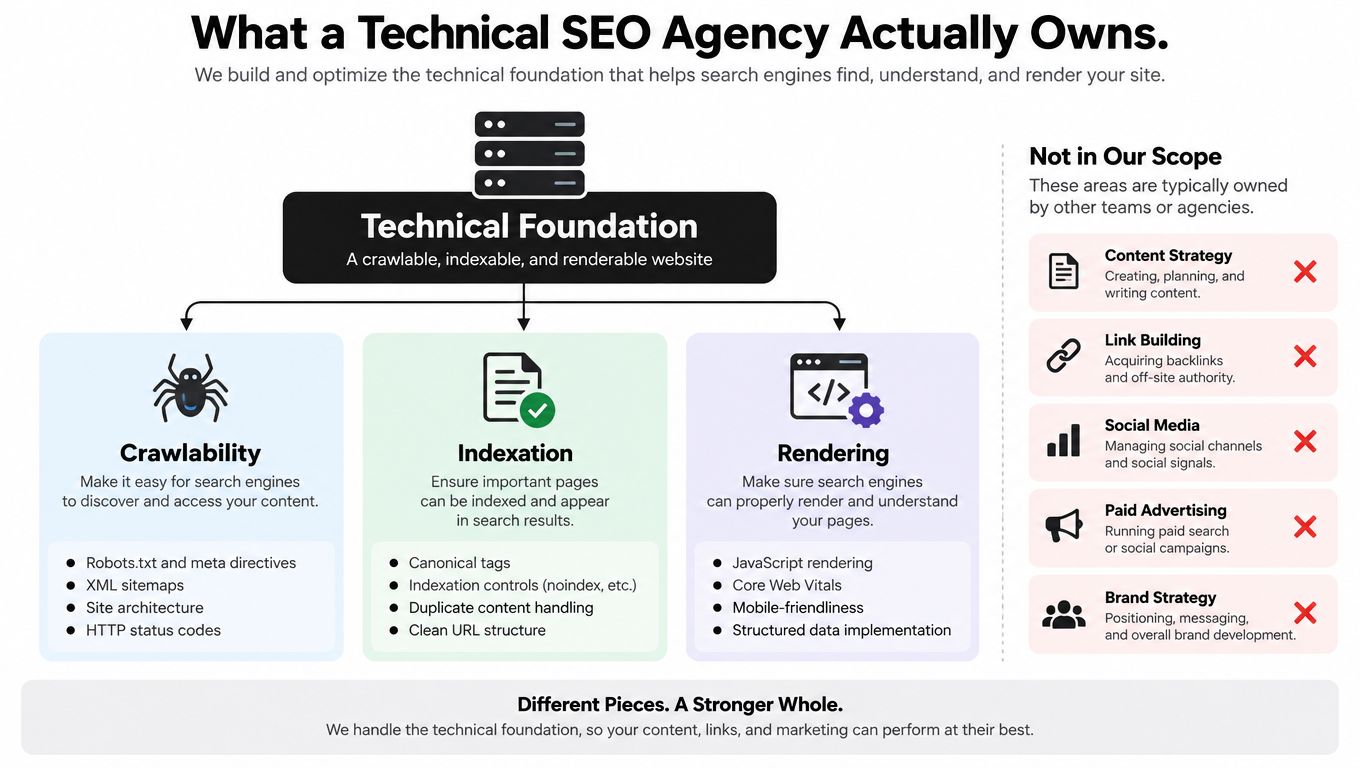
Think of the website as a building. Technical SEO is the plumbing, electrical system, access control and floor plan. Content is the furniture and signage. Conversion design is the way visitors move towards reception and make an appointment. Link acquisition is the external reputation that helps people choose the building.
The technical specialist should own:
Crawlability: Whether crawlers can reach the URLs that matter.
Indexation: Whether the right pages are eligible to appear in search.
Rendering: Whether important content and links appear when JavaScript executes.
Canonicalisation: Which version of a page search engines should treat as primary.
Architecture and internal linking: How authority and context move through the site.
Structured data: Machine-readable information about services, organisations, locations and page relationships.
Page experience: Performance, mobile usability and layout stability.
Migration controls: The safeguards that preserve visibility during a rebuild or platform change.
A technical SEO agency doesn't automatically own the content calendar, paid media, digital PR, link building or conversion copy. It should collaborate with those functions, but it mustn't hide behind a broad SEO retainer where technical work is reduced to a plugin report and a list of blog topics.
Crawl control is not index control
Robots.txt is a plain text file at the root of a website. It gives crawlers instructions such as Allow and Disallow, and it can point crawlers towards an XML sitemap, as explained in this robots.txt guide.
That file controls crawling behaviour, not indexation. A blocked URL can still remain discoverable in search if it isn't protected with noindex or authentication, which is why crawl control and index control must be treated separately.
This distinction matters for service businesses. Blocking a staging path, filter URL or private utility area may be sensible. Blocking a valuable service page and assuming it has disappeared from Google is not a strategy.
The Core Services That Sit Under the Banner
Technical SEO becomes useful when it produces decisions and implementation tasks, not when it produces a long list of warnings. A credible engagement normally falls across four connected workstreams.
Crawlability and indexation
The agency reviews robots.txt, XML sitemaps, parameter handling, crawl paths, index bloat and Search Console coverage. For larger sites, log file analysis can show which URLs search engine crawlers request and whether they spend time on irrelevant paths instead of revenue pages.
Good output is a prioritised issue register. Each item identifies the affected URL pattern, the cause, the business risk and the developer action. A weak engagement exports a generic crawl report and leaves your team to work out what matters.
Site architecture and internal links
This work maps the relationship between service pages, location pages, resources and conversion pages. A professional services firm might use a clear hub-and-spoke structure, with a core service page supported by specialist sub-services, industry pages and relevant insights.
The review should identify redirect chains, orphaned URLs and internal links that point to obsolete pages. It should also show where important pages sit too far from the main navigation or receive no meaningful contextual links.
Structured data
Schema can describe a local business, service, organisation, breadcrumb path or frequently asked question. The value isn't decorative code. It gives search systems clearer machine-readable context and can support eligibility for enhanced result presentation.
A proper deliverable includes implementation guidance, field mapping and validation through tools such as Rich Results Test and Search Console. Cheap work often adds a generic organisation schema to every page and calls the job complete.
Core Web Vitals and rendering
Performance work should examine Largest Contentful Paint, Interaction to Next Paint and Cumulative Layout Shift, alongside JavaScript execution, hydration, image delivery and hosting response time. A page can appear fast in a developer's office and still perform poorly for real mobile visitors.
The Australian benchmark is uncomfortable. An Australia-focused review found an average mobile Lighthouse performance score of 48 across 18 Australian websites, with only 2 sites scoring above 80, while only 42% of Australian origins passed all three Core Web Vitals on mobile. These findings come from Australian Core Web Vitals research.
Service area | What it includes | What good looks like | What gets skipped |
|---|---|---|---|
Crawlability and indexation | Robots directives, sitemap review, crawl paths, logs, parameters and coverage | Prioritised causes with developer-ready fixes | Generic export with no ownership |
Architecture and internal links | Hubs, spokes, redirects, orphan recovery and click depth | A clear path to commercial pages | Cosmetic navigation changes |
Structured data | LocalBusiness, Service, FAQ and BreadcrumbList markup | Validated markup mapped to page intent | Copy-pasted schema templates |
Performance and rendering | LCP, INP, CLS, JavaScript, images and hosting | Tested fixes with before-and-after evidence | A single Lighthouse screenshot |
The difference is accountability. A real technical SEO agency doesn't just identify a problem. It explains who needs to fix it, how the fix should be tested and which important business page it supports.
Core Web Vitals and Structured Data as Revenue Levers
Core Web Vitals are often treated as a ranking checklist. That framing is too narrow for a service business. Performance affects whether someone can read the offer, complete a form and trust the site enough to make contact.
The three thresholds are specific. LCP should be 2.5 seconds or less, INP should be 200 milliseconds or less, and CLS should be 0.1 or less, with all three required at the 75th percentile of real user visits to pass, according to these Core Web Vitals benchmarks.
Metric | Good threshold | Where it hurts on a service site | Revenue lever |
|---|---|---|---|
LCP | 2.5 seconds or less | Hero image, headline or primary offer appears late | Make the value proposition visible sooner |
INP | 200 milliseconds or less | Quote form, booking widget or navigation feels unresponsive | Reduce friction during enquiry |
CLS | 0.1 or less | Fonts, banners or widgets shift the form or button | Keep the conversion action stable |
Speed belongs inside the conversion review
For a buyer's agency, a slow property search page can delay the path to a valuation conversation. For a law firm, a shifting contact module can interrupt a prospective client who has finally decided to enquire. For a medical practice, an unresponsive booking control can send a patient to a competitor.
That's why performance testing shouldn't stop at a lab score. The agency needs to inspect field data, templates, third-party scripts, image formats, server response and the actual interaction path. Compressing an oversized hero image may matter more than making an already-fast blog page marginally faster.
Structured data supports a different part of the journey. LocalBusiness, Service, FAQ and BreadcrumbList markup can clarify what a page represents, how it relates to the organisation and where it sits in the site. It doesn't guarantee a rich result, but missing or invalid markup removes eligibility and weakens machine-readable understanding.
Australia has little room for technical complacency
Mobile devices account for about 67% to 68% of search volume in Australia, according to the Australian internet usage and digital behaviour research. A service site that treats mobile performance as a later refinement is choosing to add friction at the point where much of its audience starts the search.
The commercial test is simple. Don't ask whether a score looks acceptable in an audit. Ask whether the right customer can find the relevant offer, understand it quickly and complete the next action without delay.
How to Tell a Real Technical SEO Agency From a Generalist
The difference isn't whether an agency can name canonical tags or Core Web Vitals. Most can. The difference is whether it can diagnose the cause of a visibility problem and help your team ship the fix.

A generalist often begins with an automated crawl, a Lighthouse scan and a plugin checklist. Those tools are useful, but they report symptoms. A specialist tests the rendered HTML, inspects the link graph, checks server behaviour, reviews logs where appropriate and traces an indexing problem back to its source.
Compare the depth, not the vocabulary
Ask whether the proposed work includes:
Rendered page inspection: Can the agency show what a crawler sees after JavaScript runs?
Canonical diagnosis: Can it explain why duplicate or near-duplicate URLs are being consolidated incorrectly?
Crawl evidence: Can it distinguish a crawl demand problem from a blocked path or weak internal linking?
Implementation support: Will findings become tickets your developer can action?
Regression monitoring: Will someone check whether the fix survives the next release?
A one-off audit isn't automatically useless. It becomes a poor investment when nobody is responsible for implementation, testing or monitoring. A ninety-page document can create the appearance of rigour while leaving the commercial problem untouched.
A useful report answers three questions. What is wrong, why is it happening, and what should the developer change next?
Be cautious with guarantees. No honest agency can promise a specific Core Web Vitals result without controlling the codebase, hosting, assets and third-party scripts. It also shouldn't promise that schema will produce a particular search feature.
Before appointing a provider, ask these three questions:
Show me how you would investigate a page that is crawled but not indexed. What evidence would you need?
How would you test whether our JavaScript navigation and content are visible to search engines?
How will you connect technical fixes to qualified enquiries rather than only rankings and impressions?
For businesses that need the technical foundation connected to lead capture, SEO for lead generation is a useful adjacent consideration. The point is not to combine every service under one contract. It's to ensure the infrastructure supports the customer journey.
Where Technical SEO Meets Your Redesign and Funnel
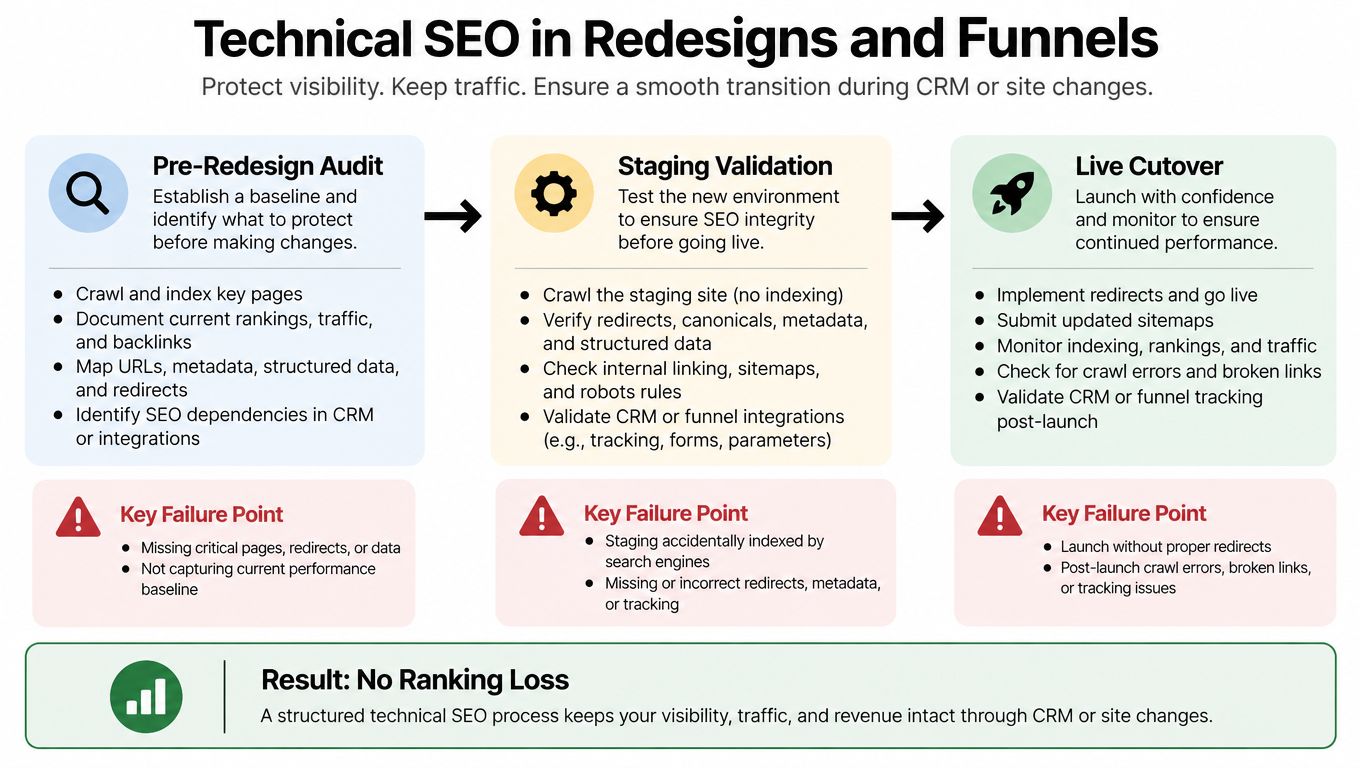
A redesign is a technical SEO event, even when the project is sold as a branding or user experience exercise. The most expensive failure usually isn't a colour choice. It's launching a new URL structure without preserving the old one.
A new site can lose organic visibility because the redirect map is incomplete, staging directives remain live, canonical tags point to the wrong host, or internal links still reference retired URLs. The agency may blame an algorithm change. The project owner should first check what changed in the migration.
Build the controls before launch
A technical SEO owner should create the legacy URL inventory, map old pages to relevant new destinations and approve the 301 strategy. The pre-launch review should also cover:
XML sitemap structure and submission
Canonical tags and indexation directives
Internal link preservation
Structured data migration
Mobile-first templates
Staging crawl parity
Form tracking and analytics events
Search Console URL inspection checks
Staging must be protected from public indexing, but it should remain crawlable to the authorised testing process. The new site needs to be inspected as a search engine would see it, not just reviewed in a browser by the design team.
Launch day needs its own checklist. Confirm redirects, submit the new sitemap, inspect priority URLs, monitor coverage warnings, test forms and verify that lead data reaches the CRM. A form that looks operational but fails to populate a hidden source field can destroy attribution without producing an obvious error.
Here is the relevant redesign resource on website redesign for SEO, particularly for teams planning a new information architecture or platform change.
The video below provides another practical visual for evaluating the redesign process.
Treat funnels and CRM changes as SEO dependencies
A funnel rebuild changes more than page layout. It can alter the data layer, consent handling, event names, form endpoints, booking flows and follow-up triggers. The technical SEO owner should work with the developer and CRM specialist so that a search visitor can move from landing page to enquiry without losing source information.
The rule is straightforward: no redesign ships without a technical SEO owner on the project. That person shouldn't arrive as a reviewer after the site is built. They need authority during planning, staging, cutover and stabilisation.
AI Search and Zero-Click Visibility in Australia
A Brisbane law firm can have a fast, attractive website and still lose a prospective client before that person visits. Search systems may summarise the firm, answer a service question without generating a click, or cite another source in an AI response. Technical SEO now protects revenue across those discovery points, not only rankings on Google.
Australian businesses already operate in a zero-click environment. One Australia-focused marketing compilation estimates that organic search drives around 68% of website traffic, while zero-click searches account for about 58% of searches, up from 51% in 2023, as described in Australian digital marketing statistics.

The commercial risk depends on the query. Someone checking a suburb opening time may get what they need without a visit. Someone comparing law firms, financial advisers or commercial builders still needs confidence, evidence and a clear next step. If the business is described inaccurately, omitted from the answer, or linked to a weak page, it can lose consideration before its site has a chance to convert.
Readiness starts with clear machine-readable signals
AI search readiness requires a site that systems can interpret reliably. A technical SEO agency should check:
Crawlable structure: Important pages must remain accessible, without broken navigation or unnecessary restrictions.
Entity clarity: The organisation, services, locations and relationships between pages should be unambiguous.
Structured data: Markup must describe each page accurately and validate correctly.
Answer-ready content: Pages should state services, qualifications, locations and next steps in clear language.
Stable performance: Slow or unstable pages create friction for users and systems retrieving information.
Crawler policy decisions: Robots.txt should reflect a deliberate approach to search and AI crawlers, rather than an accidental block.
For a deeper walkthrough, see AI search optimization.
Recent Australian industry coverage identifies robots.txt as an emerging policy surface for AI crawlers and points to llms.txt, structured data and answer-engine readiness as developing priorities, as discussed in Australian SEO trends for local businesses. Test these practices against the site and its actual search exposure. Treat claims of guaranteed placement in ChatGPT, Gemini, Perplexity or Google AI Overviews as a warning sign.
The budget decision should reflect operational risk. Compare technical SEO with the cost of having service, location and proof pages ignored, misunderstood or omitted while competitors appear in traditional and AI-assisted discovery. That risk grows after a redesign, migration or template change, when machine-readable signals can disappear without an obvious visual fault.
A Practical Way to Move Forward This Week
You don't need to appoint an agency before understanding the shape of the problem. Spend one working session collecting evidence and writing down where the business feels the commercial pain.
Start with these checks:
Open Search Console: Review indexing, page experience and sitemap reports. Inspect the URLs that generate calls, bookings or quote requests.
Map the money pages: List your core services, locations and lead-generation landing pages. Note whether each has a clear internal link from a relevant hub or navigation area.
Test the conversion path: Complete every major form on mobile and desktop. Check confirmation messages, CRM handoff, source fields and follow-up triggers.
Review the last major change: Record redesigns, migrations, template changes, tracking updates and platform releases. Technical regressions often follow operational changes.
Check search presentation: Search your brand and core services. Look for incorrect descriptions, missing pages, duplicate locations or results that point to weak destinations.
Take that evidence to potential providers. Ask who will implement the work, how they'll test JavaScript rendering, how they'll prioritise issues against lead value and what monitoring continues after deployment.
Australian law firms, accountants, buyers agencies, brokers, medical practices and B2B service companies rarely need a longer list of generic SEO tasks. They need the pages that support revenue to be crawlable, understood, discoverable and connected to a working enquiry system.
The right technical SEO agency will make that chain visible. It will tell you what is blocking it, what to fix first and how to prove the fix worked.
Raffine Studio connects technical SEO with conversion-focused website design, lead-generation funnels, AI search visibility, CRM handoff and automated follow-up for Australian service businesses. If your redesign or existing site is attracting attention but not enough qualified enquiries, visit Raffine Studio to discuss the technical and conversion issues together.