marketing automation for b2b, b2b lead generation, crm automation, speed to lead, conversion optimisation
Marketing Automation for B2B Lead Pipelines
by raffiné studio

Most advice about marketing automation for B2B starts with email nurture sequences. That's the wrong starting point for most Australian service firms. If a prospect submits a pricing enquiry, requests a consultation or asks to book a call, the commercial problem isn't a lack of educational emails. It's whether the right person responds while the prospect is still paying attention.
Marketing automation should operate as a website-to-booking and lead-routing system. It should identify intent, send clean data into the CRM, alert the right team member, offer an immediate next step and continue the follow-up when a human conversation doesn't happen. Email is one component, not the system.
Why Most B2B Automation Fails to Drive Revenue
Many firms automate the easiest activity to configure, not the activity closest to revenue. A downloadable guide triggers a sequence. A newsletter goes to a list. A contact receives several polished emails, while a high-intent enquiry sits unassigned in a shared inbox.
That setup creates activity without accountability. It can produce open rates and click data, but it does not answer the questions a founder needs answered. Who owns this lead? How quickly did they respond? Did the prospect book? Did sales qualify the opportunity?
Historical Australian evidence shows why this distinction matters. The 2016 B2B Marketing Outlook report found that 51% of B2B marketers in Australia were using marketing automation, up from 47% in 2015. Among those users, 64% had integrated automation with their CRM, while 61% cited improved lead generation and nurturing and 59% pointed to better marketing productivity as benefits. Yet only 36% had a satisfactory volume of leads followed up by sales, revealing the handoff problem automation was meant to solve.
Commercial rule: Automation isn't successful because it sends more messages. It's successful when qualified intent reaches a responsible human and a measurable next step follows.
The difference between nurture and response
Nurture is appropriate for people who aren't ready to speak with sales. It keeps a firm visible, answers common questions and builds confidence over time. A pricing request or consultation form belongs in a different operational lane.
An Australian speed-to-lead benchmark recommends first human contact in under 5 minutes for Tier 1 enquiries, under 1 hour for Tier 2 content leads and under 24 hours for Tier 3 newsletter or low-intent leads. The same Australia-focused benchmark reports average B2B response times of 42 to 47 hours. A system that waits for a daily sales check-in has already failed its most valuable job.
Your sales funnel and pipeline need different controls. The funnel describes how people move towards a decision. The pipeline makes sure an identified opportunity has an owner, a status and a next action.
What a revenue-focused workflow does
A useful workflow captures the source and page context, classifies intent, checks availability, assigns ownership and sends an alert through the channel the team monitors. It can also deliver an immediate acknowledgement that sets expectations without pretending to replace a salesperson.
This changes the priority from “send another sequence” to protect the buying window. For law firms, brokers, accountants and specialist B2B providers, that window often starts with a direct enquiry rather than a long nurturing journey.
Capturing Fragmented Intent from AI Search Surfaces
The old funnel assumes a prospect discovers a website, reads several pages, fills in a form and enters an email sequence. That path still exists, but it no longer describes every serious buying journey. Prospects may encounter a firm through Google, an AI-generated answer, a social post, a comparison page or a direct referral, then arrive on a single page with most of their research already complete.
An Australian B2B search study found AI Overviews appearing in 51.7% of B2B services search engine results pages. The 2026 Australian B2B search analysis makes the implication clear: discovery can happen before a visitor reaches your website, so the website must convert a shorter, more decisive visit.
The automation question is therefore broader than form capture. It's how your content, calls to action, booking path and CRM preserve context when the prospect arrives from a fragmented discovery journey.
Build around intent signals, not page counts
A visitor reading a general educational article has a different need from someone viewing a service page, pricing explanation or booking page. Treating both people as identical contacts produces irrelevant automation and weakens trust.
Useful signals include:
Entry context: Record whether the visitor came from an AI search result, an organic service page, a social post, a referral or a campaign.
Page behaviour: Distinguish broad education from visits to pages that address fees, suitability, process, timing or next steps.
Action language: Forms should ask what the visitor wants to do, not merely collect a name and email address.
Booking readiness: Put a clear booking option beside the enquiry path so a qualified visitor doesn't need to wait for a follow-up email.
The point isn't to score every click with artificial precision. It's to give sales enough context to respond intelligently. A broker should know whether someone is exploring finance options or requesting a conversation. A professional services firm should know which service page generated the enquiry and what issue the prospect described.
Make the handoff consistent across surfaces
Your AI-visible article, social post and landing page should make the same promise. If a LinkedIn post offers a practical consultation but the landing page leads to a generic contact form, automation can't repair the mismatch.
Use a small set of deliberate conversion paths. High-intent pages should lead to booking or a short qualification form. Educational pages can offer a relevant resource, but they should still make the next commercial step visible. The AI search optimisation approach should connect discoverability with a clear action, not treat visibility as the finish line.
A short visit isn't necessarily a weak visit. It may mean the prospect already understands the problem and wants confirmation that your firm can solve it. Your workflow needs to recognise that possibility before it sends them into a generic nurture track.
Designing a Tiered Speed-to-Lead Routing Engine
Speed-to-lead starts with intent classification, not a faster inbox. If every enquiry enters one queue, urgent opportunities wait beside low-value requests and staff respond according to visibility rather than commercial value. Set the tiers before building the workflow.
Tier 1 for immediate commercial intent
Demo requests, pricing forms, consultation requests and booking actions belong in Tier 1. Set the service level at first human contact in under 5 minutes, following Australian speed-to-lead guidance.
The workflow should:
Create or update the CRM record.
Assign the lead by service, location, capacity or account ownership.
Send an alert through SMS, Slack or another monitored channel.
Email an acknowledgement with the assigned contact or booking link.
Escalate when the owner does not accept or update the lead.
Record response time for reporting.
An email notification is not a response system. If nobody monitors the inbox, the alert has failed.
Tier 2 for developing demand
Content downloads, webinar registrations and detailed educational enquiries need a relevant human response, with contact expected under 1 hour. The first message should reference the resource, ask what prompted the enquiry and offer a useful next action.
Tier 2 requires a promotion rule, not a generic nurture sequence. For example, a contact who downloads a guide and then submits a service question should gain a Tier 1 status in the CRM. The automation can update the priority, notify the relevant salesperson and preserve the original source and activity history. That prevents sales from treating a developing opportunity like a cold subscriber.
Tier 3 for low-intent contacts
Newsletter sign-ups and broad information requests belong in a nurture path, with a response expectation of under 24 hours. The slower route still needs a defined purpose. A sensible sequence can explain your point of view, show how your process works and direct the reader to a relevant service page or booking option.
Use engagement to identify changing intent, not to celebrate activity. A reader who repeatedly visits a commercial page, returns from an AI search result or submits a detailed question may qualify for promotion. A single open does not. The automated system examples show why the workflow should specify the trigger, owner and next action for each route.

Design the exception handling
People take leave, work across time zones and miss alerts. Configure fallback ownership, business-hours rules and visible escalation. Handle duplicate records, incomplete form data, existing clients and enquiries outside the assigned person's remit.
Judge the system by its failure path. A reliable workflow exposes a missed handoff and gives someone a defined recovery action. Track 90th-percentile response performance, not only the average, because a reasonable median can conceal neglected enquiries. A founder should know how often slow cases breach the agreed service level.
Selecting the Right Platform Architecture for Service Firms
Platform selection becomes easier when you start with the handoff rather than the feature list. A service firm doesn't need every enterprise capability. It needs a dependable connection between the website, CRM, calendar, notifications and reporting.
Australia already has strong CRM adoption. 93% of Australian businesses use a CRM system, according to the Australian CRM software directory. That makes the quality of the workflow inside and around the CRM more important than buying another isolated marketing tool.
Compare the architecture, not the logo
Platform Type | CRM Integration | Native Booking | Best For |
|---|---|---|---|
All-in-one suite | Usually deep, with shared records and workflow logic | Often available | Firms that want one governed system and can support its complexity |
CRM plus specialist tools | Strong when integrations are maintained | Usually provided by a calendar tool | Established teams that need flexibility without replacing the CRM |
Email automation platform | Often limited or dependent on connectors | Rarely central to the product | Newsletter and nurture programmes with modest sales coordination |
Bespoke modular stack | Can be tailored closely to existing systems | Added through selected tools | Firms with unusual routing rules and internal technical capability |
An all-in-one suite can reduce connector maintenance, but it may introduce features and costs your team won't use. A modular stack can be more practical for a broker or professional services firm that already relies on a CRM and calendar, provided someone owns integration quality.
Use these decision criteria
Choose the architecture that can answer “yes” to the following:
Record ownership: Can every relevant enquiry receive a named owner automatically?
Booking continuity: Can the visitor book without waiting for a manual reply?
Workflow branching: Can the system separate a pricing request from a newsletter sign-up?
Data visibility: Can marketing and sales see the same source, intent and activity history?
Operational alerts: Can the system notify the person responsible through a monitored channel?
Reporting: Can you connect the enquiry to a booked call and later pipeline stage?
Raffine Studio connects conversion-focused websites with booking automation and CRM handoff for service businesses. The right choice for your firm may instead be an existing CRM combined with carefully selected calendar and automation tools. The decision should follow the workflow, not the sales pitch.
Aligning Website Architecture with Automated Workflows
Automation can't fix a website that asks the wrong question. If every page ends with “Contact us”, the CRM receives poor context and the sales team starts each conversation from scratch. If the form is long, unclear or disconnected from the page promise, high-intent visitors abandon before the workflow can act.
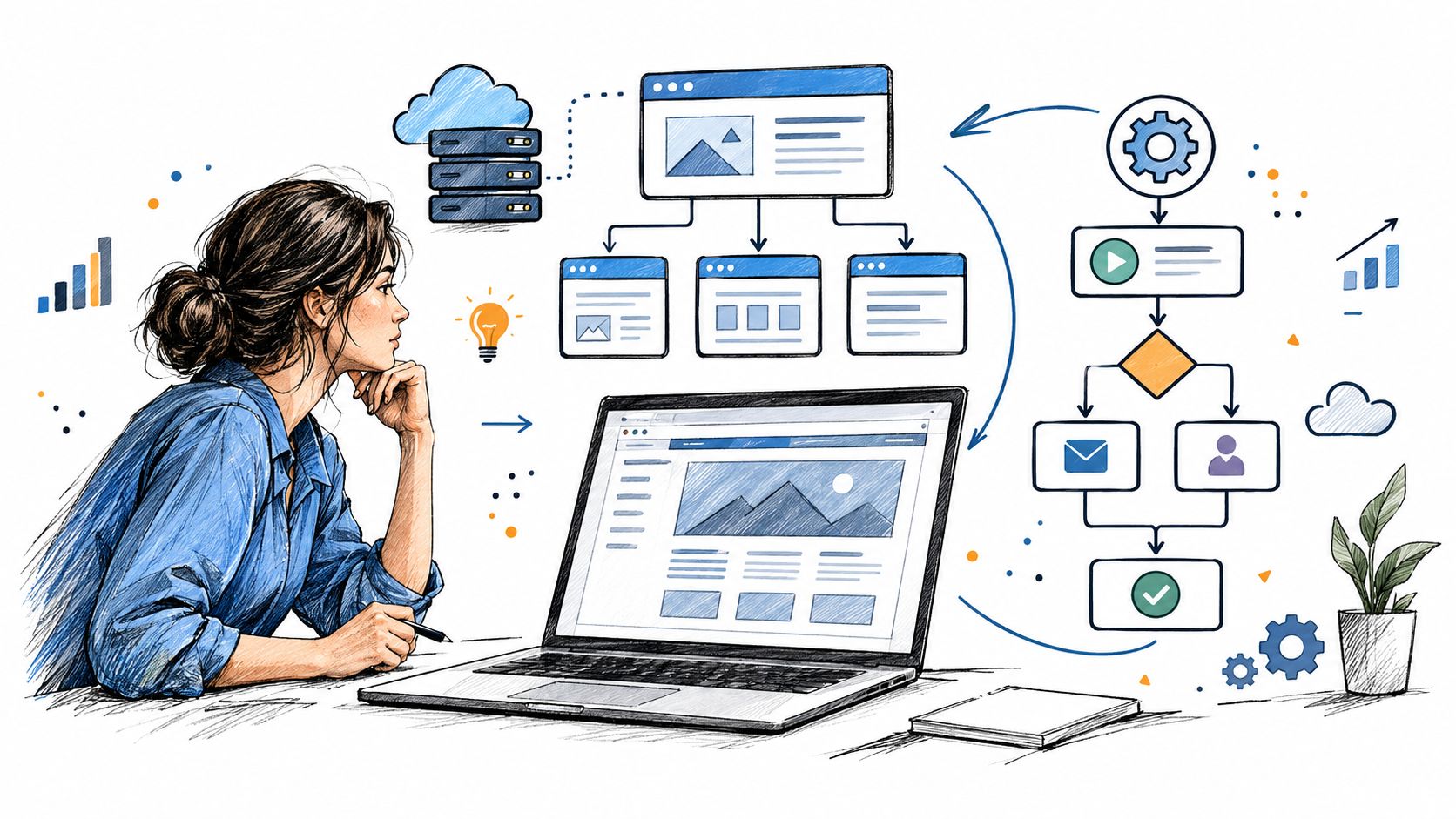
The website and automation layer should be designed as one system. SEO brings qualified people to the right page. Page structure clarifies suitability and value. The form captures useful intent. The CRM routes the record. The booking flow creates a measurable next step.
Give every page a job
A service page should help a qualified visitor decide whether to enquire or book. A comparison page should resolve uncertainty. A case-led page should show how your process addresses a commercial problem without forcing the reader through a generic lead magnet.
Use page-specific calls to action:
High-intent service pages: Offer a direct booking path and a short form for visitors who need to explain their situation.
Complex B2B pages: Use a multi-step form that asks the minimum useful questions across manageable stages.
Educational articles: Provide a relevant next action, such as a diagnostic conversation, related service page or practical resource.
Social landing pages: Match the message and offer from the post so visitors don't need to reinterpret the proposition.
Send clean context into the CRM
Capture the page, source, service interest, message, location where relevant and preferred next step. Avoid collecting fields that nobody uses. Every field adds friction and creates another opportunity for incomplete or inconsistent data.
Exit-intent prompts can help when they offer a useful alternative, such as a short checklist or a booking option. They shouldn't interrupt every visitor or disguise a weak page. Test the message and trigger against the actual commercial path, not only form submissions.
Design principle: The best automation starts with a clear decision for the visitor and a clear responsibility for the team.
A website redesign should therefore include workflow mapping, not just new layouts. Otherwise, the firm gets a more attractive front end connected to the same broken follow-up process.
Measuring Commercial KPIs Beyond Email Open Rates
Open rates and click-through rates can help diagnose message delivery and engagement, but they aren't the commercial result. A campaign can receive attention without producing a conversation, and a small number of high-intent enquiries can matter more than a large low-intent list.
The dashboard should follow the path from source to revenue opportunity. Start with speed-to-lead compliance, then measure whether the visitor reached a meaningful action and whether sales progressed the opportunity.
Track the operational controls
For each intent tier, report:
Response-time compliance: The proportion of enquiries contacted within the agreed tier benchmark.
90th-percentile response time: The slow-tail performance that exposes neglected records.
Unassigned lead volume: Enquiries that entered the system without a clear owner.
Alert acceptance: Whether the assigned person acknowledged or progressed the lead.
CRM data quality: Records with missing source, service or intent information.
The benchmark problem is substantial. A Harvard Business Review audit of 2,241 companies found an average web-enquiry response time of 42 hours, while 23% never responded. Those figures are reported in Australian speed-to-lead guidance, and they show why response control deserves a place on the executive dashboard.
Measure the commercial path
The useful conversion chain is:
Qualified visit → enquiry → booked call → attended call → qualified opportunity → pipeline progression
Track conversion between each stage. A high enquiry rate with few booked calls points to booking friction, weak follow-up or poor qualification. A healthy booking rate with weak opportunity quality points to targeting, page messaging or scoring problems.
Also monitor source-level performance. Search, social, referrals and AI-assisted discovery may produce different intent patterns, so judge them by qualified conversations rather than traffic volume alone. For cost reporting, use cost per booked call and, where data permits, cost per qualified opportunity instead of treating every lead as equal.
The Australian benchmark commonly used by sales teams classifies response within 5 minutes as best-in-class, 15 minutes as strong and 60 minutes as the competitive minimum. Delays beyond 2 hours during business hours put a lead at high risk of loss, according to Australian speed-to-lead guidance.
Reporting test: If your monthly report can't show how many qualified calls the system created, it's measuring marketing activity rather than commercial contribution.
Auditing and Upgrading Your Current Lead Pipeline
Start with a live enquiry, not a software audit. Submit every important form yourself, request a booking and test the paths from an organic service page, a social post and an AI-visible article. Record what happens from submission to human contact.
You're looking for the gaps that software brochures rarely reveal. The system may technically integrate while the lead still arrives without an owner, the booking link may work while calendar availability is wrong, or the acknowledgement may send while nobody follows up.
Use a practical pipeline audit
Check these controls in order:
Source capture: Does the CRM store the page, campaign or channel that produced the enquiry?
Intent classification: Can the system distinguish pricing, booking, consultation and general information requests?
Ownership: Does every qualified enquiry receive a named person or accountable team?
Alert delivery: Does the alert reach a monitored channel, and does the system escalate missed responses?
Booking path: Can a prospect schedule a suitable conversation without unnecessary back-and-forth?
Human context: Does the assigned person see the message, source and relevant page before responding?
Nurture logic: Do non-ready contacts receive useful follow-up without being treated like active opportunities?
Measurement: Can you connect response time, booking, attendance and pipeline stage in one report?
Fix the highest-value break first
Don't begin by rebuilding every email. Fix the slowest high-intent handoff, then remove the biggest form or booking obstacle. After that, clean duplicate records, test notifications and define who owns exceptions.
Australian B2B automation has moved beyond basic adoption. Green Hat ADMA research reported adoption rising from 57% to 66% in 2019, while 46% of respondents said account-based marketing was delivering ROI, according to the Australian B2B Marketing Research Report. The lesson isn't to add more tools. It's to connect the tools you already use to a disciplined commercial process.
The firms that benefit from marketing automation for B2B don't outsource judgement to software. They define intent, ownership, response standards and next actions, then use automation to make those decisions repeatable. That is how a website becomes a pipeline asset rather than a digital brochure.
Raffine Studio designs conversion-focused websites, SEO and AI search visibility systems that connect qualified traffic with booking, CRM handoff and measurable follow-up. Visit Raffine Studio to review your website-to-booking workflow and identify the lead-routing problems costing your business real conversations.