sales funnel vs pipeline, sales pipeline, buyers agents, lead generation, conversion optimisation
Sales Funnel vs Pipeline: What Buyers Agents Need to Know
by raffiné studio

A Sydney buyers agency can have a healthy flow of website enquiries and still finish the week with an empty calendar. The marketing dashboard says leads are arriving. The principal knows the phone is ringing. Yet follow-up is inconsistent, qualification happens in someone's inbox, and the few promising prospects never become signed engagements.
That's why the sales funnel vs pipeline question matters. A funnel shows how potential buyers move from awareness to enquiry. A pipeline shows what your team must do with known opportunities to move them towards an engagement, property search, settlement and referral. They're connected, but they aren't interchangeable.
Australian buyers and B2B decision-makers also do much of their research before speaking with a vendor. One Australian source places that pre-contact journey at 73%, which means your website has to educate and pre-qualify visitors before a principal or broker ever joins the conversation. The Australian B2B buyer journey data makes the operational point clear: lead generation alone isn't enough.
Why Buyers Agents and Brokers Confuse Funnel With Pipeline
The confusion usually appears after a familiar pattern. Paid search or organic content produces a reassuring stream of enquiries, and the Monday dashboard looks healthy. By Tuesday, only a couple of discovery calls are booked, some prospects haven't replied, and the calendar contains more gaps than the lead report suggests.
A principal starts asking whether the business needs a better sales funnel or sales pipeline. The answer is usually both, but for different reasons. The funnel measures how strangers become aware of the firm, consider its advice and raise their hand. The pipeline measures what happens after that hand is raised, including qualification, proposals, signed engagements and active client work.
Salesforce Australia describes the funnel as the buyer's journey and the pipeline as the seller's sales process. That distinction from Salesforce Australia is more useful than treating the terms as interchangeable labels.
Two systems with different jobs
A funnel answers questions such as:
Demand creation: Are the right people finding the business through Google, referrals, social content or advertising?
Message fit: Do buyers understand the suburbs, property types and client situations the firm handles?
Conversion: Are visitors taking the next step, such as downloading a guide, submitting an enquiry or booking a call?
A pipeline answers different questions:
Opportunity status: Which enquiries have been qualified?
Next action: Who needs a call, proposal, reminder or decision?
Revenue visibility: Which opportunities are likely to become signed work?
Practical rule: If you're measuring website visitors to judge sales performance, you're probably looking at the wrong system.
Where the commercial damage starts
A firm that optimises only the funnel may celebrate traffic while sales staff chase poor-fit enquiries. A firm that only manages the pipeline may keep working existing opportunities while its future lead supply dries up.
For buyers agencies, the handoff is especially valuable because the final commercial outcome is often separated from the first enquiry by a substantial amount of education and trust-building. Your real estate website design approach should therefore make the next action obvious, capture enough information to qualify intent and pass the enquiry into a process someone owns.
The terminology matters because the KPI follows it. Marketing needs to improve qualified demand. Sales needs to progress real opportunities. Confuse those responsibilities and a business can spend more on traffic without improving booked calls, or spend more time updating CRM stages without creating enough new demand.
What a Sales Funnel Actually Is in an Australian Service Business
A sales funnel is the demand-side view of the buyer journey. It starts with people who may not know your firm and narrows towards people who understand the service, see a fit and make contact.
For a buyers agency, the funnel might begin with suburb-level search behaviour and end with an enquiry or discovery-call booking. It's audience-shaped rather than deal-shaped. Marketing usually owns it, although the principal's sales feedback should influence the content and qualification logic.
Four practical funnel stages
Stage | Buyer question | Primary channels |
|---|---|---|
Awareness | Who can help me understand this market or buying problem? | Suburb SEO, vendor advocacy content, local press |
Interest | Can this firm help someone in my position? | Suburb reports, buyer guides, educational articles |
Consideration | What does the service involve, and is the fit credible? | Suburb comparisons, service pages, fee transparency |
Intent | What should I do if I want expert help? | Enquiry forms, phone calls, discovery-call booking |
Awareness content earns attention from a prospective buyer researching a location or problem. Interest content helps them understand the options. Consideration content addresses risk, fees, experience and process. Intent content removes friction from contacting the business.
The funnel doesn't need to pretend every visitor is a deal. That's one of its strengths. It captures early behaviour before a person has shared enough information to become an opportunity.
What funnel reporting should tell you
Useful funnel measures include cost per enquiry, cost per qualified lead and the proportion of visitors who become enquiries. These metrics help marketing decide whether a page, campaign or content asset is attracting the right audience and giving them a credible next step.
They don't tell you whether the business will hit its revenue target. A booked appointment can still be a poor opportunity, and a strong enquiry can be lost through slow follow-up. The funnel ends at the point where demand is captured and ready for a defined handoff.
For businesses building or rebuilding that journey, funnel building for service businesses should include the page structure, forms, booking path and follow-up logic, not just a landing page with a button.
What a Sales Pipeline Actually Tracks Day to Day
A sales pipeline is the seller-facing system for managing known opportunities. Each prospect has a record, a current stage, an owner and a next action. The purpose isn't to describe how a buyer feels. It's to make clear what the business needs to do next.
MYOB Australia presents the pipeline as a systematic way to track where prospects are and what the sales team needs to do. MYOB's explanation of pipeline management fits the practical reality of a buyers agency or broker. A pipeline is a working list of opportunities, not a decorative CRM report.
Stages should trigger action
A useful pipeline for a buyers agency or broker might look like this:
Pipeline stage | Action triggered | Key metric |
|---|---|---|
New enquiry logged | Review source and intake details | Time to first response |
Discovery call booked | Confirm appointment and context | Booking-to-held rate |
Discovery call held | Assess fit and define next step | Discovery-to-proposal rate |
Proposal sent | Follow up against a clear decision date | Proposal-to-signed rate |
Engagement signed | Start onboarding and collect required information | Signed-to-active rate |
Property shortlisting | Deliver agreed search and selection work | Days in stage |
Offer accepted | Coordinate next client and transaction steps | Stage progression |
Settlement | Complete service and record outcome | Signed-to-settled rate |
Referral ask | Request an introduction at an appropriate moment | Referral activity |
The exact labels can differ, but every stage should answer two questions. What event moved the opportunity here, and what action moves it forward?
The pipeline is where forecasting becomes possible
A principal can't forecast from a list of raw enquiries. They need to know which opportunities have been qualified, which have received a proposal, which are waiting on a decision and which have stalled.
Pipeline reporting therefore focuses on stage movement, conversion between stages, days in stage, opportunity value and win rate. A CRM such as HubSpot, Pipedrive or Salesforce can support this, but the software won't repair vague stages or missing ownership. If the next action is blank, the record is not being managed.
The strongest pipeline reviews are short and specific. Remove dead opportunities, assign overdue follow-ups, identify stalled proposals and check whether the next period has enough qualified work. That discipline gives a buyers agency a clearer view of future capacity than a top-line enquiry count ever can.
Funnel vs Pipeline Side by Side on Real Criteria
For an Australian buyers agency, the handoff is the operational test. The funnel must turn website attention into a suitable enquiry, then qualification and booking must create a pipeline record someone owns. If those steps do not connect, the business can report activity without creating a manageable opportunity.
Criteria | Sales funnel | Sales pipeline |
|---|---|---|
Purpose | Generate and measure demand | Progress and forecast known opportunities |
Audience | Anonymous visitors, subscribers and leads | Qualified prospects and active opportunities |
Stage definitions | Buyer awareness, interest, consideration and intent | Seller actions such as qualification, meeting, proposal and close |
Day-to-day owner | Marketing, with sales feedback | Sales, principal or appointed opportunity owner |
Primary KPIs | Traffic quality, enquiry rate, cost per enquiry and qualified lead volume | Stage conversion, velocity, opportunity value, win rate and next action |
Main commercial question | Are we attracting and capturing enough suitable demand? | Will current opportunities become signed work, and when? |
The funnel reports patterns across groups. It can show that a service page attracts visits but produces few enquiries. The pipeline records the individual response, such as a prospect who attended a call, received a proposal and is waiting for a decision.
Why the two models forecast differently
Funnel benchmarks show how quickly demand narrows before sales has a live opportunity. An Australian benchmark places website visitors becoming marketing-qualified leads at roughly 5–10%, with later movement from MQL to SAL, SAL to SQL, SQL to opportunity and opportunity to customer narrowing at each stage. The Australian lead-generation benchmark makes the operational point clear: traffic cannot be counted as pipeline until a person meets the business's qualification standard.
For Sydney buyers agencies and brokers, that standard should be explicit. A completed form may still lack budget, timing, service fit or a workable booking path. Those missing details belong in the handoff, not in a vague “lead” total.
A separate benchmark places average lead-to-customer conversion across industries at 2.5–5%, meaning 1,000 leads may produce roughly 25 to 50 customers on average. The lead-to-customer conversion guidance supports separating demand metrics from revenue-bearing pipeline metrics.
The funnel answers whether enough suitable people enter the system. The pipeline shows whether the business qualifies, follows up and progresses them. Review both together, especially the point where a website enquiry should become an owned opportunity.
Benchmarks AU Buyers Agents Should Plan Around
Benchmarks earn their place when they change a planning decision. For an Australian service business, the useful calculation runs backwards from signed engagements, not forwards from website traffic.
Set the required customer outcome first. Then estimate the opportunities needed to reach it, using your own opportunity-to-close history where available. From there, calculate the qualified calls and enquiries the website must supply. This approach separates demand generation from pipeline capacity and exposes weak handoffs between the two.
A practical planning sequence is:
Start with target customers: Set the number of signed engagements the business needs.
Estimate opportunity requirements: Apply your recorded close rate to work out how many genuine opportunities are required.
Check pipeline coverage: Keep enough qualified opportunity value open to absorb normal losses and delays.
Work backwards to demand: Calculate the qualified calls and enquiries needed to create those opportunities.
Review the assumptions: Replace broad benchmarks with your own source, service and suburb data as it accumulates.
The earlier conversion guidance provides context for the top of the funnel, but it should not become the forecast itself. Your CRM should show whether enquiries become qualified opportunities, whether those opportunities receive a next action and whether proposals progress.
One AU-relevant planning benchmark recommends 3–4x quota coverage in open pipeline value. The pipeline coverage benchmark frames pipeline as a capacity and forecasting tool, rather than a count of names.

Scenario one for a buyers agency
A buyers agency may attract visitors through suburb content, buying guides and search pages. The funnel shows whether those visitors submit enquiries and whether the enquiries contain enough information to qualify.
Once a suitable person books a discovery call, the pipeline records the buyer's location, budget position, timing and motivation. The principal then moves the opportunity through agreed stages, with a next action attached to each stage. A proposal left untouched is a pipeline action problem, not a marketing problem.
Scenario two for a finance broker
A broker's website may attract homeowners or investors researching finance options. Its content should answer basic questions while collecting information about urgency, loan purpose and readiness for a conversation.
The pipeline tracks the conversation, required documents, assessment, proposal and client decision. If enquiries come from people outside the broker's service scope, review targeting and messaging. If suitable prospects submit details but receive no clear next step, fix the handoff.
Use benchmarks to set initial assumptions, then let CRM records decide where to invest. High enquiry volume with weak opportunity creation indicates a disconnected system.
How the Funnel Hands Off to the Pipeline in Practice
The handoff starts before a prospect becomes a CRM opportunity. A visitor needs to find a relevant page, understand the service, decide that the firm is credible and provide enough information for the business to respond intelligently.
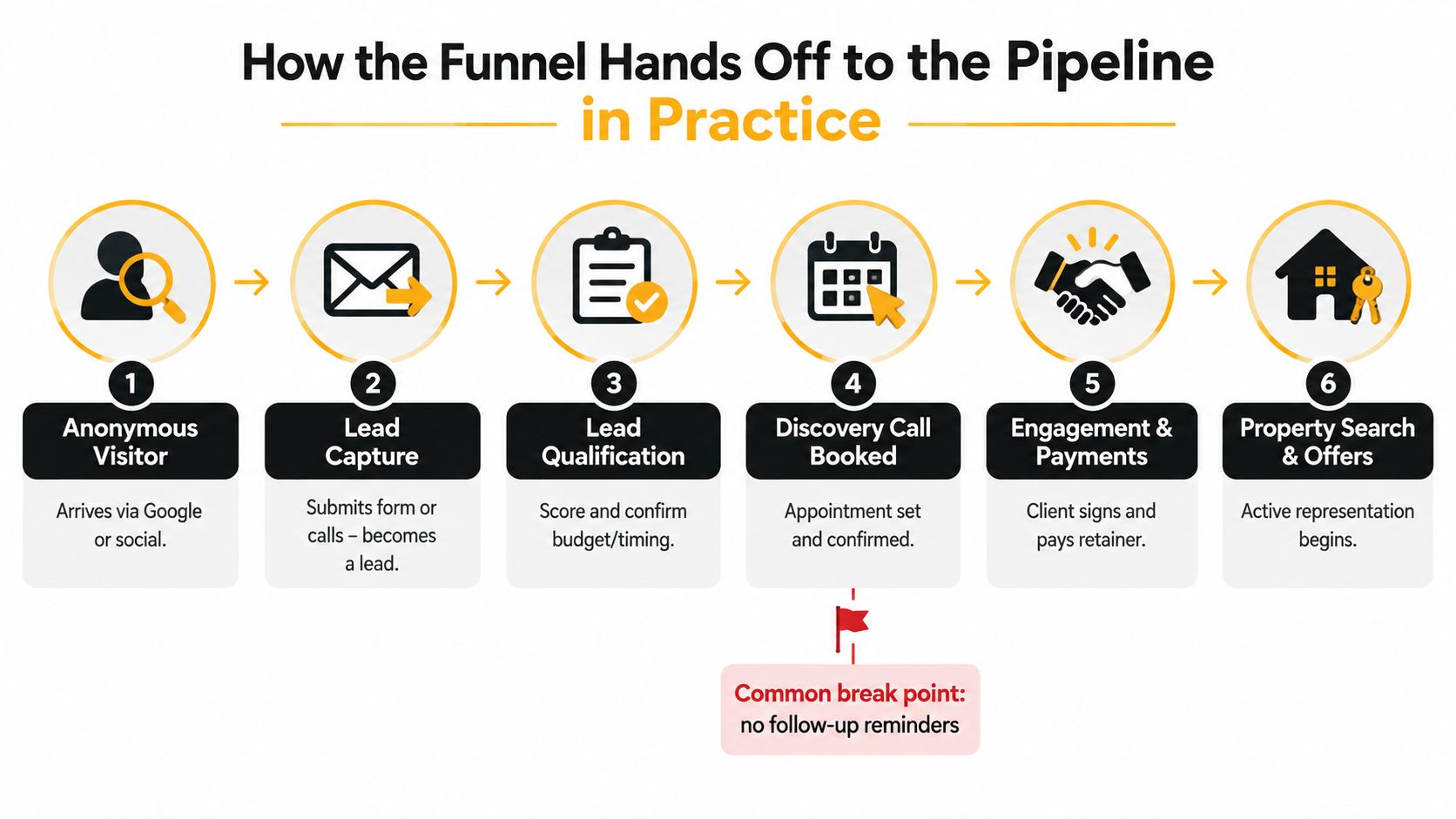
The six transitions that need an owner
Anonymous visitor to lead. The page should match the visitor's intent. A buyer researching a specific Sydney suburb needs a different next step from an investor looking for broad market advice. The form or phone path must be visible without forcing every visitor through the same generic enquiry.
Lead to qualified lead. Intake fields should collect information that changes the response. For a buyers agency, that might include target suburb, property type, purchase timing, budget position and the reason the buyer wants representation. For a finance broker, relevant fields may include loan purpose, finance stage, property status and timing.
Qualified lead to booked call. The prospect needs a direct booking route, not an instruction to wait for someone to call. Calendar availability, confirmation messages and reminders belong to the conversion system because an unbooked lead hasn't entered the active pipeline.
Booked call to held call. A confirmation email should restate the appointment, explain what to prepare and make rescheduling easy. The CRM should create a task for the owner rather than rely on memory.
Held call to proposal or disqualification. A pipeline becomes useful when the business records a decision. Suitable prospects should receive a defined next step. Poor-fit prospects should be marked clearly, with a reason that can later improve targeting.
Signed engagement to delivery. Once the client signs, the opportunity should trigger onboarding, payment handling and the first delivery action. That prevents sales records from becoming disconnected from the service team.
Where automation earns its place
Automation should remove administrative delay, not replace judgement. Immediate acknowledgements, calendar confirmations, task creation and follow-up reminders are sensible uses. A principal should still make the qualification decision where the service is high-value or the circumstances are complex.
A connected automated system for lead handling can link website forms, calendar tools, CRM records and follow-up sequences. Raffine Studio is one option for businesses that need those website, booking and CRM handoffs designed as one journey.
A Sydney buyers agency might route a buyer with a defined suburb, confirmed finance position and near-term search window to a discovery call. A finance broker may prioritise a person with a clear loan purpose and an immediate property decision. The details vary, but the principle doesn't. Qualification should determine the next action, and the CRM should preserve the context.
Diagnosing Where Your Bookings Are Breaking and Fixing It
When enquiries arrive but bookings remain weak, resist a full redesign. Trace the handoff in order: traffic source, landing page, qualification, response and booking attendance. Each checkpoint should show where intent is being lost and who owns the next action.
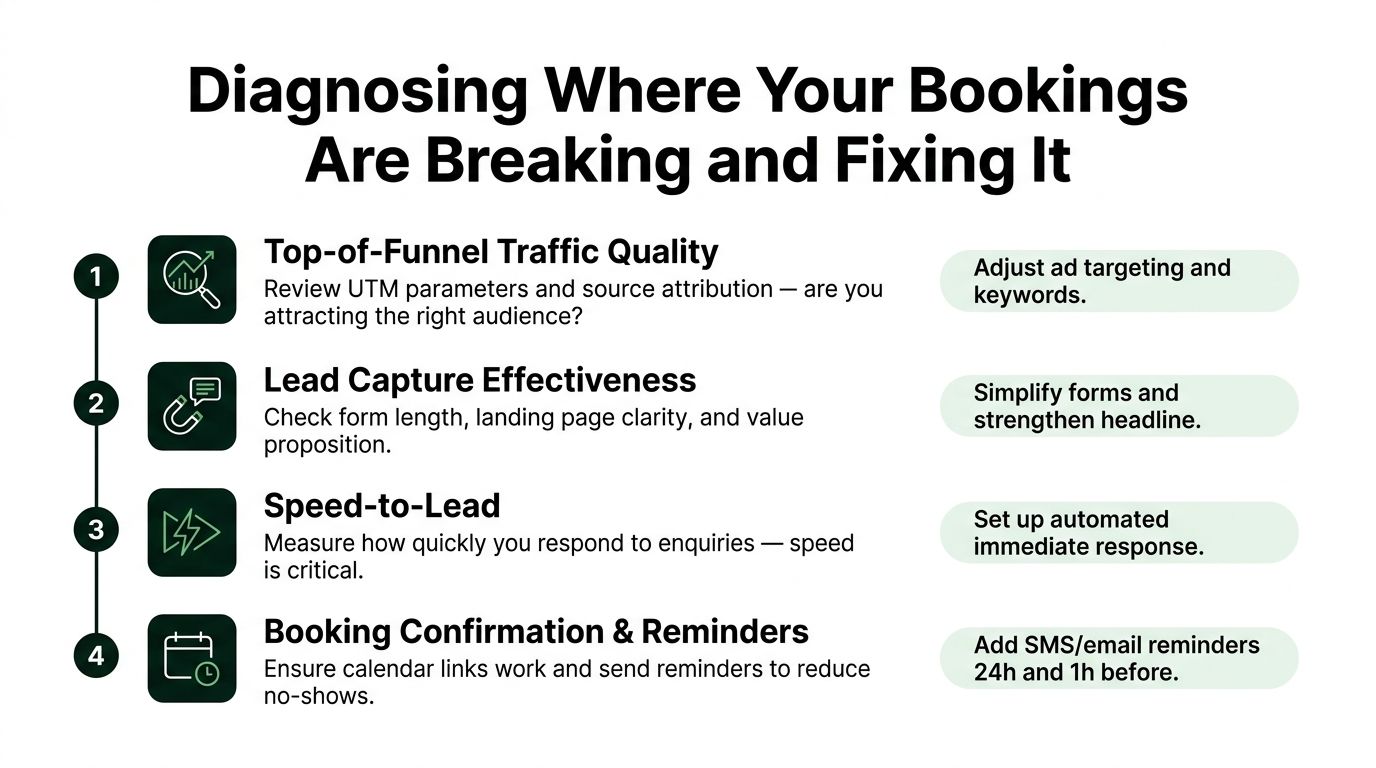
Checkpoint one is traffic quality
Symptom: Enquiry volume looks healthy, but the principal receives few suitable prospects.
Test: Review UTM parameters, source attribution, search terms and submitted information. Separate suburb research, general curiosity and genuine buying intent. If poor-fit enquiries cluster around one campaign or page, correct targeting and message alignment before changing the CRM.
Checkpoint two is landing-page conversion
Symptom: Relevant visitors reach a service page but rarely enquire or book.
Test: Confirm that the page explains who the service suits, what happens next and what information the visitor should provide. Remove competing calls to action, reduce unnecessary form friction and place the booking option near the decision point.
As noted in the funnel versus pipeline comparison, use the 5–10% MQL range as a planning reference, not a promise. Traffic still needs a clear service offer, a credible next step and a booking path that matches the visitor's intent.
Checkpoint three is qualification quality
Symptom: Enquiries arrive, but the team cannot decide who should receive a call first.
Test: Add only fields that affect routing or preparation. For a buyers agency, suburb, purchase timing, property type and finance readiness may matter. For a broker, loan purpose, purchase stage and urgency may be more useful than a long personal questionnaire. Every field should change the next action or help the adviser prepare.
Checkpoint four is response latency
Symptom: Good prospects enquire, then disappear before a conversation is booked.
Test: Compare enquiry time with the first human response, automated acknowledgement, booking invitation and reminder activity. Assign an owner to every lead. Use a same-day response standard, with an internal target of under two hours if the team can support it reliably.
Three fixes to ship this quarter
Tighten the intake form: Keep information needed to qualify and route, then remove fields that do not change the next action.
Set a response service level: Give every enquiry an owner, immediate confirmation and a defined human follow-up process.
Review pipeline coverage weekly: Compare qualified opportunity value with the business target. Use the AU planning benchmark of 3–4x quota coverage as a reference, without treating it as a guarantee.
No-show problems usually need a booking fix, not more traffic. Add clear confirmations, calendar invitations and reminders, then measure booked calls separately from held calls. A funnel can create the opportunity, but a managed pipeline must turn that opportunity into a commercial conversation.
Raffine Studio designs conversion-focused websites, funnel architecture and automated CRM handoffs for Australian buyers agencies, brokers and professional services firms. If enquiries are not becoming qualified booked calls, visit Raffine Studio to review the path from search and website traffic through to follow-up and pipeline.