sales funnel automation, lead funnel, CRM automation, funnel system, booking automation
Sales Funnel Automation for Australian Service Businesses
by raffiné studio

A new enquiry arrives while the founder is in a meeting. It sits in a shared inbox until someone notices it, then the team discovers the form never created a CRM record. By the time a follow-up email goes out, the prospect has already spoken with another broker, buyers agent or professional services firm.
That isn't a traffic problem. It's a handoff problem.
Sales funnel automation fixes the points where an interested visitor becomes an uncontacted lead, an unassigned CRM record or a missed booking. For Australian service businesses, the practical system usually connects website capture, CRM routing, calendar booking and behaviour-based follow-up. It doesn't replace judgement or good sales conversations. It makes sure those conversations have a better chance of happening.
The strongest systems are rarely the ones with the most features. They're the ones where every enquiry has a clear next step, an accountable owner and a measurable outcome.
Where Leads Quietly Disappear in Your Funnel
A Monday meeting is a common failure point. The enquiry arrives through the website, Facebook or a campaign landing page while the team is discussing active clients. Nobody sees it immediately. The inbox has no routing logic, the sender receives no useful confirmation, and the business loses the opportunity to respond while intent is high.
A different lead completes a form, but the submission only goes to an email address. The CRM never receives the contact, so there's no source data, service interest, qualification response or follow-up task. When the prospect calls later, the team has to reconstruct the interaction from scattered messages.
The third leak happens after contact. Someone sends a polite email twelve hours later, perhaps with a generic booking link. The message doesn't reflect the service the prospect asked about, and there's no reminder if they don't book. The business may believe it has followed up, but the prospect experiences delay and uncertainty.
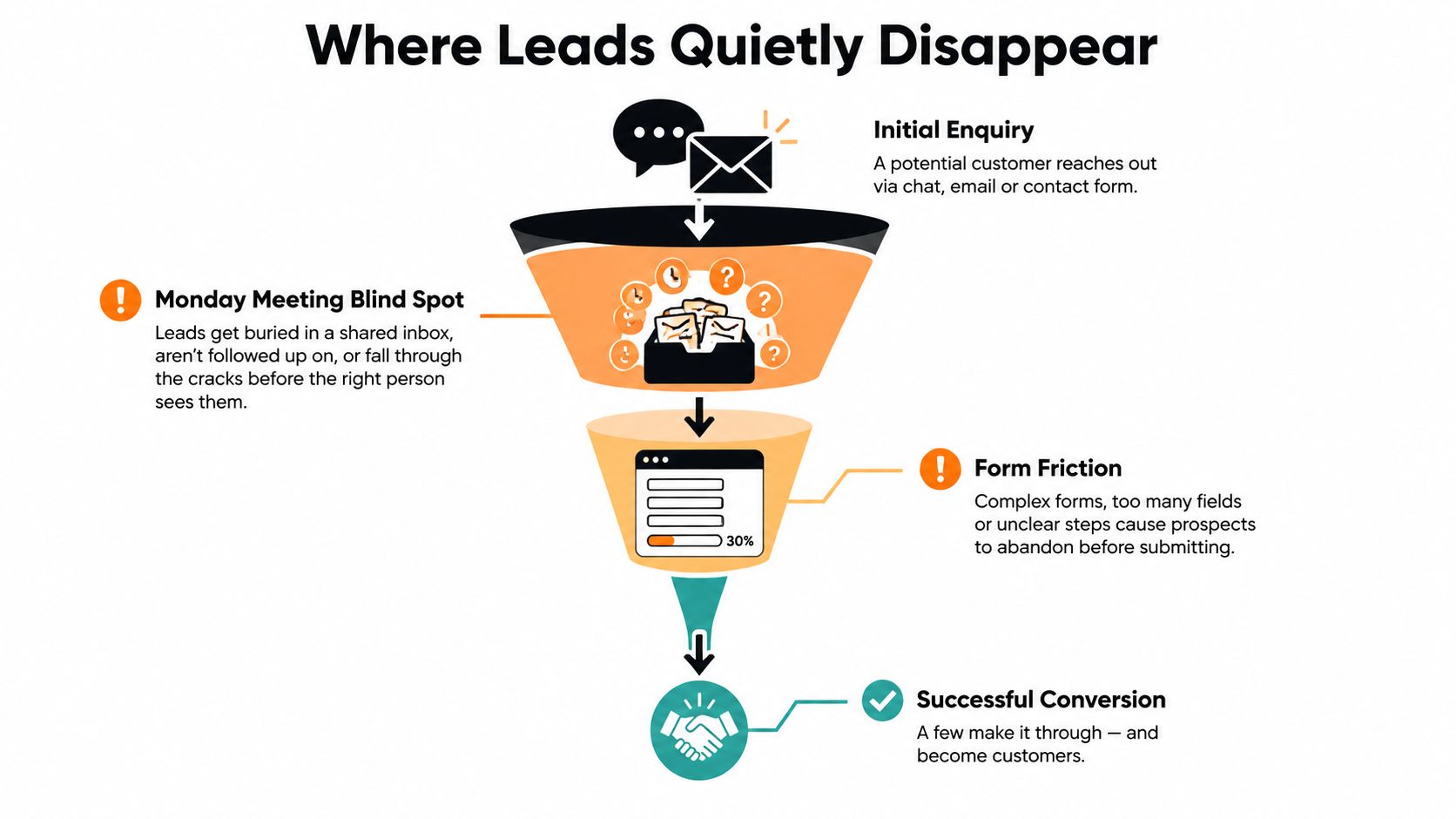
The three handoffs that need ownership
Enquiry to acknowledgement: The website should confirm receipt and explain what happens next.
Form to CRM: The lead record should be created or updated with the information the team needs.
CRM to conversation: The right person should receive the lead, booking option and follow-up task without manual triage.
Australian buyers have been moving away from spreadsheets and paper-based customer management towards integrated systems. In the Australian market sample described by Prime Leads' speed-to-lead discussion, over half of CRM buyers were still using manual methods, while 88% requested sales force automation, 34% asked for an integrated sales and marketing suite, and nearly three quarters preferred cloud-hosted solutions. The significance isn't just historical adoption. It shows that businesses wanted connected pipeline management, not another contact database.
Practical rule: Automate the handoff before automating the message. A beautifully written sequence can't recover a lead that never reaches the person responsible for it.
Sales funnel automation is useful because it addresses these operational gaps directly. The rest of the system should be designed around the same principle: capture the enquiry, route it correctly, make booking easy and follow up according to what the lead did. Raffine's explanation of what funnel building involves provides useful context for connecting those parts into one conversion path.
What Sales Funnel Automation Actually Means
Sales funnel automation is the set of rules that moves an enquiry from first interaction to the next commercially useful action without requiring someone to perform every handoff manually.
Consider a Sydney mortgage broker offering a discovery call. A prospective borrower arrives from a search result or a social post and lands on a focused service page. They complete a form that asks about the type of finance they need, their location and their preferred contact method.
A practical lead journey
Capture: The website form records the enquiry. The submission event triggers the workflow.
CRM entry: A connector sends the details to the CRM. The system creates a contact, adds the source and applies a service tag.
Qualification: The answers determine whether the lead is suitable for an immediate call, a different service pathway or a human review.
Booking: The CRM or workflow sends a relevant calendar link. The available times come from the correct broker calendar rather than a general team inbox.
Confirmation: Once the prospect books, the workflow updates the CRM stage and sends confirmation details.
Reminder: The system sends the agreed email or SMS reminders and gives the broker the information collected through the form.
Reporting: The booking and source remain attached to the record, allowing the team to compare enquiries with qualified conversations.
The tools can vary. A WordPress or Webflow form may handle capture, HubSpot, ActiveCampaign or another CRM may hold the contact, Calendly or a native calendar tool may manage availability, and an email or SMS platform may handle reminders. The tool names matter less than the trigger between each stage.

An email blast isn't a complete automated funnel. Sending the same newsletter to every contact doesn't decide who should receive a booking link, who needs qualification or who should be assigned to a particular team member. Proper automation uses events and conditions, such as form submission, service selection, booking completion, no-show status or an unanswered call.
The Australian speed-to-lead benchmark makes this distinction operationally important. The sources cited by Yes AI's response time calculator state that responding within five minutes can make a lead about 21 times more likely to be qualified than responding after 30 minutes, while some summaries describe a gap of up to 100 times in qualification odds. The same source reports an average Australian small-business response time of around 42 hours. For a booked-call business, an immediate acknowledgement and booking path are basic infrastructure, not decorative extras.
The Automations That Move the Needle
Most businesses don't need a complex automation map at the beginning. They need to identify which manual action causes the most delay or creates the most uncertainty, then automate that handoff first.
Automation | Manual Step It Replaces | Typical Trigger | Common Failure If Missing |
|---|---|---|---|
Booking automation | Sending calendar links and checking availability | Qualified form submission or service selection | Leads exchange messages without booking |
CRM handoff | Copying form details into a contact or deal record | New website, ad or chat enquiry | The team loses source and qualification context |
Behaviour-based follow-up | Remembering who needs a call or email | No booking, page visit, reply or completed booking | Every lead receives the same mistimed message |
Lead routing | Deciding who owns each enquiry | Service, location, value or qualification answer | Leads sit unassigned or reach the wrong person |
Booking should reflect the service
A buyers agency may need separate calendars for initial strategy calls, vendor consultations and investor enquiries. A professional services firm might route by practice area or partner availability. Sending one generic calendar link is easy to install, but it often creates the wrong expectation and gives the prospect too much work.
The trigger should be meaningful. If the form identifies a commercial finance enquiry, the workflow should send the commercial finance booking path. If the prospect hasn't supplied enough information, the system should request clarification or create a review task instead of pretending every lead is ready for a call.
CRM handoff is the system of record
The CRM record should arrive with the details that make a human response useful. That can include the page or campaign that generated the enquiry, service interest, consent status, qualification answers and booking status. If the record is incomplete, the automation may technically work while the sales process remains slow.
Australian benchmark guidance from Leads Now's lead response research recommends moving high-intent web enquiries into first human contact within five minutes, with a best-in-class target under 60 seconds. It also warns that after 30 minutes, the odds of reaching the lead can fall by up to 100 times compared with a five-minute response. That points to event-triggered routing, not a form that sends another notification to a busy inbox.
Follow-up should respond to behaviour
A lead who submits a form but doesn't book needs a different message from someone who booked and then cancelled. A no-show needs a rescheduling path. A lead who replies with a specific question may need a human task rather than another automated email.
The system should stop or change a sequence when the person takes the next action. Otherwise, the prospect can receive a booking prompt after booking, a nurture email after requesting a proposal or a sales message after asking not to be contacted.
For further examples of the workflows that can be connected, see Raffine's automated system examples. The useful question isn't how many automations a platform offers. It's which manual delay disappears when the rule goes live.
How the Tools Connect Behind the Scenes
A funnel works as a chain. The website captures an enquiry, a connector transfers the data, the CRM creates or updates the record, routing rules determine ownership, the calendar presents the right availability, and messaging confirms the next step. Reporting then needs to preserve the source and outcome so the business can see which paths produce qualified conversations.
A break anywhere in that chain creates a misleading result. The form may show a successful submission while the CRM contains nothing. The CRM may contain the contact while the calendar link points to an unavailable staff member. The booking may happen while the source disappears, leaving the marketing team unable to distinguish useful traffic from noise.
Audit the order, not just the apps
Layer | Example Tools | What It Does |
|---|---|---|
Capture | WordPress, Webflow, Typeform, Meta Lead Ads | Collects the enquiry and consent |
CRM | HubSpot, Salesforce, ActiveCampaign | Stores the contact, activity and sales stage |
Connector | Zapier, Make, native integrations | Moves data and starts workflow actions |
Routing | CRM rules, automation workflows | Assigns service, owner and priority |
Calendar | Calendly, HubSpot Meetings, Microsoft Bookings | Presents suitable times and records bookings |
Messaging | Email platform, SMS provider | Sends acknowledgements, reminders and follow-up |
Reporting | CRM dashboards, GA4, Looker Studio | Connects source, action and pipeline outcome |
The CRM handoff deserves particular attention because it carries the context used by every later step. A booking workflow that lacks service tags can't route accurately. A follow-up workflow that can't read booking status can't stop itself. A reporting layer that doesn't receive campaign information can't show which marketing activity generated the conversation.
For businesses comparing platforms, the relevant question is whether the system supports the handoff required by the sales process. Raffine's guide to online booking systems is useful for assessing the booking layer, but the calendar should never be evaluated in isolation from the form, CRM and follow-up rules.
Reliability beats novelty
Native integrations are often preferable when they pass the required fields and preserve consent information. Connectors such as Zapier or Make can fill gaps, but each additional dependency introduces another place where credentials, field mappings or permissions can fail.
Test the full path with real scenarios. Submit every major form, use each service selection, book a call, cancel it, reschedule it and leave the lead unbooked. The system is ready only when the CRM, calendar, messaging and reporting layers all reflect those events correctly.
Common Mistakes That Break an Automated Funnel
DIY funnel builds often fail because the owner automates the visible action and ignores the hidden dependency. A form sends an email, so it looks finished. A calendar link appears on the thank-you page, so booking seems covered. Yet the team still has to search for the lead, decide who owns it and remember what to send next.
The quiet technical failures
Forms that stop at the inbox create an information gap. The person who receives the email may be away, may not know which service applies or may forget to create the CRM record. The fix is to make CRM creation part of the submission event, then alert the human owner after the record exists.
Calendar links attached to the wrong person create a trust problem. A prospect may book with someone who doesn't handle the service, or select a time that isn't suitable for the actual adviser. Route the calendar from service and team rules, not from whichever link was easiest to copy.
Follow-up before qualification makes automation feel careless. A buyer seeking urgent guidance shouldn't receive the same educational sequence as an unqualified contact. Use the available form answers to decide whether the next step is booking, clarification, referral or human review.
Over-built nurture flows create maintenance debt. Every branch needs an owner, a reason for existing and a test case. If nobody reviews the messages, outdated offers, former staff names and incorrect service descriptions remain active.
Australian operating details matter
A distributed team can introduce time-zone errors. A calendar may display availability in the wrong zone, or a reminder may arrive at an inconvenient hour for an interstate prospect. Set the account, calendar and reminder rules deliberately, then test from the locations your business serves.
Facebook lead forms deserve the same treatment as website forms. They can create a useful enquiry without sending the person to your site, which means the CRM and notification workflow must monitor that source separately. If nobody checks those submissions, the business can generate leads without creating a dependable response process.
Australian SME adoption makes ownership more important, not less. SmartCompany's reporting on SME investment says seven in ten SMEs are investing in marketing automation, AI or online communities. The differentiator is whether the business measures the workflow and maintains it, not whether it has purchased automation software.
Another Australian and New Zealand report found that 59% of organisations manage marketing automation in-house, 20% outsource it, and nearly half identify data integration as the biggest implementation barrier, as reported by Econsultancy's marketing automation coverage. That is a useful warning for founders. Someone must own field mappings, testing, consent, copy updates and failure alerts.
Reliability trade-off: A smaller workflow that runs correctly is more valuable than a sophisticated sequence nobody can explain or maintain.
What This Looks Like in Different Service Businesses
The same funnel pattern changes according to lead value, urgency and sales-cycle length. A buyers agency, mortgage broker and accounting firm may all want booked calls, but they shouldn't use identical questions, routing rules or follow-up timing.
Buyers agencies
Buyers agencies usually need fast classification. The form may ask about suburb, property type, purchase intent and whether the prospect wants an initial strategy conversation. Those answers can route the enquiry to the right team member and present a relevant booking path.
The priority is reducing delay between a motivated prospect and a useful conversation. The workflow should acknowledge the enquiry, preserve the property criteria in the CRM and notify the assigned person. A generic newsletter sequence is less valuable than accurate routing and a clear same-day call option.
Brokers and advisers
Brokers often need sharper qualification because the service depends on circumstances that shouldn't be handled through blanket messaging. The form can separate residential, commercial, refinancing or investment enquiries, then apply CRM tags and task ownership.
Speed still matters. Yes AI's benchmark source describes the high-conversion window as operationally significant for Australian businesses, particularly those relying on booked calls. The adviser needs enough context to make the first conversation relevant, while the automation should avoid giving regulated or situation-specific advice before a qualified human review.
Professional services firms
Law, accounting and consulting firms often work with longer consideration cycles. A prospect may request an initial conversation, review a capability page, compare providers and return later. The funnel therefore needs more than an immediate booking prompt.
The useful automation may include service-specific education, proposal reminders, stalled-deal tasks and reactivation rules. It should still acknowledge the original enquiry quickly, but the follow-up needs to respect the decision process and the firm's professional obligations.
The engineering effort shifts by business:
Urgency-led businesses: Prioritise routing, alerts and booking availability.
Qualification-led businesses: Prioritise form design, consent and CRM segmentation.
Longer-cycle businesses: Prioritise relevant nurture, proposal follow-up and pipeline visibility.
NAB's SME Business Insights report found that 51% of Australian SMEs use AI in marketing and sales, while 35% identify automation as the strongest AI opportunity and 31% select marketing and sales optimisation, according to NAB's SME AI adoption report. The commercial lesson is straightforward. Australian businesses are already applying automation close to lead capture and conversion, so execution quality matters more than adding another disconnected tool.
Your Sales Funnel Automation Checklist and Next Step
Run this audit against the live funnel, not a diagram in a project document. Test each action as a prospect would experience it and confirm that the human team receives the right context.
Capture
Test every enquiry form: Confirm each submission creates a usable event.
Check mobile completion: Remove unnecessary fields and friction.
Record consent and source: Preserve the information needed for follow-up and reporting.
Booking
Confirm the booking automatically: Send the correct calendar details after the relevant trigger.
Route by service: Direct each enquiry to the right calendar or team member.
Test cancellations and reschedules: Update the CRM when the appointment changes.
CRM routing
Create the lead record: Make sure the contact lands in the CRM with service interest attached.
Assign an owner: Give each suitable enquiry a named person or defined review queue.
Tag the source: Keep campaign, landing page or referral information connected to the record.
Follow-up
Send an immediate acknowledgement: Explain what happens next without pretending a human has replied.
Create a no-booking path: Follow up when a suitable lead submits but doesn't schedule.
Pause after conversion: Stop promotional messages once the person books or enters a sales process.
Measurement
Track first human response: Work towards contact within five minutes, based on the Australian operating benchmark described by Leads Now.
Review median and p90 response time: Separate typical performance from delayed cases.
Compare source-level contact and qualified rates: Find channels that generate conversations rather than just form fills.
Review the workflow weekly: Look for failed tasks, unassigned leads and broken field mappings.
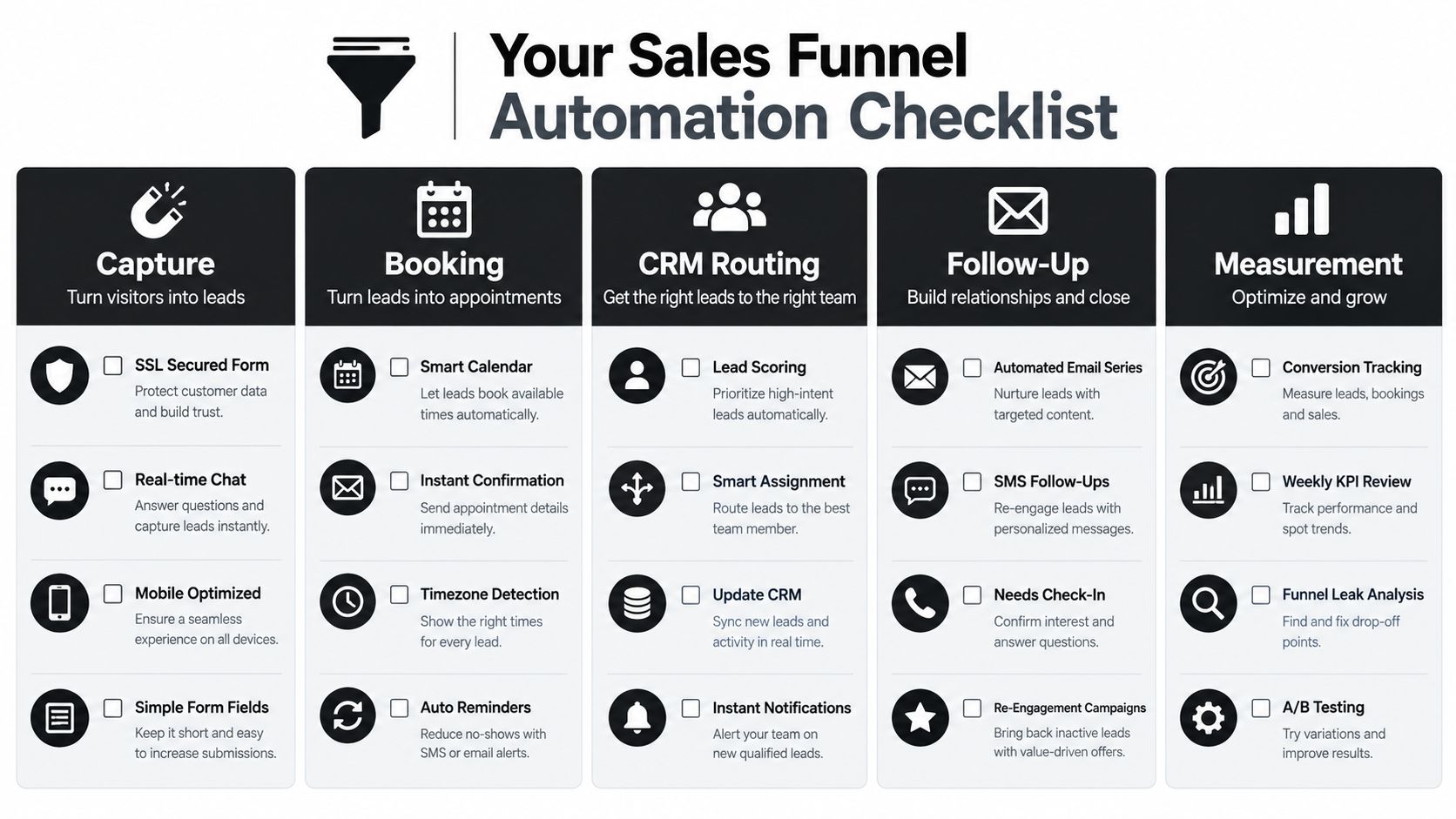
A practical next step is a funnel audit that follows one enquiry from the first form event through CRM creation, routing, booking and follow-up. Raffine Studio can map where enquiries stall, redesign the conversion path and connect the booking, CRM and follow-up layers so the website supports a measurable pipeline instead of another unattended inbox.
Raffine Studio helps Australian buyers agencies, brokers and professional services firms connect conversion-focused websites with booking automation, CRM handoff, SEO and AI search visibility. Visit Raffine Studio to review your current funnel and start a conversation about fixing the handoffs that turn enquiries into qualified calls.