sales funnel landing page template, landing page templates, conversion funnels, lead generation, service business marketing
10 Sales Funnel Landing Page Template Resources
by raffiné studio

A strong sales funnel landing page template matches visitor intent and the business's ability to follow up, rather than just looking polished. Australian benchmarks report a 4.8% average landing-page conversion rate in 2026, compared with a 2.3% average website conversion rate for service businesses, so the right page can create a meaningful commercial advantage.
The popular advice is to choose a clean template, add a compelling headline and publish. That's incomplete. A landing page only performs when its promise matches the traffic source, its proof answers the buyer's concerns, its form asks for the right level of information, and the next step leads reliably to a booked call, CRM record or useful nurture sequence.
This comparison evaluates ten resources by the business problem each one solves. The focus is practical: brand control, paid-traffic testing, multi-step qualification, CRM handoff, nurture, scalability and suitability for Australian professional services. A mortgage broker may need a qualification path rather than a short newsletter form. A buyers agency may need suburb-specific messaging and a direct booking journey. A law firm may need stronger trust signals before asking for sensitive information.
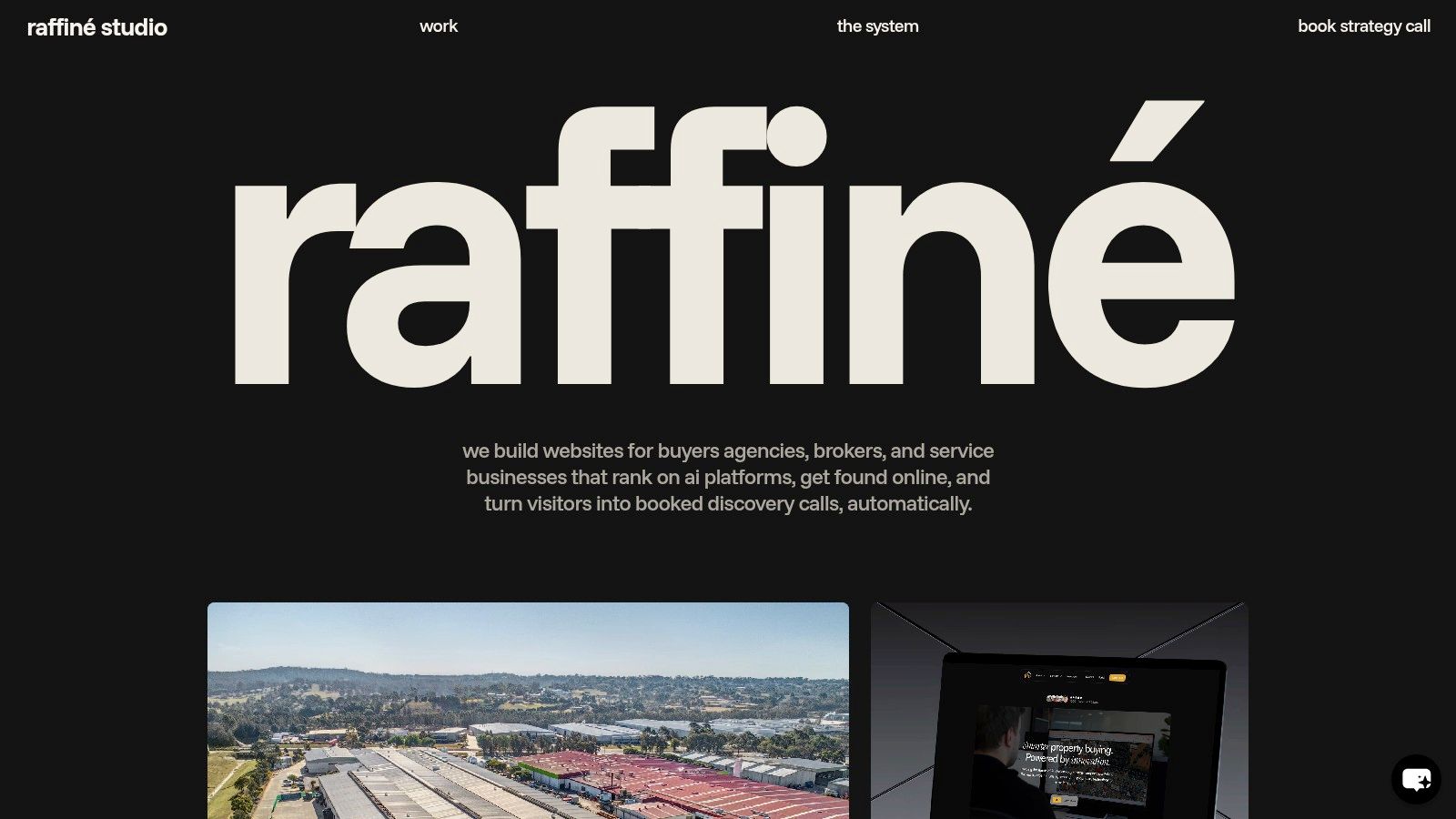
Raffine Studio is a useful reference point because it treats the page as part of a broader system, connecting website strategy, SEO, AI search visibility, booking and CRM handoff instead of treating the template as the finished product.
1. Raffine Studio
A downloadable template cannot resolve unclear positioning, weak follow-up or a disconnected CRM. For many Australian service businesses, the better option is a funnel system designed around the offer, audience and sales process.
Raffine Studio is a Sydney-based web design and funnel studio serving buyers agencies, brokers, professional services firms and B2B businesses. Its work connects conversion-focused website design with landing pages, social content, SEO, Generative Engine Optimisation, booking automation and CRM handoff.
That connection matters when a page must qualify and progress enquiries, not just collect email addresses. A buyers agency could adapt the headline to “Buy with confidence in Sydney's competitive property market”, then support it with suburb expertise, a clear buying process, relevant proof and a discovery-call booking path. A finance broker may place an initial qualification form before the calendar. A professional services firm may create separate journeys for referral traffic, organic search and LinkedIn campaigns.
The business problem it solves
Raffine suits businesses with fragmented digital journeys. The website attracts visitors, but its message is unclear. Social content creates interest, yet sends people to a generic homepage. Enquiries arrive, while staff manually chase them and struggle to connect marketing activity with qualified pipeline.
Its approach brings the main stages into one system:
Conversion-focused redesigns: Website structure and page messaging are shaped around enquiries and booked discovery calls.
Funnel architecture: Multi-step journeys separate low-friction lead capture from higher-intent qualification.
Search visibility: Google SEO and AI search optimisation support discovery beyond paid campaigns.
Operational handoff: Booking, CRM triggers, attribution and follow-up reduce the gap between enquiry and sales response.
The trade-off is bespoke delivery. Public pricing and guaranteed timelines are not listed, so a business should expect a scoping conversation instead of an instant template purchase. Raffine is also a specialist fit for service businesses, rather than a retail-first platform for catalogue-heavy e-commerce.
Choose this approach when the page needs to clarify the offer, qualify prospects and route them into sales follow-up. If the underlying issue is positioning, handoff or nurture, changing the template alone will not fix it.
2. Unbounce
Unbounce is the strongest fit when a team is buying traffic and needs to test landing-page variations without waiting for a full website release. Its templates are built around lead generation and campaign use cases, while the drag-and-drop editor lets marketers move well beyond the starting design.
The business problem it solves
Paid traffic exposes weak message match quickly. If a Google ad promises a property appraisal but the visitor arrives on a broad real estate homepage, the campaign has to work harder than it should. Unbounce makes it practical to build a dedicated page where the headline, supporting copy, form and CTA reflect the ad group.
For a mortgage broker, the template should replace generic “Get started” copy with a specific promise such as “Understand your borrowing options before you make an offer”. The form might request an enquiry type and preferred contact method first, with more detailed qualification handled later by the broker or CRM.
Unbounce's native A/B testing, variant management and integrations with platforms such as HubSpot, Salesforce, GA4 and Zapier make it useful for paid-acquisition teams. Its templates are a starting point, not a substitute for campaign architecture. Test one meaningful change at a time, such as a finance-specific headline, proof placement or form sequence, rather than redesigning every element simultaneously.
Where it falls short
Tiered pricing can be difficult to justify for a small firm running occasional campaigns. Visitor caps on lower plans may also limit an active testing programme. The platform gives marketers control, but that control creates responsibility for analytics, CRM field mapping and lead-quality review.
Unbounce is best when the website is stable and the campaign needs a focused conversion layer. It's less suitable when the underlying brand, positioning and follow-up process need a strategic rebuild.
3. Instapage
Instapage is aimed at teams that manage a high volume of paid campaigns, variants and stakeholders. It combines a large library of mobile-responsive templates with reusable Instablocks, collaboration tools, heatmaps, scheduling and server-side testing.
The business problem it solves
Large marketing teams often lose time rebuilding the same sections for every campaign. A professional services group may need landing pages for separate locations, service lines and audience segments, while keeping legal disclaimers, trust sections and booking components consistent. Reusable global elements reduce that duplication.
Instapage is particularly useful when the journey from ad to page must feel highly specific. A construction company running campaigns for commercial developments could create separate pages for investors, owner-occupiers and development partners. Each page can retain the same proof and compliance content while changing the headline, imagery, qualification questions and CTA.
Dynamic text replacement and server-side A/B testing support more advanced paid-traffic workflows. Heatmaps can help identify where visitors hesitate, although visual evidence still needs to be interpreted alongside qualified enquiry data. A page that attracts more form completions but fewer suitable prospects hasn't necessarily improved the funnel.
The trade-off
Instapage sits at the premium end of the market. Its enterprise workflow is valuable for agencies and larger teams, but the feature depth can be excessive for a single Australian firm launching one discovery-call page.
Use it when campaign scale, governance and collaboration are the bottlenecks. If the main challenge is writing a clear offer and connecting a form to a CRM, a lighter platform or a strategic build will usually be easier to manage.
4. Leadpages
Leadpages offers a practical middle ground for small and established businesses that want speed without giving up core conversion tools. Its library includes templates for lead generation, sales, webinars and industry-specific layouts, and its editor is designed for non-technical marketers.
The business problem it solves
Many professional service firms don't need enterprise campaign infrastructure. They need to launch a focused page for a guide, consultation or event, connect it to an email system and understand whether it produces useful enquiries. Leadpages is built for that level of operation.
A financial adviser could adapt a template around a retirement planning review, using a short form for name, email, phone and broad enquiry type. A law firm could use a consultation page with plain-language eligibility prompts, a short explanation of the process and proof close to the booking decision. The page should avoid collecting every detail upfront when the first goal is to establish a relevant conversation.
Leadpages includes AI-assisted page creation, A/B testing and dynamic text replacement on higher plans. It also offers unlimited traffic across its plans, which makes it easier to avoid a cost structure tied directly to visits. Advanced automation, however, may require external tools or webhooks, and heatmaps and AI personalisation are restricted to higher tiers.
What to watch
The platform is easy to start with, but ease can encourage generic pages. A template designed for a broad industry category won't automatically understand an Australian buyer's concerns, local terminology or the firm's sales capacity.
Leadpages works well when the offer is clear and the team owns the copy, tracking and follow-up decisions. It won't replace a proper conversion strategy.
5. ClickFunnels 2.0
ClickFunnels 2.0 makes sense when the business needs a multi-step funnel rather than an isolated landing page. Its templates support opt-ins, applications, webinars, upsells, downsells, checkout and membership journeys, with follow-up automation built into the wider platform.
The business problem it solves
A service business with a longer decision process may need to segment visitors before a sales conversation. A business coaching firm could offer an introductory resource, ask a small number of qualifying questions, present a strategy session and trigger follow-up based on the answers. A broker could use a staged application path where the initial page captures intent and subsequent steps establish readiness.
The advantage is speed. Teams can assemble a connected journey without stitching together a page builder, checkout, email platform and separate automation tool. For businesses selling courses, memberships or paid programmes, native checkout and post-purchase flows may be useful.
A professional service business should adapt the templates carefully. Replace aggressive sales-page language with a clear commercial promise, credible proof and a booking path that reflects the actual sales conversation. A long funnel isn't automatically better. Each step should earn its place by answering a question, qualifying fit or moving the prospect towards a defined action.
Where the stack becomes costly
ClickFunnels can feel restrictive when a brand needs precise design control or wants to preserve an existing website experience. Costs can also accumulate when the business mainly needs a single campaign page rather than a complete funnel environment.
Its built-in follow-up options can support a stronger post-enquiry process, but automation still needs thoughtful ownership, message timing and CRM rules. For practical examples of connected automation, see automated system examples for service businesses.
6. Webflow Landing Page Templates Marketplace
Webflow is the design-first choice. Its marketplace provides templates from independent designers, while the visual designer offers detailed control over layout, responsive behaviour, components and CMS content.
The business problem it solves
Some professional services firms can't afford to look interchangeable. A property developer, architecture practice or specialist B2B consultancy may need a page that carries a distinctive brand system while still directing visitors towards one enquiry path.
Webflow allows a team to adapt a template at a much deeper visual level than many simpler builders. A development campaign could use a refined project narrative, interactive plans and structured sections for location, design and enquiry. A consultancy could build a landing page that feels consistent with its broader brand rather than resembling a generic lead-generation layout.
The platform's hosting is designed for performance, but page speed still depends on design decisions. Large video backgrounds, unnecessary animations, uncompressed imagery and third-party scripts can undermine the experience. An Australian design guide recommends a dominant hero section, one primary CTA, minimal form fields, sub-2.5-second mobile load targets, compressed WebP assets, lazy loading and reduced script bloat. It also recommends GA4 events for form submissions and phone calls, as outlined in this Australian landing-page design guide.
The operational limitation
Webflow doesn't provide built-in email marketing. Forms need to connect to a CRM, booking system or automation platform, and A/B testing generally requires third-party tools or custom implementation. That's a fair trade for design control, but it means the build team must own the integration architecture.
Use Webflow when brand control and a coherent website experience matter more than launching a fully automated funnel from one dashboard. A useful companion is Raffine's perspective on branding and web design for stronger digital consistency.
7. Landingi
Landingi is built for teams that need many landing pages, variants and audience-specific versions. Its platform combines a large template and section library with AI page generation, Smart Sections, server-side A/B testing, dynamic text and programmatic page creation.
The business problem it solves
Scale changes the template decision. An agency managing multiple clients, or a national service business targeting different locations, may need a repeatable way to create pages without rebuilding every section manually.
A buyers agency could create structured pages for different suburbs, provided every page contains useful local content rather than superficial location swaps. A B2B firm could develop pages for separate industries, preserving the same consultation process while changing the business problem, proof and qualification language. Smart Sections help maintain shared elements while allowing controlled variation.
Landingi's agency features and sub-accounts support multi-brand workflows. Its pricing provides room to grow from a smaller campaign operation, although advanced features can use credits. Teams should monitor consumption and establish rules for when AI-generated content is reviewed, rewritten or rejected.
The risk of scaled sameness
Programmatic publishing can create a large collection of pages that look relevant but don't answer a buyer's real question. That creates a brand and search-quality problem. Each page needs a specific intent, a clear promise and proof that relates to the audience.
Landingi suits marketers who already understand campaign structure and need production capacity. Solo operators may find the interface deeper than necessary. It's a strong operational choice when page volume is the bottleneck, not when the business is still uncertain about its offer.
8. GetResponse
GetResponse is the most useful option in this list when the landing page is primarily the first step in an email nurture system. The platform combines landing pages with forms, pop-ups, analytics, email automation, webinars and simple funnels.
The business problem it solves
Many service businesses generate leads before prospects are ready to book. An accounting firm might promote a tax planning guide. A B2B consultancy might offer an operational review framework. A buyers agency might capture people who are researching the market but haven't decided whether they need representation.
In these situations, the page shouldn't pretend every visitor is ready for a sales call. A good GetResponse journey can offer a useful resource, capture a permission-based contact, deliver the asset and continue the conversation through relevant email content. The booking invitation can appear after the prospect has received enough context to understand the firm's role.
The benefit of one platform is fewer integrations. Forms, landing pages, email sequences and basic analytics sit together, making it easier for a small marketing team to manage the workflow. A page can be published on a custom domain or subdomain and connected to CRM and automation functions.
The compromise
The page designer is simpler than Webflow, so highly distinctive brands may find the visual system limiting. The free plan caps landing-page visits at 1,000 per month, according to GetResponse's landing page creator information. That cap matters if a campaign attracts substantial traffic or if several pages share the same allowance.
GetResponse is a practical nurture choice, not the best answer for complex qualification, advanced paid-media testing or a highly bespoke brand experience.
9. Elementor Kit Library for WordPress
Elementor works well when a business already has a sound WordPress website and wants to add funnel pages without moving platforms. Its kit library and page templates can be imported into the no-code editor, then connected to WordPress forms, CRM, booking and conversion plugins.
The business problem it solves
A professional services firm may not need a separate campaign platform. It may already have a functioning domain, hosting arrangement, SEO foundation and content management process. In that case, a new opt-in, consultation or thank-you page can be built inside the existing environment.
An accounting practice could create a dedicated page for a business advisory review, with an Elementor template adapted to the firm's colours, proof and service language. A medical practice could create a condition-specific enquiry page with a suitable booking path, privacy considerations and clear expectations about what happens after submission.
The WordPress ecosystem provides flexibility. Forms can send data to a CRM, booking plugins can present appointment times, and automation tools can trigger notifications or follow-up. The team owns the architecture, though, so field mapping and consent handling need proper attention.
Performance depends on discipline
Elementor's performance varies with hosting, theme configuration, image sizes and plugin hygiene. Adding multiple add-ons to recreate every marketing-platform feature can create maintenance and speed issues. Native A/B testing isn't built in, so testing usually requires an additional plugin or external service.
A form reduction can have a direct effect on friction. One Australian source reports that reducing a form from 11 fields to 4 lifted conversions by 120%, and recommends three to five fields for many lead-generation forms. That finding is cited in Australian landing-page optimisation guidance, but the right number for a broker, lawyer or medical practice still depends on the purpose of the form.
Choose Elementor when the existing WordPress site is healthy. Don't choose it just because it's familiar if the site already has serious performance, plugin or structural problems.
10. HubSpot Landing Page Builder and Template Marketplace
HubSpot is the CRM-first choice. Its landing-page builder sits inside the Content and Marketing Hub, with templates, drag-and-drop editing, CRM personalisation, smart content, analytics and A/B testing connected to the wider customer record.
The business problem it solves
A landing page is only useful if the sales team knows what happened after conversion. HubSpot can connect form submissions to contacts, deals, sequences and attribution, giving marketing and sales a shared view of the journey.
A B2B company might show different content to a returning prospect based on CRM data. A law firm could route enquiries by service area and assign follow-up tasks. A broker could separate first-home buyers, refinancers and investors, then use the source and form responses to guide the next conversation.
The benefit is continuity. The page, contact record and follow-up workflow can live in one environment rather than being passed between disconnected tools. Built-in analytics and testing also make it easier to assess outcomes beyond raw form volume.
The commercial trade-off
HubSpot's advanced capabilities are tied to paid Content Hub tiers, and its design freedom is less open-ended than Webflow. A business that only needs a simple booking page may pay for more platform than it uses. The CRM connection is valuable only when the team maintains clean properties, lifecycle stages, ownership rules and follow-up responsibilities.
The landing page must also remain discoverable where appropriate. A page designed for paid traffic can be intentionally narrow, while an organic service page may need stronger information architecture, crawl access, structured content and internal links. Raffine's approach to website design and SEO is relevant when conversion and search visibility need to work together rather than compete.
Top 10 Sales Funnel Landing Page Templates Comparison
Service | Core focus | UX & effectiveness (★) | Value & pricing (💰) | Target audience (👥) | Unique selling points (✨) |
|---|---|---|---|---|---|
Raffine Studio 🏆 | Conversion‑first websites + funnels, AI & Google SEO, booking automation | ★★★★★ KPI‑driven, discovery‑call optimized | 💰 Bespoke pricing, high ROI per booked call | 👥 Buyers agents, brokers, professional services, Australian SMEs | ✨ Systems approach: site + SEO + social + automation → measurable booked calls |
Unbounce | Drag‑drop landing pages & templates for paid traffic | ★★★★☆ Fast iteration, native A/B testing | 💰 Tiered subscriptions; can be pricey for low volume | 👥 Marketers & agencies running paid acquisition | ✨ Flexible editor, curated conversion templates, strong integrations |
Instapage | Enterprise landing pages, server‑side testing & collaboration | ★★★★☆ Enterprise workflow, heatmaps & personalization | 💰 Premium pricing for enterprise features | 👥 Agencies & enterprise marketing teams | ✨ Server‑side A/B, dynamic text, real‑time collaboration |
Leadpages | Template library + CRO tools with AI page creation | ★★★☆☆ Easy to use; unlimited traffic on plans | 💰 Clear, SMB‑friendly plans; good value for budget teams | 👥 SMBs, solopreneurs, small agencies | ✨ AI page creation, unlimited visits policy |
ClickFunnels 2.0 | Multi‑step funnel builder with native checkout & automations | ★★★☆☆ Rapid funnel assembly; limited design freedom | 💰 Subscription; costs add up for simple needs | 👥 Direct‑response marketers, course creators, SMBs | ✨ End‑to‑end funnels, checkout, upsells & built‑in follow‑up |
Webflow (Marketplace) | Designer templates editable in Webflow visual CMS | ★★★★☆ Pixel‑level control, performant hosting | 💰 One‑time template + hosting plans; designer‑grade value | 👥 Designers, agencies, brands needing control | ✨ Pixel control + CMS + global hosting performance |
Landingi | Scale‑friendly landing platform with AI and programmatic pages | ★★★★☆ Suited to multi‑page/variant campaigns | 💰 Competitive entry pricing; agency sub‑accounts | 👥 Agencies, multi‑brand teams managing many pages | ✨ AI page generation, programmatic pages, server‑side testing |
GetResponse | Marketing suite: landing pages + email, webinars & automation | ★★★☆☆ Integrated automation; simpler page designer | 💰 Bundled pricing, fewer tools to integrate | 👥 SMBs needing email + landing pages in one platform | ✨ Tight email/webinar integration + AI page generator |
Elementor (Kit Library) | WordPress kits & page templates with no‑code editor | ★★★☆☆ Fast kit deployment; dependent on hosting | 💰 One‑time kits + plugin costs; flexible budget options | 👥 WordPress sites, agencies, freelancers | ✨ Massive ecosystem, plugin extensibility, one‑click kit import |
HubSpot (Landing Pages) | Landing pages embedded in CRM/Marketing Hub | ★★★★☆ Strong analytics, personalization & attribution | 💰 Free start; advanced features on paid (can be expensive) | 👥 SMBs → enterprises needing CRM + marketing unification | ✨ Deep CRM personalization, built‑in attribution & marketplace |
Choose the Template That Matches Your Sales Process
The right sales funnel landing page template depends on where the business is struggling.
Choose a bespoke funnel system when the website, messaging, lead qualification and follow-up all need strategic work. Raffine Studio is the strongest fit for Australian buyers agencies, brokers and professional services firms that want website traffic to become qualified enquiries and booked conversations, with the CRM and reporting process designed at the same time.
Choose a testing-focused builder when the offer is already clear and paid acquisition is the priority. Unbounce suits teams that need fast campaign iteration. Instapage suits larger teams managing collaboration, personalisation and a high volume of variants. Landingi is a practical choice when the production challenge involves many pages, locations or brands.
Choose a design-first platform when brand control is central. Webflow gives a business more freedom to create a distinctive, high-quality experience, but forms, CRM connections, nurture and testing need to be planned separately.
Choose an all-in-one marketing suite when nurture is the main gap. GetResponse can connect an opt-in page to email and automation without a large integration project. HubSpot is stronger when CRM records, sales ownership, attribution and personalisation matter more than a lightweight launch.
Choose a WordPress option when the existing site is sound. Elementor can add campaign pages quickly, but performance and testing depend on hosting, plugin discipline and the quality of the implementation.
Whatever resource you choose, adapt the page against this short decision framework:
One audience: Write for a defined buyer, such as a commercial property investor, business owner seeking advisory support or homeowner comparing brokers.
One promise: State the useful outcome clearly above the fold.
Proof near the decision: Place relevant experience, credentials, testimonials, process detail or case-led evidence close to the CTA.
Appropriate friction: Ask only for information the next step requires. A low-intent guide download shouldn't use the same form as a qualified consultation.
Owned follow-up: Decide whether the next step belongs to a calendar, sales team, CRM workflow or nurture sequence.
Mobile review: Test the actual page on a phone, including load time, form completion, tap targets and booking.
Conversion tracking: Track submissions, calls, bookings and qualified outcomes, not just visits.
Australian benchmark reporting places the lead-generation website range at 1% to 2.5%, while optimised landing pages are reported at 8.8% to 18.2% when matched to mobile and intent-based traffic. Those figures appear in Australian conversion rate benchmarking commentary, but they're benchmarks, not promises. Your useful comparison is the current performance of your own page, the quality of enquiries it generates and the percentage that progresses into genuine sales conversations.
Technical execution deserves the same attention as copy. One Australian page-speed benchmark projects an average website load time of 3.2 seconds by 2026 and associates faster pages with a projected conversion rate near 4.8%, as reported in Australian page-load-time research. Another Australian conversion source reports that image optimisation and browser caching can produce a 2% to 5% conversion lift, which is why performance work should be treated as a commercial task rather than a developer clean-up exercise.
Finally, don't build a page that only humans can find. Australian AI-search reporting found an average AI visibility score of 38.3 out of 100 in a sample of 300 search-visible businesses, while another report found only 12.3% of businesses moved from Google presence to AI search visibility. The figures are cited in Australian AI visibility reporting. For pages intended to support organic discovery, use accessible content, descriptive headings, crawlable text, relevant schema and clearly formatted FAQs where they answer buyer questions. The page must still convert the person who arrives, but it should also give search systems enough structure to understand the offer.
The template is only the visible layer. The commercial result comes from the connection between website, traffic, conversion, follow-up and growth.
Raffine Studio builds conversion-focused websites, landing pages and funnel systems for Australian buyers agencies, brokers and professional services firms. Visit Raffine Studio to review whether your landing page, search visibility, booking flow and CRM handoff are working as one system.