sales funnel strategy, lead generation, funnel optimisation, conversion rate, Australian marketing
Sales Funnel Strategy for Service Businesses
by raffiné studio
You've got website traffic, a few enquiry forms, and a calendar that stays suspiciously empty. The marketing report says people are finding you, but nobody can explain what happens after a visitor submits an enquiry. Leads sit in an inbox, staff reply when they get time, and the sales team starts conversations without knowing where each prospect came from or what they need.
That isn't a traffic problem. It's a sales funnel strategy problem.
For Australian service businesses, the funnel needs to connect the website, offer, form, CRM, booking process and follow-up. A page that persuades someone to enquire is only one part of the commercial system. The test is whether your business captures intent, qualifies it, routes it quickly and turns it into a useful sales conversation.
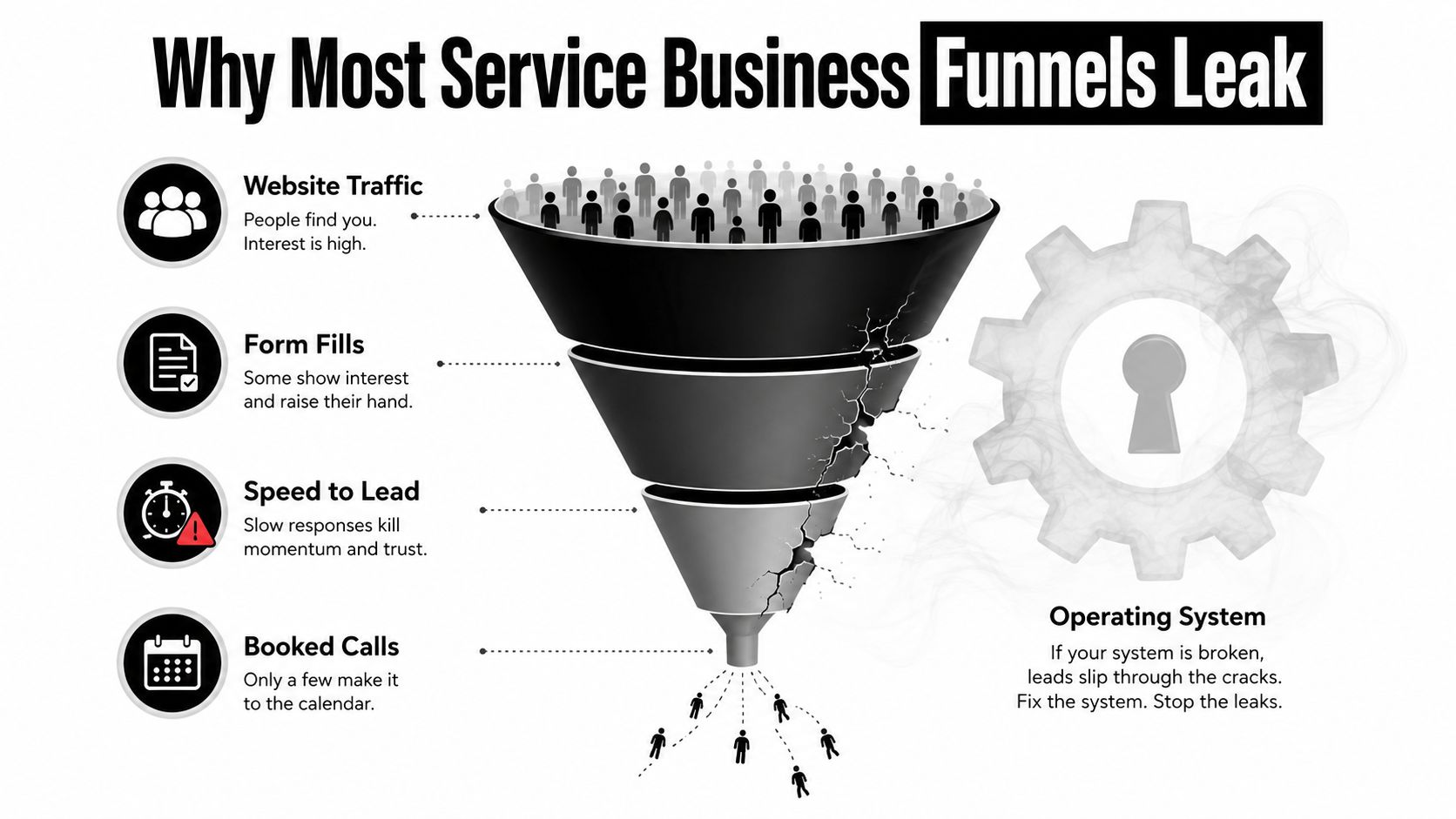
Why Most Service Business Funnels Leak Before the Sales Call
Founders often review analytics from the top down. They see search traffic, social visits and paid clicks, then ask why the numbers aren't producing more revenue. That review misses the point if the business hasn't measured what happens between form submission and booked call.
A complete funnel has four operating stages:
Capture, turn attention into an identifiable enquiry.
Qualify, establish whether the lead fits the service, location, timing and commercial model.
Route, send the lead to the right person, workflow or booking path.
Close, turn a qualified conversation into a proposal, engagement or transaction.
Each stage has a different conversion goal. A landing page shouldn't try to close a complex legal engagement in one interaction. A CRM shouldn't merely store a name. A booking page shouldn't force a high-intent prospect to wait for a manual reply.
Australia has broad business connectivity, but digital presence and online commerce have developed unevenly. Data cited by ZDNet on Australian business digital adoption reports that 97% of Australian businesses have an internet connection, while 54% have a web presence, 45% have a social media presence, 62% place orders online and 41% receive orders online. The commercial lesson is clear: being online doesn't mean having a structured path from demand to enquiry.
Strategic rule: Treat the funnel as an operating system, not a collection of pages.
The four failure points to audit
Capture fails when the page speaks broadly about capability but gives the visitor no specific next step. “Get in touch” is weaker than a service-relevant offer such as a property appraisal conversation, a fixed-fee accounting review or a project feasibility discussion.
Qualification fails when every lead enters the same queue. A buyer's agency, law firm or finance broker needs enough information to identify fit, but not so many questions that the form becomes an application.
Routing fails when an enquiry lands in a shared inbox with no owner, alert, service line or response rule. The business may have generated demand, but it hasn't created accountability.
Closing fails when the sales call begins without context. A consultant who doesn't know the visitor's service interest, source, urgency or stated problem has to rebuild trust from the beginning.
The first audit should follow one real enquiry from click to conversation. Record every handoff, delay, missing field and manual step. If you can't draw that journey clearly, you don't yet have a reliable sales funnel strategy. You have disconnected marketing activities.
For the page-level work, start with conversion-focused website design, then connect the resulting enquiry path to your operational follow-up.
Mapping Your Funnel from Stranger to Booked Call
A useful funnel map follows the buyer through five stages, not just “traffic” and “leads”. The handoff between stages matters more than the label.
Cold traffic has a problem, question or need but may not know your firm. Search content, social posts, referrals and paid campaigns introduce the business. The responsible asset is the source message, such as an ad, social post or search result, and its job is to earn a relevant visit.
An engaged visitor consumes enough of the page to assess relevance. They may read a service page, compare approaches or inspect proof. The landing page owns this transition, and its job is to make the next action obvious without demanding a sales commitment too early.
An identified lead has provided contact information through a form, booking request or other enquiry mechanism. The form owns capture, while the CRM trigger records the source, service interest and consent status.
A qualified opportunity matches the business's commercial criteria. Qualification might include budget fit, location, project type, urgency, decision authority or service suitability. A routing rule, not a vague inbox process, should decide who handles it.
A booked call is a confirmed calendar event with an accountable owner and enough context for a productive conversation. The calendar link owns the booking, but the CRM should retain the original journey.
The same stage requires different treatment across service categories.
Funnel Stage | Professional Services | Brokers | Lead-Gen Sites |
|---|---|---|---|
Cold traffic | Educational search, referrals and authority content | Rate, eligibility and scenario-led demand | Local problem and immediate-need searches |
Engaged visitor | Service detail, expertise and risk reduction | Trust, options and qualification clarity | Proof, availability and response expectations |
Identified lead | Enquiry form or consultation request | Scenario form with financial or policy context | Short contact form or callback request |
Qualified opportunity | Fit, matter type, timing and decision process | Borrowing, insurance or finance suitability | Location, job type and service urgency |
Booked call | Consultation or discovery meeting | Broker appointment or document review | Estimate, inspection or provider handoff |
A lawyer's visitor may need confidence before sharing sensitive information. A mortgage broker's prospect may want a rapid response because the scenario is time-sensitive. A local lead-gen visitor may be ready to request a quote immediately. Using one generic form and one generic CTA across all three creates avoidable friction.
Build the map before changing the design
Write down the answer to five questions:
Which traffic source brought the visitor?
What evidence shows intent?
What information is needed to qualify the lead?
Who owns the next action?
What event confirms the transition?
If any answer is “someone will check later”, the funnel has a structural gap. Fix the ownership and event tracking before spending more on traffic.
Designing Landing Pages, Offers, and CTAs by Traffic Intent
Traffic sources carry different levels of intent, so they shouldn't all land on the same page.
Problem-aware visitors arrive through Google search, SEO content or an answer surfaced by an AI assistant. They understand the problem but may still be evaluating the category. Give them a diagnostic offer, a useful explanation, or a focused assessment rather than an aggressive booking request.
Solution-aware visitors may have visited competitor pages, review sites or comparison content. They're evaluating approaches and providers. Give them a comparison offer, a transparent process, relevant proof and a clear explanation of who the service suits.
Brand-aware visitors arrive through referrals, branded search or retargeting. They've already encountered the business, so a direct booking CTA can work. Don't make them consume an introductory essay before they can schedule a conversation.
Match the promise to the page
Message match is basic, but Australian service websites break it constantly. If an ad promises a commercial property feasibility discussion, the landing page headline should use that idea. It shouldn't switch to “Solutions for modern businesses” and expect the visitor to work out the connection.
Use the page to answer four commercial questions:
Is this service relevant to my situation?
Does this firm understand the risk or complexity involved?
What happens after I enquire?
What's the easiest sensible next step?
The CTA should reflect intent. “See whether we're a fit” suits an uncertain professional-services visitor. “Compare your finance options” suits a broker. “Request a callback” suits a visitor with an immediate local service need.
Forms need the same discipline. Conversion research on form fields reports conversion rates of 18.2% for one-field forms, 11.5% for three fields, 9.9% for four fields and 4.2% for forms with nine or more fields. The precise benchmark won't predict your result, but it reinforces the principle: every field needs a commercial reason.
Ask for information that changes routing or qualification. Leave deeper discovery for the confirmation step or the call.
Remove quiet conversion killers
Generic hero photography: A stock image of a handshake says nothing about your service or market.
Trust badges above the fold: Proof matters, but it shouldn't displace the proposition and next step.
Multiple competing CTAs: A visitor shouldn't choose between an ebook, newsletter, contact form and booking link when the commercial goal is a qualified enquiry.
Long forms for cold visitors: Start with the minimum information required to continue the conversation.
Vague service language: “Strategic solutions” forces the visitor to decode what you do.
A practical page structure is proposition, relevance, proof, process, qualification and CTA. For a more detailed starting point, use this sales funnel landing page template, then adapt it to the traffic intent and sales motion.
Speed to Lead, Booking Automation, and CRM Handoff
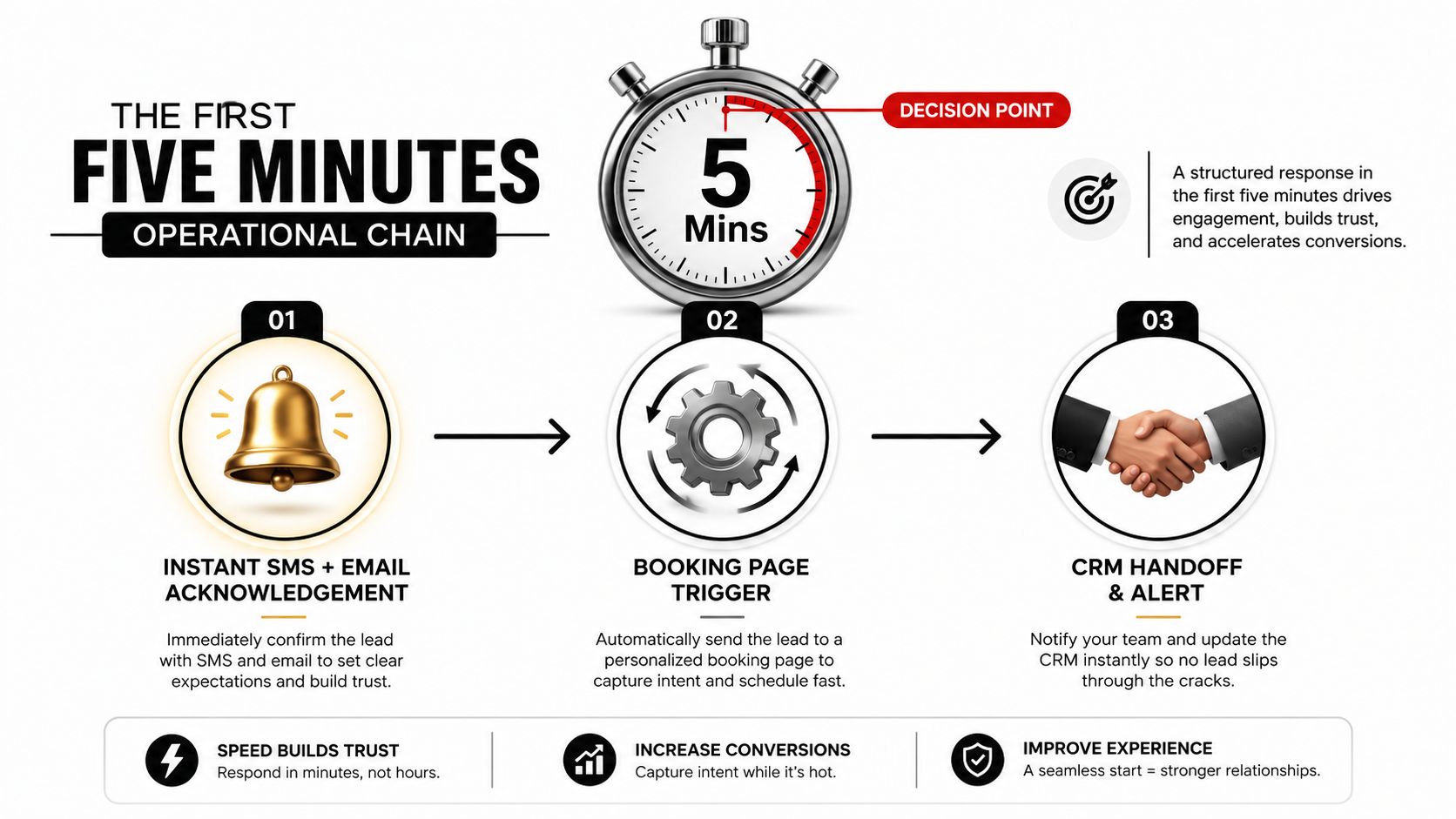
The first five minutes after an enquiry are operationally decisive. An Australian lead-conversion study summarised in the ASBFEO report reported that more than 63% of businesses never responded to a lead, while responding businesses took over 29 hours on average. The same source reported that roughly half of online leads were never contacted, and only 0.1% of leads in one audit were reached within five minutes.
That's why speed-to-lead belongs inside the funnel design. It isn't a customer-service detail to solve after the campaign launches.
Build the post-submit chain
First, acknowledge instantly. Send an SMS and email confirming receipt, setting expectations and presenting the next appropriate action. The message should name the service or request, not merely say “thanks for contacting us”.
Next, trigger a human response. Best-practice Australian guidance recommends a response within 5 minutes, with high-performing teams aiming for under 60 seconds. Australian lead-response benchmarks also recommend tracking median minutes to first human contact, 90th-percentile response time, contact rate and qualified rate by source.
Then, route by fit. A conveyancing enquiry shouldn't sit behind a general website queue. Route by service line, location, deal size, urgency and team availability. When a lead is stalled, escalate it to a named human rather than allowing automation to hide the delay.
Finally, create the CRM record. Store source, campaign, landing page, service interest, consent and qualification responses. Without this information, your sales team can't compare traffic quality or identify where the funnel is leaking.
Use a business-hours SLA for live human response and a next-business-day callback rule for after-hours submissions. Make the booking calendar timezone-aware, and review SMS consent language against Australian communications requirements before activating automated messages.
Watch this operational walkthrough before building the workflow:
Examples of automated systems can help your team identify which triggers, alerts and handoffs belong in the first version of the workflow.
Response standard: A form submission should create an acknowledgement, an owner, a next action and a timestamp.
A practical sequence is form capture, immediate SMS and email, booking-page trigger, human alert, CRM creation and scheduled follow-up. Test it with a real submission, including after hours. A workflow that works in a diagram but fails on a mobile form or an unavailable calendar isn't production-ready.
The KPI Model and Australian Benchmarks That Actually Matter
A single website conversion rate hides the location of the leak. A better KPI model separates leading indicators, which show whether the system is functioning, from lagging indicators, which show whether it makes money.
Leading indicators include form completion, response time, contact rate, qualification rate, booking rate and show rate. Lagging indicators include cost per booked call, close rate, revenue per enquiry and payback period. Measure each by traffic source and service line, because a channel that produces fewer leads may still produce better commercial outcomes.
Australian funnel benchmark guidance suggests the following staged model:
Funnel Stage | Professional Services | Brokerages | Local Lead-Gen |
|---|---|---|---|
Website visitors to MQLs | 5% to 10% | 5% to 10% | 5% to 10% |
MQLs to SALs | 20% to 30% | 20% to 30% | 20% to 30% |
SALs to SQLs | 10% to 20% | 10% to 20% | 10% to 20% |
SQLs to opportunities | 25% to 30% | 25% to 30% | 25% to 30% |
Opportunities to closed deals | 20% to 40% | 20% to 40% | 20% to 40% |
These ranges come from Australian funnel benchmark guidance. They're useful as diagnostic reference points, not promises. A complex legal service, a mortgage broker and a local clinic have different buying cycles, qualification rules and commercial values.
Read the leak, not the headline
If visitors become leads but leads rarely become qualified opportunities, inspect the offer, form questions and routing. If qualified leads fail to book, inspect speed, trust, calendar friction and the call-to-action. If booked calls fail to close, inspect sales fit, pricing, authority and the promise made before the meeting.
For example, a $120 enquiry that becomes a $4,800 closed deal produces a simple revenue-to-acquisition relationship. The gross revenue value is $4,800, the acquisition cost is $120, and the difference before delivery costs is $4,680. That doesn't prove the funnel is healthy, because the calculation says nothing about lead quality, staff time, margin, refunds or repeat work. It does show why a business should measure revenue by source rather than celebrate cheap enquiries in isolation.
The benchmark problem is especially visible across industries. Australian conversion-rate comparisons cite professional-services conversion around 2.9% to 3.3%, while lead-generation pages can reach 5% to 8% or higher on warm traffic. Compare like with like. A cold social visitor and a high-intent search visitor shouldn't share one target.
Set a CAC envelope from your acceptable acquisition cost, close rate and contribution margin. Then scale only when response, qualification and sales capacity can support the additional demand.
What Changes When AI Search Shrinks the Top of the Funnel
The assumption that more traffic automatically creates more pipeline is becoming weaker. AI Overviews and AI Mode can answer an informational question before the searcher visits a service website, so the business may receive fewer exploratory clicks while attracting a higher proportion of people who already recognise the brand or need a specific service.
Google's Australia-facing marketer guidance says AI Mode began rolling out to Australians from 8 October 2025 and reports that 60% of potential lead-generation users who saw an AI Overview felt decision-making became faster or easier. The same guidance reports 27% more conversions at similar CPA or ROAS for AI Max campaigns. Treat those as platform-reported claims, not universal outcomes, and test them against your own CRM data. Google's AI search guidance for Australian marketers provides the relevant context.
The strategic shift is from maximising informational clicks to becoming the source an assistant can confidently summarise, compare and recommend.
Build for citation and decision-making
Compress broad awareness content into clear answer assets. Explain who the service suits, what the process involves, what information a prospect needs, which situations require specialist help and what happens after an enquiry. Use structured headings and direct answers, but don't flatten the content into generic definitions.
Create pages that help buyers make decisions:
Comparison pages: Explain the difference between service models, providers or approaches.
Pricing pages: State what affects cost, scope and suitability without making unsupported promises.
Process pages: Show the steps from first enquiry to delivery.
Evidence pages: Connect expertise, qualifications, outcomes and constraints to the buyer's actual risk.
Branded search now deserves more attention because awareness can happen inside an answer interface. Your website must convert the visitor who searches your firm by name, checks your service details and decides whether to book.
The correct test isn't whether organic traffic keeps rising. Ask whether the business could absorb a serious reduction in top-of-funnel clicks and still reach its booked-call target. That requires stronger brand demand, better first-party data capture, clear commercial pages and owned follow-up.
A legacy funnel relies on volume. An AI-shaped funnel earns visibility through useful structured answers, then converts the smaller group that arrives with a specific commercial question.
Your 30-60-90 Testing and Optimisation Playbook
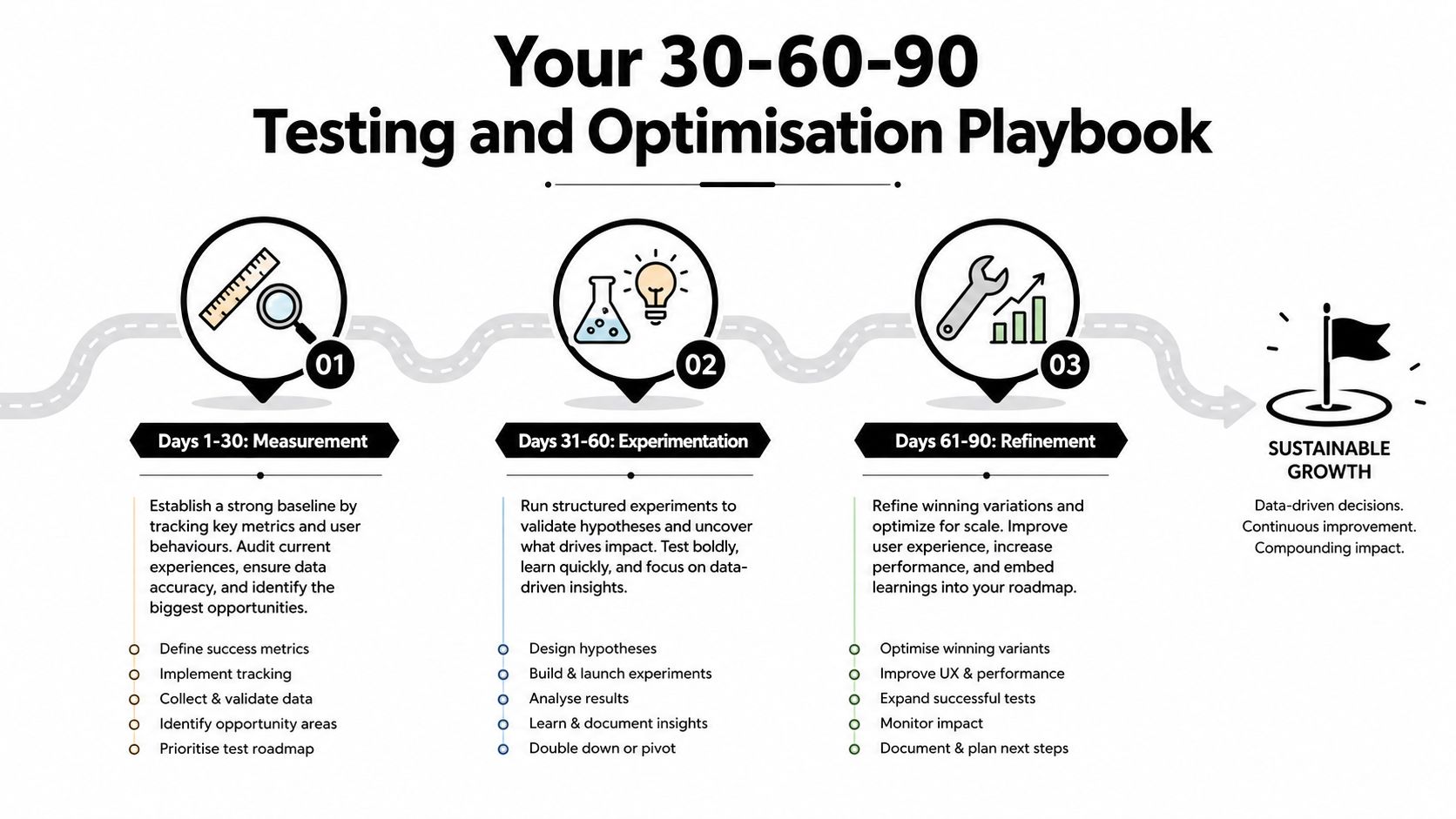
Optimisation works best as a controlled operating cycle. Don't change the headline on Monday, the form on Wednesday and the follow-up sequence on Friday, then call the result a test. You won't know which change affected lead quality or booked calls.
Days 1 to 30 establish measurement
Connect website events, form submissions, CRM records and calendar outcomes. Record the original source, campaign, landing page, service interest and response time for every enquiry.
Document the baseline for:
Lead capture: Page visits, form starts and completed enquiries.
Lead quality: Qualification rate by service and source.
Sales progression: Booked-call rate, show rate and close rate.
Commercial return: Revenue, acquisition cost and contribution by source.
Operational performance: Time to acknowledgement, time to human contact and stalled handoffs.
Audit tracking gaps before redesigning pages. A business can't optimise an event it doesn't record.
Choose one primary constraint. It might be weak form completion, slow response, poor qualification, unclear proof or low booking completion. Fix the highest-value constraint first, not the metric that looks easiest to improve.
Days 31 to 60 run focused experiments
Run one or two high-impact tests at a time. Prioritise message match, CTA clarity, form length, proof placement, page speed, response automation, routing rules and follow-up messaging.
Hold the audience, page purpose and commercial conditions steady where possible. Define the conversion event before launch, and set a minimum evidence threshold before judging the result. Don't declare victory because more people clicked a button if fewer qualified leads booked useful calls.
Pair quantitative data with sales evidence. Review call notes, objections, disqualified leads and comments from the team handling enquiries. A page can produce more form fills while attracting poorer-fit prospects.
Days 61 to 90 scale what survives scrutiny
Roll proven changes into the main journey, then create variants for different services or traffic intents. Remove tests that don't improve the commercial outcome, even when they produce attractive surface metrics.
Review the entire path from first touch to closed revenue. Document the principles that worked, such as a clearer service promise, fewer form questions, faster human contact or better qualification routing. Add the next constraints to a prioritised backlog.
A focused funnel review should leave you with three things: a measured baseline, a ranked list of leaks and a testing plan tied to revenue rather than vanity metrics. Raffine Studio designs conversion-focused websites, landing pages, CRM handoffs and booking systems for Australian service businesses that need qualified conversations, not just more visits. Visit Raffine Studio to review your current funnel and book a focused conversation about where your pipeline is breaking.