seo for mortgage brokers, mortgage broker marketing, local SEO Australia, broker lead generation, AI search visibility
SEO for Mortgage Brokers: A Practical Growth Guide
by raffiné studio

Brokers now sit in a market where visibility decides who gets the enquiry first. The MFAA reported that brokers facilitated 81.0% of residential home lending in March 2026, up from 55.3% in March 2018. That's not a small shift, it's a structural change in how borrowers research, compare and choose advice, and it makes SEO for mortgage brokers a commercial priority, not a branding exercise. The same reporting showed leading aggregators settled $124.88 billion in new home loans in the March 2026 quarter, which tells you where the volume is moving, and why being absent from search is expensive. MFAA data review
If your website isn't visible when borrowers are actively comparing broker options, you're forcing your business to rely on referrals, paid leads, and hope. That's a weak mix. Search is where intent shows up, and in this category, intent is commercially valuable because borrowers don't just want information, they want someone they can trust to get them to settlement.
Why SEO Now Decides Which Brokers Win Enquiries
27,100 monthly searches for “mortgage broker” show why search deserves a place in a broker's acquisition plan. The same Google Keyword Planner estimate records 9,900 searches for “refinance home loan” and 8,100 for “mortgage broker near me”. Those figures come from a Sydney-based guide, so use them as directional demand signals, then validate priorities against your own Search Console and conversion data. The ASIC review also shows that broker market structure has been tracked quarterly since 2013, confirming a long-running competitive field rather than a short-lived search trend.
Visibility is a lead-capture problem
A broker website that misses high-intent searches loses more than visits. It loses opportunities to speak with borrowers who are already comparing options, and it leaves the business dependent on referrals, paid lead providers, or lender-controlled channels. Those sources can still contribute enquiries, but they do not give the broker reliable control over demand or lead quality.
Search visibility should therefore be built around the next action. A page needs to answer the borrower's question, establish trust, and make contacting the broker easy. Rankings matter because they create access to that moment. The commercial outcome is the enquiry, not the position in isolation.
If the website isn't capturing search intent, the broker is effectively renting visibility from someone else.
Borrowers often compare several brokers before choosing whom to call, contact, or book. The broker appearing during that comparison window has a practical advantage. SEO for mortgage brokers should be treated as lead infrastructure, with every important page connected to a clear enquiry path.
Referrals need a search layer
Referral networks remain useful, but they depend on memory, goodwill, and timing. They also limit how consistently a broker can reach people outside the existing network. Search creates another route into the business, covering suburb, city, loan-type, and problem-based queries throughout the year.
The strongest operators map search demand to commercial intent. High-intent terms deserve different treatment from research queries, and both should support a path toward a conversation. This intent-to-competition matrix helps decide where to invest first: target valuable searches where the broker can produce a useful, locally relevant answer, rather than chasing broad terms that consume budget without producing settled business.
Search visibility now includes AI-generated answers as well as traditional results. Clear service explanations, evidence of expertise, consistent business information, and pages that directly resolve borrower questions give search systems stronger material to interpret. Apply the principles in this guide to generative engine optimisation for AI search visibility-matters), then measure whether those efforts create qualified enquiries.
The practical test is simple: can a borrower find the broker, understand the service, trust the advice, and take the next step? If any answer is no, more traffic will not solve the commercial problem. Fix the capture system first.
Building High-Intent Location and Borrower Pages
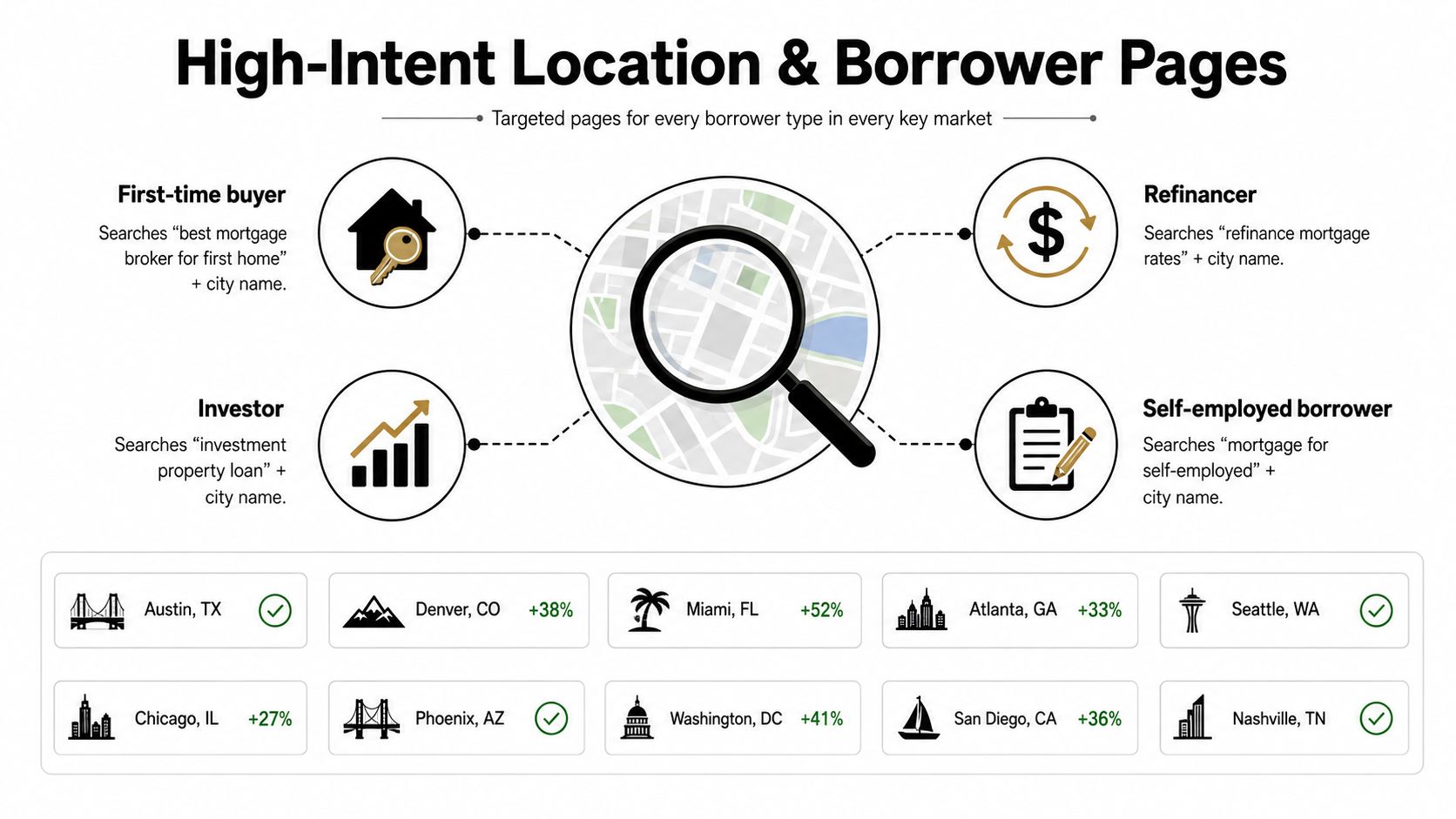
Generic “Home Loans” pages are lazy, and they usually underperform. They're too broad, too competitive and too disconnected from how borrowers search. The smarter play is a city-by-persona matrix, where each page targets one location and one borrower type, because that combination creates clearer intent and less competition.
Start with intent, not with page count
Build the matrix in this order.
Pick the market first. Focus on city and suburb combinations where you already operate or want to win enquiries.
Add the borrower persona next. First home buyer, refinancer, self-employed borrower, investor, or SMSF buyer.
Filter for transactional wording. Phrases like “mortgage broker near me” or “best broker for self-employed home loan Melbourne” signal commercial intent far better than generic educational terms.
Publish the best six to ten pages first. One well-targeted page beats ten broad ones because it aligns tightly with the searcher's need.
That prioritisation matters because your resources are limited and the competition isn't. Industry guidance for Australian brokers says the highest-impact move is to concentrate on the 6 to 10 cells with the strongest intent-to-competition ratio before expanding further. Australian broker city-page strategy
Build pages that actually answer the query
A high-intent page should feel specific from the first screen. Use an H1 that matches the search theme, add local proof points, and answer the obvious borrower question immediately. Include suburb context, state stamp-duty or grant notes where relevant, a calculator embed, and a short FAQ block.
That's not decorative. It helps the page do two jobs at once, it ranks for the query and it converts the visitor once they land.
A practical page structure looks like this.
Headline matched to the query. “Mortgage Broker in Parramatta for First Home Buyers”.
Short local intro. Explain the type of borrower you help in that area.
Proof above the fold. Credentials, reviews, lender panel, response time, or office location.
Relevant FAQ block. Handle common objections before they call.
Clear next step. Book a discovery call, request a callback, or use the calculator.
Rule: if the page could be copied to another city by replacing the suburb name, it isn't specific enough.
Keyword tools still matter. Use Google Keyword Planner and something like Ahrefs to sort pages by intent, then build the ones closest to revenue first. One strong location-persona page will usually do more commercial work than a cluster of thin service pages because it mirrors how the borrower thinks.
Winning the Local Map Pack for Broker Searches
The local map pack appears prominently for location-based searches, giving brokers a direct route to high-intent enquiries. Local searches account for 46% of all Google search queries, so a well-managed Google Business Profile can put your practice in front of borrowers before they reach the organic results. Follow this Google Business Profile guidance when setting up or reviewing the listing.

Get the profile right before you chase anything else
Set up the fundamentals before investing in additional local activity.
Claim and verify the listing. An unverified profile cannot support the rest of your local strategy.
Choose the right category. Select Mortgage Broker, rather than a broad category that weakens relevance.
Write for search intent. Include location and service terms naturally in the description.
Upload real photos. Office, team, signage and workspace images provide stronger proof than stock photography.
Keep the profile active. Maintain services, hours, posts and Q&A so the listing remains current.
A multi-location brokerage needs separate listings and matching location pages. If the Sydney and Parramatta offices use identical content and positioning, they create confusion and competing relevance. Give each location its own profile, local proof and service-area page.
Reviews and citations still move the needle
Google reviews influence both trust and local visibility. Build review requests into the post-settlement workflow, so they follow a successful close consistently. Reply to every review with a specific response that reflects the borrower's experience.
Citation consistency supports the same objective. Keep business details aligned across directories such as Yellow Pages and TrueLocal, then remove duplicate listings that split local signals.
The intent-to-competition matrix should guide where you spend effort. Prioritise locations and borrower needs with strong enquiry intent and manageable competition, then strengthen those profiles with reviews and evidence. A roofing company SEO example shows how clear service-area structure and consistent proof can support local visibility across multiple markets.
A broker assistant can usually complete the first round of GBP cleanup in one week. Start there before paying for more advanced local tactics.
Technical Foundations and AI Search Visibility
Most broker sites don't lose rankings because they lack content. They lose rankings because the site is technically messy and machine-unfriendly. If Google can't crawl the pages cleanly, and AI tools can't understand what the business does, the site leaks visibility at both layers. That's why technical SEO and AI search readiness now sit in the same bucket.

Make the site readable before you add more pages
Fix the basics first.
Page speed and mobile rendering. If pages load slowly or break on mobile, you'll lose both users and crawl efficiency.
Clean indexation. Make sure only useful pages are being indexed, not junk URLs and duplicates.
Structured data. Use schema that clearly identifies the business, its service areas, and its FAQs.
Internal linking. Connect location pages, loan-type pages and educational pages so Google sees a coherent topic structure.
Structured data is where most broker sites are underdone. FinancialService schema, FAQ schema, and LocalBusiness schema help search engines read the site with less guesswork. For a broker, that means the machine can more easily identify the service, the location, and the borrower questions being answered.
AI search visibility needs plain, explicit answers
AI search tools reward pages that are easy to extract and summarise. That means explicit headings, direct definitions, and content that answers the question near the top. A page that hides the answer halfway down in marketing copy is weaker than a page that states it cleanly in the first 120 words.
One Australian source on AI search visibility says a site needs to be crawlable by OpenAI's OAI-SearchBot, indexed, and filled with clear public content such as business name, location, services, prices and answers to common questions. That lines up with what works in practice, because answer-first content is easier for assistants to surface. AI search visibility guidance
Raffine Studio is one option that connects websites, SEO and booking flows into a single system, but the principle matters more than the vendor. If your pages are not structured for both Google and AI assistants, you're leaving discovery to chance.
Practical rule: if a borrower's question can't be answered in plain English on the page, AI tools are unlikely to lift it cleanly.
The big mistake is treating schema and crawlability as technical chores. They're not. They're the plumbing that lets your content get found in the first place.
Turning Search Traffic Into Booked Discovery Calls
Unconverted traffic is expensive vanity, not a business outcome. A broker website must move a visitor from search intent to enquiry and then to a booked discovery call. Borrowers make that decision quickly, so every page needs a clear path to contact.
Treat every page like a lead-capture asset
Match the landing page to the search term, then make the next action obvious. Place trust signals above the fold, rather than hiding them in the footer. Lender panel logos, settlement proof, review snippets and credentials should appear before the visitor scrolls.
Keep the enquiry form short. Asking for too much information upfront suppresses response. Conditional logic keeps questions relevant without forcing every visitor through the same fields.
Click-to-call tracking matters just as much. Mortgage searches often happen on mobile, and a caller still needs attribution. Track which location or service page generated the call, not only which forms were submitted.
A useful benchmark is 3% conversion as the minimum viable target for organic search. Results below that usually point to a messaging or friction problem rather than a traffic shortage. Small conversion gains can change the commercial return from the same search visibility.
Broker Website Conversion Benchmarks | Monthly Enquiries (1,000 visitors) |
|---|---|
1.0% conversion | 10 |
1.2% conversion | 12 |
3.0% conversion | 30 |
3.5% conversion | 35 |
These figures show the relationship between visitor volume and enquiries. They do not predict settled loans or revenue, because those outcomes depend on lead quality, lender fit, follow-up and the broker's conversion process.
A high-converting page increases the value of every ranking earned. A weak page wastes the investment behind that visibility.
Commercial truth: SEO without conversion design is a donation to Google.
Search, copy, form design and follow-up must operate as one system. Set response ownership in the CRM, notify the broker when a form arrives, and make missed calls easy to return. A lead-capture system also needs a page structure that supports both search visibility and user action, as outlined in this guide to SEO web design for lead generation.
Raffine Studio connects websites, SEO and booking flows in one system. The platform matters less than the implementation. If a page ranks but creates no call, form submission or booked conversation, it has failed commercially.
Measuring SEO Performance Against Settled Business
Impressions don't pay the bills. Settled loans do. For brokers, the only SEO reporting that matters is the one that shows how search activity turns into actual business, and that means tying organic traffic to the CRM, the pipeline and the final settlement.

Build a clean attribution chain
Track the journey from keyword cluster to enquiry, from enquiry to application, and from application to settlement. Use UTMs where possible, and pair that with CRM stage tracking so organic leads are separated from referral and paid sources.
If a visitor calls instead of submitting a form, use unique tracking numbers for different location pages. If the lead comes in through a quieter channel, ask a post-enquiry source question so the origin doesn't get lost in the handoff.
Measure cost per settled loan, not just cost per lead
The cleanest business metric is simple.
Cost per settled loan = total SEO investment divided by settled loans attributed to organic search
That gives the owner a commercial lens, not a traffic story. It also stops pointless arguments about rankings when the key question is whether the channel is funding the pipeline.
Use a monthly dashboard that shows:
Keyword visibility by cluster
Organic enquiries by page and location
Conversion rate by traffic source
Settled loans attributed to organic search
Cost per settled loan against other channels
That dashboard makes weak pages obvious. It also makes strong pages easier to scale because you can see where search demand is turning into revenue.
If you want a partner that can connect the site, the enquiry flow and the follow-up logic into one measurable system, Raffine Studio works on that exact problem for service businesses that need qualified discovery calls, not just traffic. If your broker website is getting visits but not creating enough booked conversations, it's time to review the pages, the forms and the attribution together.
If you want a sharper view of where your broker website is losing enquiries, start with a conversion and visibility audit. Raffine Studio builds websites, funnels, SEO and AI search visibility systems that are designed to capture intent and turn it into booked calls, not just clicks. Visit Raffine Studio and book a conversation about what's happening on your site now.