website design sydney, sydney web design, web design agency, conversion focused design, AI search visibility
Website Design Sydney: A Buyer's Guide to Real Results
by raffiné studio

You've approved a new website, reviewed the homepage mock-ups and signed off on the colour palette. Six months later, enquiries haven't moved. The site looks more polished, but your phone still isn't ringing consistently and your sales team is still relying on referrals.
That's the commercial problem with much of the Sydney website design market. Agencies sell a creative deliverable when the business needs a measurable acquisition and conversion system. A better-looking website can help, but only when it makes the right buyer more likely to trust you, enquire and take the next step.
Australian businesses are operating in a market where digital presence is now a core capability. As of June 2025, 97.3% of Australian businesses were small businesses, while 62% of SMEs had a website and another 7% planned to get one within 12 months, according to the Australian Small Business and Family Enterprise Ombudsman's small business data. The opportunity isn't just to have a website. It's to build one that performs better than the alternatives.
Why Most Sydney Website Projects Underperform
A website project can finish on time, match the approved mock-ups and still produce fewer qualified enquiries. Visual polish is not a commercial result. Typography, imagery and animation matter only when they help the right visitor trust the business and take the next step.
Underperformance usually begins before the first design concept. Many proposals lead with page counts, templates, colour palettes and CMS platforms, while leaving the buying logic undefined:
Who is the priority buyer? A first-home buyer, commercial property investor and corporate tenant follow different decision paths.
What counts as a conversion? A phone call, booked consultation, finance application and brochure download carry different commercial value.
What must the visitor believe? Professional services buyers may need evidence of experience, a clear process and confidence that the firm understands their situation.
What happens after the form is submitted? An enquiry left unanswered in an inbox is a missed sales opportunity, not a successful conversion.
A website also needs to perform technically and remain discoverable. Australian digital performance data found that only 30% of Australian SME websites passed a speed test, while 64% of SME owners either lacked awareness of SEO or struggled to understand how it produces results, according to Australian small business digital statistics. A project can therefore succeed in project management terms and still fail to generate useful demand.
The practical test: Ask the agency to identify the visitor segments that matter, the action each segment should take and the measure that will show whether it worked. If it cannot answer clearly, you are buying design files rather than business infrastructure.
The brochure-site trap
A brochure site provides information. A lead-generation site helps a prospective customer decide whether to contact you.
That distinction changes the navigation, copy, page structure, proof, forms and follow-up process. A law firm may need separate paths for business disputes, employment matters and private clients. A buyers agency needs to establish expertise quickly, explain its process and guide visitors towards a discovery call. A B2B consultancy may need to qualify enquiries before sending them to sales.
Sydney buyers rarely assess a website on its own. They compare it with competing firms while deciding whether you understand their problem and whether contacting you will justify the effort. The agency must connect design decisions to conversion economics, search visibility and the next sales action. Strategy belongs before the visual system.
What Modern Website Design in Sydney Actually Covers
A Sydney website project starts with commercial decisions. The agency should understand your qualified lead, average deal value, sales cycle, priority services and the competitors you face across relevant suburbs. If those inputs are missing, the visual work is being shaped before the business case is clear.
That discovery should produce a conversion model. It should identify the pages that attract high-intent visitors, the evidence that supports a decision and the route from first visit to enquiry or booked call. Ask to see this model before approving designs.
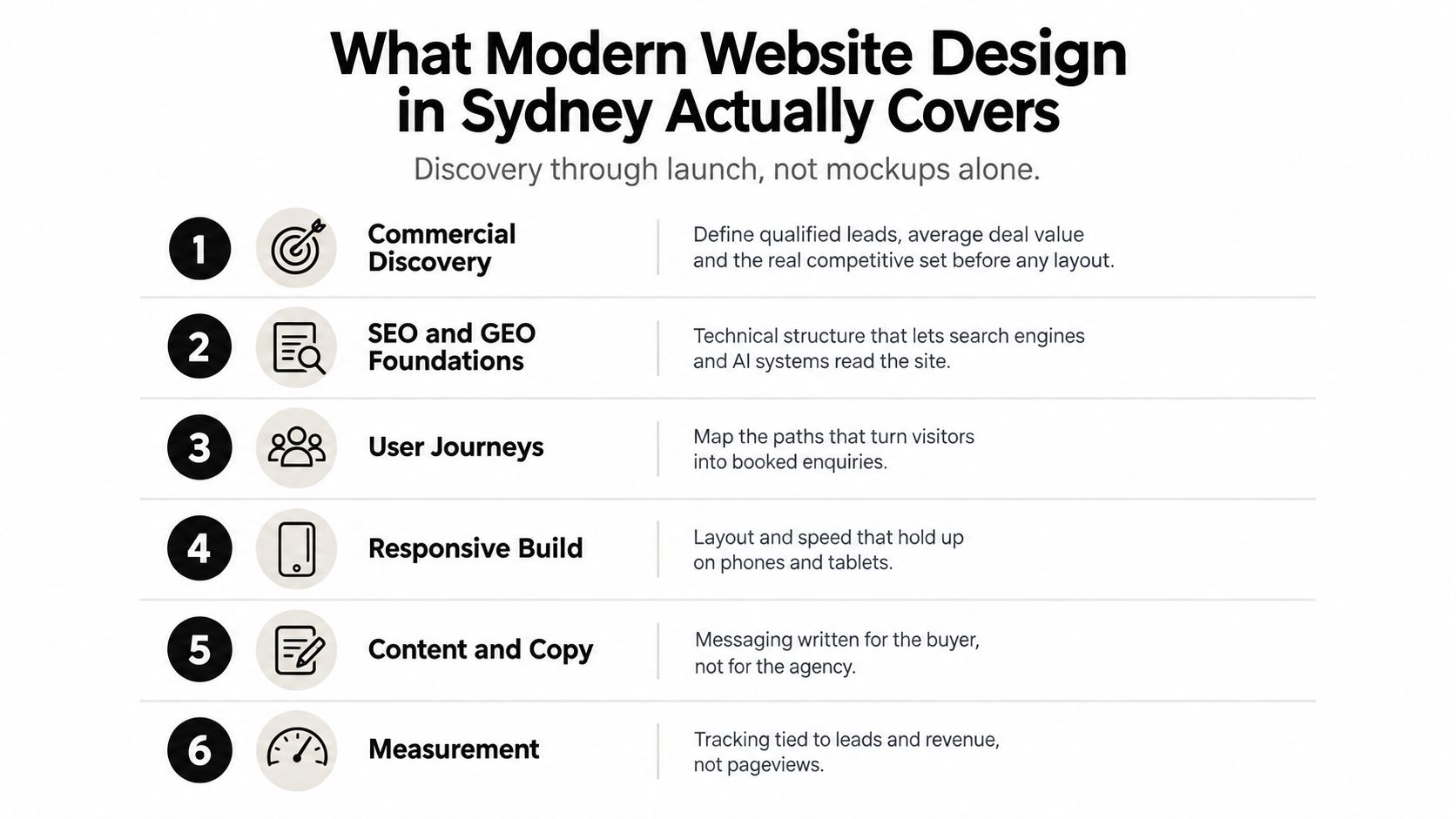
The scope worth paying for
A serious engagement should include:
Commercial discovery, covering qualified lead definitions, deal economics and buyer priorities.
Information architecture, organised around the questions and objections that shape buying decisions.
Responsive design, tested across phones, tablets and desktop layouts, with performance treated as a build requirement.
Conversion copywriting, focused on customer problems and decisions rather than placeholder text.
Technical SEO foundations, including crawlable page structure, relevant schema, internal linking, sitemaps and canonical controls.
Accessibility, with the build reviewed against relevant WCAG 2.2 principles.
GEO readiness, using clear entities, structured information and answer-ready content that Google and AI search systems can interpret.
CMS and integration planning, covering whether WordPress, Webflow or a headless setup fits, alongside CRM, analytics, booking, payment and other required connections.
Post-launch optimisation, based on real visitor behaviour and observed conversion problems.
Mobile usability, speed and trust signals deserve close attention. A service page that explains what you do without showing why a buyer should trust you leaves a major conversion gap. Include testimonials, relevant proof and clear next actions where they support the decision.
A proposal missing several of these areas is not automatically cheaper. It may postpone necessary work until after launch, when changes cost more to coordinate and can disrupt enquiries, search visibility or integrations. Ask the agency to mark each item as included, excluded or dependent on a separate scope.
How Much Website Design Costs in Sydney
Sydney website design prices vary because the work varies. A basic template brochure site and a conversion-focused service platform may both be described as a “business website”, but they require different levels of strategy, content, development, testing and support.
Published price lists should therefore be treated as starting points, not reliable budgets. The useful question is what the fee buys and which important work it excludes.
Provider Type | Typical Investment (AUD) | Scope | What's Usually Included |
|---|---|---|---|
Freelance designer using a template | AUD 3,000 to AUD 8,000 | Basic brochure site | Template configuration, core pages and limited revisions |
Boutique Sydney web design agency | AUD 12,000 to AUD 35,000 | Around 15 to 25 pages, conversion-focused | Strategy, tailored design, copy direction, development and launch support |
Mid-tier agency | AUD 35,000 to AUD 80,000 | Strategy-led build with SEO | Discovery, custom design, technical SEO, integrations and broader project management |
Enterprise or custom headless team | AUD 100,000 or more | Complex digital platform | Bespoke architecture, integrations, governance and multi-team delivery |
These ranges are planning guidance, not a universal tariff. The final scope depends on the number of unique page templates, the depth of copywriting, custom CRM or booking integrations, payment requirements, SEO and GEO work, migration complexity and post-launch optimisation.
What cheaper proposals often leave out
Low quotes commonly exclude discovery, accessibility review, performance testing, analytics configuration and content production. Those items then reappear as variations, or the agency delivers a site without them.
Ask for a line-item breakdown and a written definition of scope. Also ask what happens when the project reaches 80% of the agreed budget. You want to know whether the remaining work is routine completion or a point where the agency expects to renegotiate.
The Raffine Studio guide to website design prices is useful when comparing inclusions rather than comparing headline fees alone. The cheapest site is expensive if it leaves your sales team with the same enquiry problem.
Comparing Sydney Web Design Providers
The right provider depends on your revenue model, sales process and internal capability. A local café chain, a buyers agency, a financial firm and a B2B software company may all need a website, but they don't need the same partner.
Provider Type | Typical Fit | Strengths | Watch For |
|---|---|---|---|
Generalist agency | Established brands with multiple marketing channels | Broader strategy, paid media, development and account management | Higher overhead, slower decisions and less specialist attention |
Specialist boutique | Service firms prioritising conversion, SEO or a specific platform | Focused expertise, direct access to senior specialists and sharper execution | Smaller delivery capacity and fewer adjacent services |
Freelancer | Simple brochure sites, technical tasks or defined builds | Lower overhead, direct communication and flexible scope | Single-person dependency, limited QA and gaps in copy, SEO or strategy |
A full-service agency can make sense when several teams need coordinated delivery. You may value one partner for paid campaigns, brand, web development and ongoing optimisation. The premium should buy more than a larger presentation deck. It should buy stronger delivery capacity and accountability.
A specialist boutique often suits an ambitious professional services firm that needs senior strategic input without a large agency structure. The trade-off is that you should confirm exactly which disciplines are handled internally and which are subcontracted.
Freelancers can deliver excellent work when the brief is narrow and the business already has strong marketing capability. They're less suitable when the site must handle positioning, conversion copy, technical SEO, CRM handoff and ongoing improvement.
Five checks that matter more than the portfolio
Discovery depth: Ask what the agency needs to learn before proposing a sitemap.
Production ownership: Find out who writes, designs, develops and tests the work.
Support after launch: Clarify whether support is included, retained or charged hourly.
Retainer transparency: Separate hosting and maintenance from strategic optimisation.
Relevant proof: Look for experience with your sales cycle and compliance environment.
The Sydney web design services overview from Raffine Studio reflects the broader point. A provider should connect website structure with lead capture, search visibility and follow-up, not treat the website as an isolated object.
Reading Case Studies With a Buyer's Eyes
A case study is marketing collateral until you test it as evidence. Attractive screenshots demonstrate presentation quality. They don't prove that the agency improved qualified enquiries, reduced friction or helped the client produce more commercially valuable conversations.
Start with the brief. A useful case study should identify the client, explain the starting problem and describe the work delivered. It should distinguish between a visual redesign, a technical rebuild, a messaging project, a traffic campaign and a conversion optimisation programme.
Look for a baseline
Outcome claims only mean something beside a starting point. Ask whether the agency can show:
Enquiry volume: Were enquiries qualified, or did total form submissions rise?
Conversion rate: Which page and event were measured?
Lead quality: Did the sales team accept the leads as commercially useful?
Revenue connection: Could the client connect opportunities or closed work to the website?
Traffic source: Did the result come from the redesign, paid media, brand activity or seasonal demand?
Request dated analytics evidence rather than a polished landing-page mock-up. The evidence might include relevant views from GA4, CRM records or reporting dashboards, with sensitive information appropriately redacted.
A result without a baseline is a slogan. A baseline without lead quality is still incomplete.
You should also ask what didn't go to plan. Did the scope change? Did content arrive late? Did the timeline move? Did the client already have strong organic visibility? An agency that can explain constraints is more credible than one that presents every project as effortless.
Verify the story independently
Check that the client is still operating and that the project remains live. Ask for two recent client references you can contact without the agency controlling the conversation.
Use those calls to ask about budget management, delays, responsiveness, post-launch fixes and the difference between what was promised and what was delivered. If the agency can't provide references willing to discuss those subjects, treat its case studies as decoration rather than proof.
SEO, GEO and AI Search Visibility Built Into Design
Sydney buyers increasingly discover service businesses through several routes at once. They may use traditional organic results, Google AI Overviews, Perplexity or ChatGPT Search, then move to a service page before calling, submitting a form or booking a meeting.
Those channels don't use identical systems, but they depend on a shared foundation. The site needs clear structure, reliable technical signals, understandable entities, useful content and an obvious path to action.
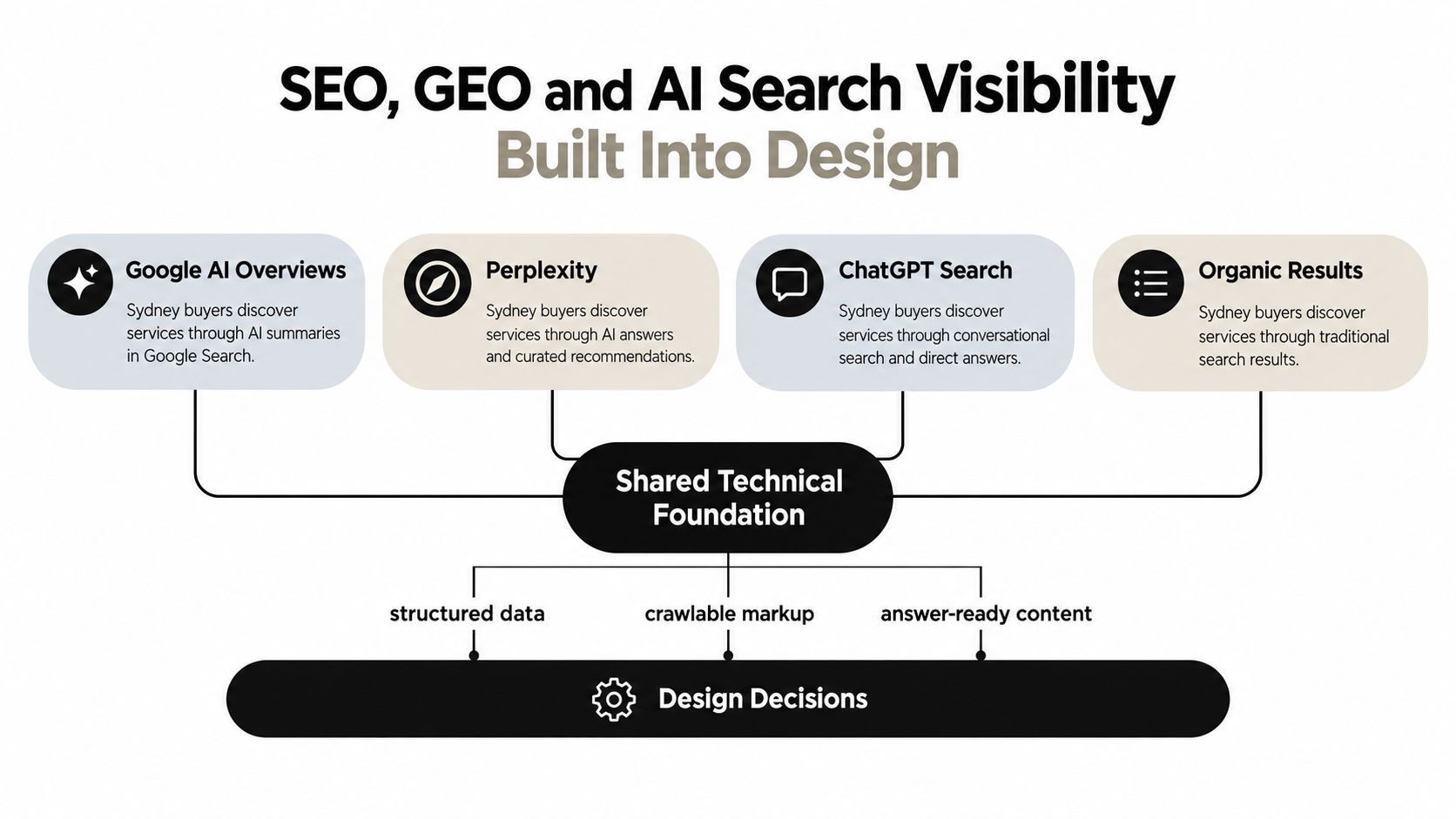
One foundation, several discovery channels
Traditional SEO requires crawlable architecture, logical internal linking, relevant page relationships and structured data where it helps search engines interpret the business. GEO adds a stronger emphasis on entity clarity, answer-ready content, author and organisation information, and credible third-party signals.
The Australian Capgemini discussion of generative engine optimisation makes a commercially useful point, AI visibility and technical health matter beyond simple click and keyword reporting. That changes what your agency should measure. A business needs to know whether search systems understand its services, location, expertise and trust signals, not just whether a keyword moved.
A design team should therefore plan:
Service architecture: Separate pages for meaningful services and buyer intents.
Location relevance: Sydney and suburb-level content where local intent exists.
Structured information: Schema and page formats that clarify organisations, services and FAQs.
Trust evidence: Testimonials, reviews, credentials, case material and useful citations.
Conversion paths: Short forms, click-to-call actions, booking flows and clear next steps.
Local search makes the final point especially practical. A Google Business Profile listing view produces a website click, call or direction request 5% of the time on average, representing about 59 actions per month for the average business and 67 median monthly actions for Australian businesses, according to Beacon Journal's Australian generative search coverage. Your website needs to handle those actions well once local discovery sends people through.
The Raffine Studio article on why GEO matters-matters) provides a useful next step for businesses assessing AI search visibility. Don't bolt SEO, GEO and CRO onto a completed design as separate projects. Build the relationships between them from the first sitemap.
Questions to Ask Before You Sign
Your discovery call is a live audit of the agency. Listen less to the presentation and more to whether the team can explain ownership, dependencies, measurement and risk.
The image above contains the practical checklist. Put these questions in front of the agency and ask for specific answers:
Who writes the code? Confirm whether senior developers, junior staff or external contractors will build the site.
Who runs quality assurance? The person who builds the site shouldn't be the only person checking it.
Who is my day-to-day contact? You need one accountable owner for decisions and delivery.
What happens after launch? Clarify support, updates, security, fixes and optimisation terms.
How is success measured? Agree on the primary lead event and the supporting measures before work starts.
What is fixed and what is variable? Separate approved scope from assumptions, third-party fees and potential variations.
Push beyond the sales answer
Ask for the discovery artefacts that support the proposal. Depending on the project, that could include a conversion review, technical audit, competitor comparison, proposed information architecture or measurement plan.
Ask how the agency manages dependencies between content, design, development and QA. If nobody owns the schedule, the project will drift whenever one input arrives late.
You should also ask how the team works with regulated industries. Finance, law and allied health businesses often need tighter handling of claims, privacy, approvals, accessibility and content governance than a standard brochure site.
A useful challenge: “Show me where this requirement appears in the scope, who owns it and how we'll know it's working after launch.”
Finally, ask for independent references and request source data behind claims about Core Web Vitals, organic traffic or lead volume. A screenshot can be selected to support almost any story. A clear explanation of the date range, conversion definition and traffic source is much harder to fake.
Choosing the Right Path for Your Business
Choose the provider that matches your operating reality, not the proposal with the most impressive visual treatment.
A founder-led Sydney service company with a modest internal marketing function will often benefit from a specialist boutique that can cover strategy, copy, design, development and measurement without the structure of a large agency. An established operator with complex funnels, multiple stakeholders and broader market requirements may need a larger partner with deeper project management and integration capability.
In-house marketing combined with freelance execution can work when the business already owns positioning, content decisions, analytics and performance management. It becomes risky when the freelancer is expected to supply all strategic and technical disciplines alone.
Business Profile | Best-Fit Provider | Watch Out For |
|---|---|---|
Founder-led professional services firm | Specialist boutique | Attractive design without commercial discovery |
Established mid-market business | Full-service agency or experienced boutique team | Multiple stakeholders without clear decision ownership |
Strong internal marketing team | Freelance developer or specialist production partner | Strategy gaps being mistaken for execution problems |
Complex lead funnel with CRM and booking needs | Conversion-focused team with integration capability | A brochure-site scope being stretched into a sales platform |
Before signing, define one commercial outcome, two supporting metrics and a 90-day review window. The outcome might be qualified discovery calls. Supporting metrics might include completed high-intent enquiries and booked calls from priority service pages. The exact measures depend on your business, but they must connect to how your team wins work.
Raffine Studio should be considered in that same commercial context. Its work connects conversion-focused website design with funnel architecture, SEO, AI search visibility, booking flows, CRM handoff and follow-up for Australian service businesses. Whether you choose Raffine or another provider, insist on a disciplined brief, named delivery owners and a measurable post-launch review.
Raffine Studio can audit your current website design in Sydney against buyer journeys, conversion paths, search visibility and lead follow-up, then recommend the highest-priority improvements. Visit Raffine Studio to review its conversion-focused website and funnel services, and start a conversation about building a site that contributes to qualified pipeline rather than merely looking newer.