sydney web design services, conversion web design, Sydney SEO services, lead generation website, website redesign Sydney
Sydney Web Design Services That Turn Traffic Into Calls
by raffiné studio

A Sydney founder gets a steady stream of referrals, sees website visits in Google Analytics, and still has weeks where the phone stays quiet. The site looks polished enough. The service pages are live. Social posts send people to the homepage. Yet visitors leave without booking, enquiring or giving the team enough information to follow up properly.
That isn't primarily a design problem. It's a pipeline problem.
Modern Sydney web design services should connect positioning, page structure, mobile experience, search visibility, lead capture, booking and follow-up. A new colour palette won't repair a vague offer. A faster homepage won't help if the next step is hidden. More traffic won't solve a form that asks too much or a business that takes too long to respond.
This guide is for Australian founders, directors and marketing managers in professional and high-value service businesses, particularly buyers agencies, brokers, law firms, accounting firms, consultants, property businesses and B2B teams. The commercial question isn't whether your website looks current. It's whether the site turns qualified attention into a useful conversation.
A new website may be appropriate when the structure, platform or messaging is limiting growth. A redesign may be enough when the existing brand and search equity are sound but the customer journey is weak. Sometimes the right answer is a conversion audit, improved landing pages and better follow-up, not a full rebuild.
I approach the decision in that order. Start with the journey from discovery to booked call, find the point where prospects drop out, then invest in the smallest change that fixes the commercial constraint. Raffine Studio's role is to help businesses connect website design with SEO, AI search visibility, funnel architecture, booking and lead handling, so the website functions as part of an acquisition system rather than a static brochure.
Why Most Sydney Service Websites Fail to Convert
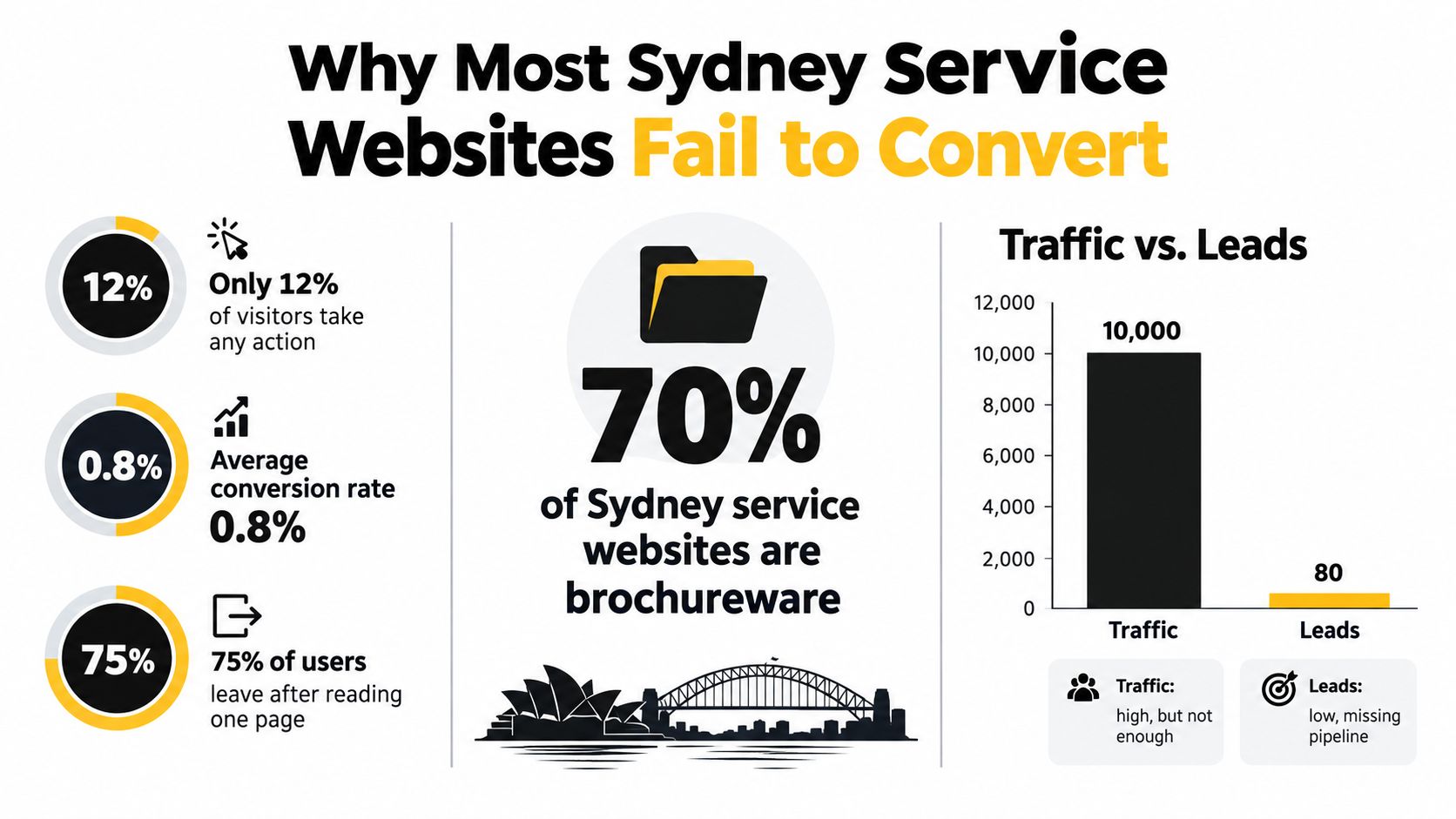
Most service websites fail after the click. The business may have a credible reputation, useful content and a recognisable brand, but the website doesn't tell a visitor what to do next or why they should do it now.
The Australian market makes this a substantial issue. The Australian Small Business and Family Enterprise Ombudsman data portal reports that 97.3% of Australian businesses were small businesses in June 2025, and 92% of those small businesses had turnover under $2 million. Industry reporting also indicates that 59% of Australian small businesses don't have a website, rising to 65% in regional areas. For Sydney agencies, the opportunity isn't limited to replacing outdated designs. Many owner-operated firms still need a first serious acquisition system.
A site that exists but behaves like a brochure creates a different problem. Australian digital benchmarks found that 85% of SMEs displayed their service offerings on their websites, but only 30% of websites passed a speed test, while just 36% of Australian small businesses were using SEO efficiently. The same reporting found only 11% of businesses were fully embracing digital strategies. These figures point to a market where visibility and service information are common, but execution is inconsistent. Australian digital marketing statistics support the commercial case for building around performance and conversion, not presentation alone.
The mobile journey is usually the weak link
Sydney prospects often arrive from a social post, a search result, a referral message or a phone. On mobile, a long homepage, buried contact details and a multi-field form create friction immediately. Australian website benchmarks commonly place mobile conversion around 1.2% to 1.8%, compared with desktop conversion around 2.1% to 3.2%, as reported in Australian conversion rate optimisation benchmarks.
That gap changes the priority. If mobile visitors are reaching the site but can't see the offer, trust signals and next action quickly, buying more traffic is often wasteful. Short forms, click-to-call options, prominent booking actions and service-specific landing pages usually deserve attention before another awareness campaign.
Commercial rule: Treat every page as a decision path. If a visitor can't identify the offer, evidence and next step without effort, the page is costing you enquiries.
Performance adds another layer. Australian benchmark work on leading local retail sites recorded average mobile PageSpeed scores of roughly 52/100, about 159 requests per page, page sizes near 3 MB and average loading time of 4.13 seconds. The ACCC web performance testing report explains that network conditions, page weight and browser loading behaviour shape page experience. A conversion-led build should compress assets, defer non-critical scripts and reduce unnecessary requests before launch.
What Sydney Web Design Services Typically Include
A serious web project starts before visual design. The team needs to understand who arrives, what they need to believe, what objections stop them and which action signals commercial intent. A Sydney buyers agency, for example, needs a different journey from a conveyancer, mortgage broker or consulting firm.

Strategy and messaging come first
The foundation is a clear value proposition. It should identify the audience, problem, service and meaningful difference without forcing visitors to decode internal business language.
Good strategy produces practical outputs:
Audience priorities: Separate high-value prospects from low-fit enquiries.
Page hierarchy: Match pages to the questions people ask before contacting you.
Proof plan: Decide whether testimonials, credentials, process detail, case material or local expertise will reduce hesitation.
Call-to-action logic: Use a low-friction action for early-stage visitors and a stronger booking action for ready buyers.
Design and user experience then make that strategy usable. Responsive layouts, readable type, clear navigation and intentional visual hierarchy matter because they reduce cognitive effort. Premium design should support the message, not compete with it.
Funnel architecture connects pages to pipeline
A funnel isn't necessarily a complicated multi-step campaign. For a professional service firm, it might be a service page leading to a short qualification form, then a calendar booking and confirmation email. For a broker, it may include an eligibility question, a compliant scenario explanation and a prompt to speak with the team.
Landing pages should have one dominant job. Social traffic should arrive at a relevant page rather than an unstructured homepage. Search traffic should find an answer that matches its intent, followed by a clear route to an enquiry or consultation.
SEO and Generative Engine Optimisation, or GEO, belong in the information architecture. That includes useful service pages, descriptive headings, internal relationships between topics, structured information and content that answers specific questions clearly. Google and AI assistants such as ChatGPT, Gemini and Perplexity need understandable, well-organised information, not just attractive layouts.
Integrations and measurement complete the system
A website should pass lead information into the tools the team already uses. Depending on the business, that may include a CRM, email platform, calendar, analytics platform or internal notification process. Automation can send an immediate acknowledgement, assign ownership and remind a prospect who hasn't booked.
The proposal should clearly include:
Strategy and messaging
UX and responsive design
Conversion paths and forms
Technical SEO foundations
Performance optimisation
CRM, calendar or email integrations where required
Analytics, attribution and conversion event setup
Launch testing and post-launch review
Nice-to-have extras include elaborate animations, large resource libraries and decorative functionality that doesn't improve a decision path. A proposal that lists design deliverables but says little about lead routing, measurement or booking should be treated as a design engagement, not a lead system.
How to Compare Sydney Web Design Agencies Without Guesswork
Portfolios are useful for judging taste, but they don't tell you whether an agency can diagnose a weak pipeline. Two websites can look equally polished while one produces clear enquiries and the other creates work for the sales team without useful context.
Compare agencies against the commercial system they propose. Ask each provider to explain the visitor journey for your main audience, the pages that support it, the conversion event being measured and what happens after a form submission.
Evaluation Criteria | What Good Looks Like | Why It Matters |
|---|---|---|
Strategy and positioning | The agency can explain your audience, offer, objections and competitive position before showing layouts. | Clear positioning filters poor-fit traffic and gives the site a persuasive job. |
Conversion architecture | Service pages, landing pages, forms and booking actions work as one path. | Visitors need a practical route from interest to conversation. |
Mobile performance | The proposal addresses page weight, image handling, scripts and mobile testing. | A slow or awkward mobile experience loses intent before contact. |
SEO and GEO | Content structure supports search intent and clear answers for Google and AI search tools. | Discovery depends on useful, understandable information. |
CRM and follow-up | Leads are routed, acknowledged and assigned rather than left in an inbox. | A captured lead still has commercial value only if someone handles it. |
Reporting | Reports focus on enquiries, qualified leads, bookings and source attribution. | Traffic and impressions don't prove that the website is creating pipeline. |
Ownership and scope | The proposal defines content responsibilities, integrations, testing, training and support. | Ambiguous scope creates delays and expensive add-ons. |
Use the Sydney web design agency evaluation guide when preparing shortlist questions, but keep the scoring tied to your own sales process. An agency should be able to tell you what it would measure first, what it wouldn't change yet and how it would protect useful search visibility during a redesign.
Red flags in proposals
Be cautious when the pitch leads with animations, awards or a homepage concept but doesn't ask how leads are currently qualified. A design-only shop may also promise SEO without discussing search intent, content ownership or measurement. Another warning sign is a proposal that treats every page as equal, even though a high-intent service page and an about page perform different jobs.
Ask for a sample reporting view. You don't need a complicated dashboard. You do need to know whether the business can connect a source, page, action and sales outcome. If the agency can't describe that chain in plain English, it probably won't manage it after launch.
What Buyers Agents Brokers and Professional Services Should Expect
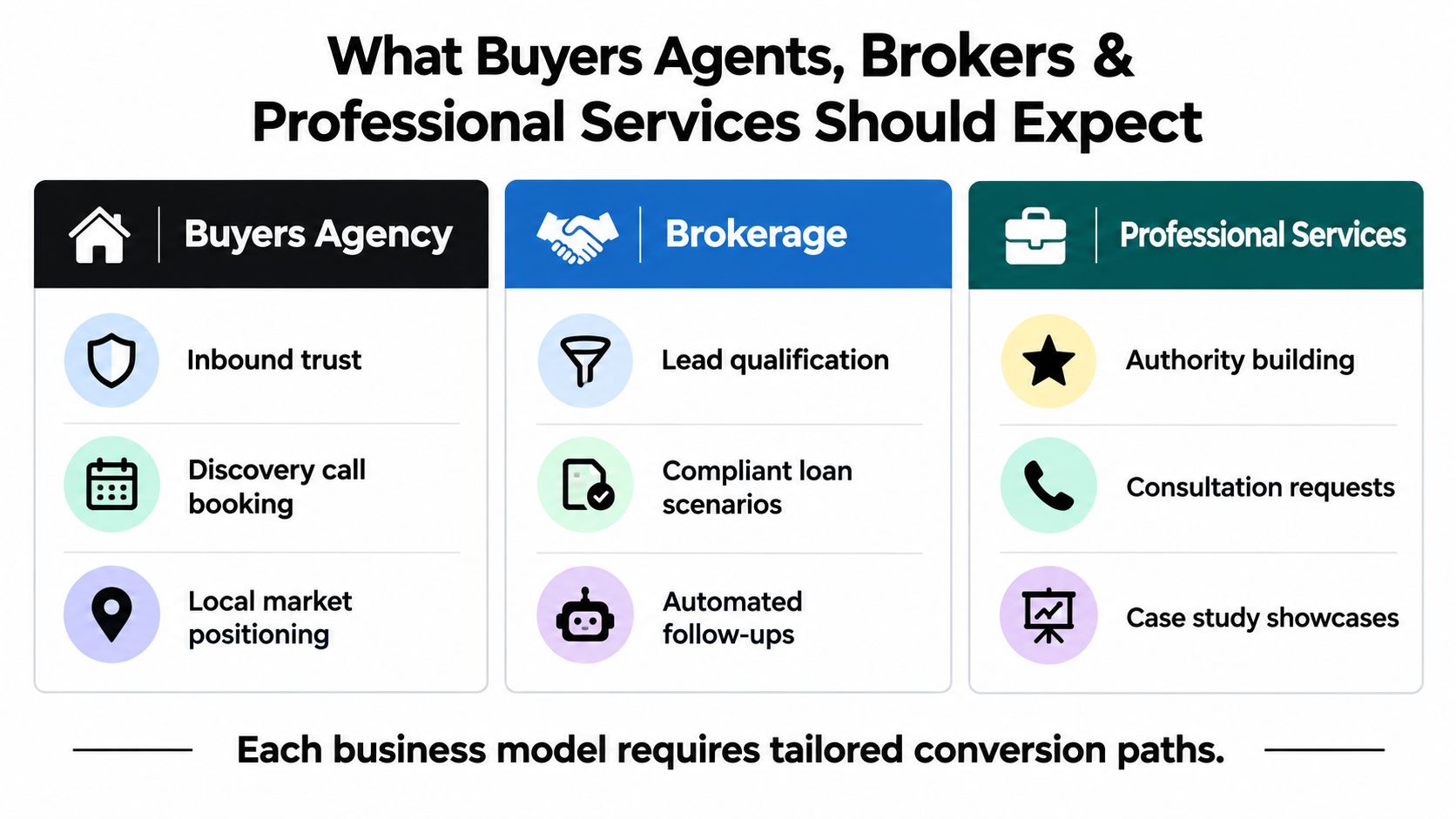
Different service models need different conversion paths. A buyer's agency sells trust, judgement and local understanding before a prospect is ready to discuss a property brief. A mortgage broker needs to qualify intent, respond quickly and handle proof carefully. A professional services firm needs to demonstrate authority while filtering enquiries that don't fit its expertise or commercial model.
Buyers agencies need confidence before contact
The buyer's agency site should answer practical questions about location, property type, process, fees and suitability. It should make local knowledge visible without turning the homepage into a suburb directory.
The strongest journey usually combines:
Specific positioning: Explain who the agency helps and what type of buying problem it solves.
Evidence with context: Use market insights, process detail and relevant outcomes without making unsupported promises.
A discovery call path: Let a qualified prospect book without searching through the navigation.
Useful qualification: Ask enough to prepare the first conversation, but not so much that an interested buyer abandons the form.
Brokers need speed and review governance
A broker's site must help a prospect describe their situation and understand the next step. The form should capture useful context, while the follow-up process alerts the right person and acknowledges the enquiry promptly.
Speed-to-lead has a direct commercial effect. One cited benchmark says responding within 5 minutes instead of 30 minutes can make a lead about 21 times more likely to qualify, while the average company takes 42 hours to respond to a web enquiry and 23% never respond. These figures come from Australian speed-to-lead benchmarks. Treat them as a process warning, not a reason to add more traffic.
Testimonials require equal care. The ACCC found potentially misleading review practices at 37% of 137 businesses in its online review sweep, including fake positive feedback, hidden negative reviews and undisclosed incentives, as detailed in the ACCC online reviews and testimonials report. Brokers should use transparent collection and moderation processes, retain provenance and avoid presenting review schema in ways that overstate what the page supports.
Professional services need authority and qualification
Law firms, accountants, consultants and financial firms rarely benefit from a generic “contact us” button repeated across every page. They need service-specific entry points, clear expertise signals and forms that identify the matter, business type or need before the first call.
The web design approach for professional services should reflect the firm's buying cycle. Some prospects need a concise consultation request. Others need a guide, a diagnostic conversation or evidence that the team handles work of comparable complexity. The site should make that distinction visible.
Local Case Patterns That Show What Good Looks Like
A useful case pattern doesn't require a fabricated client name or a dramatic before-and-after statistic. It starts with an observable operating problem, identifies the change in the journey and tracks the commercial output that matters.
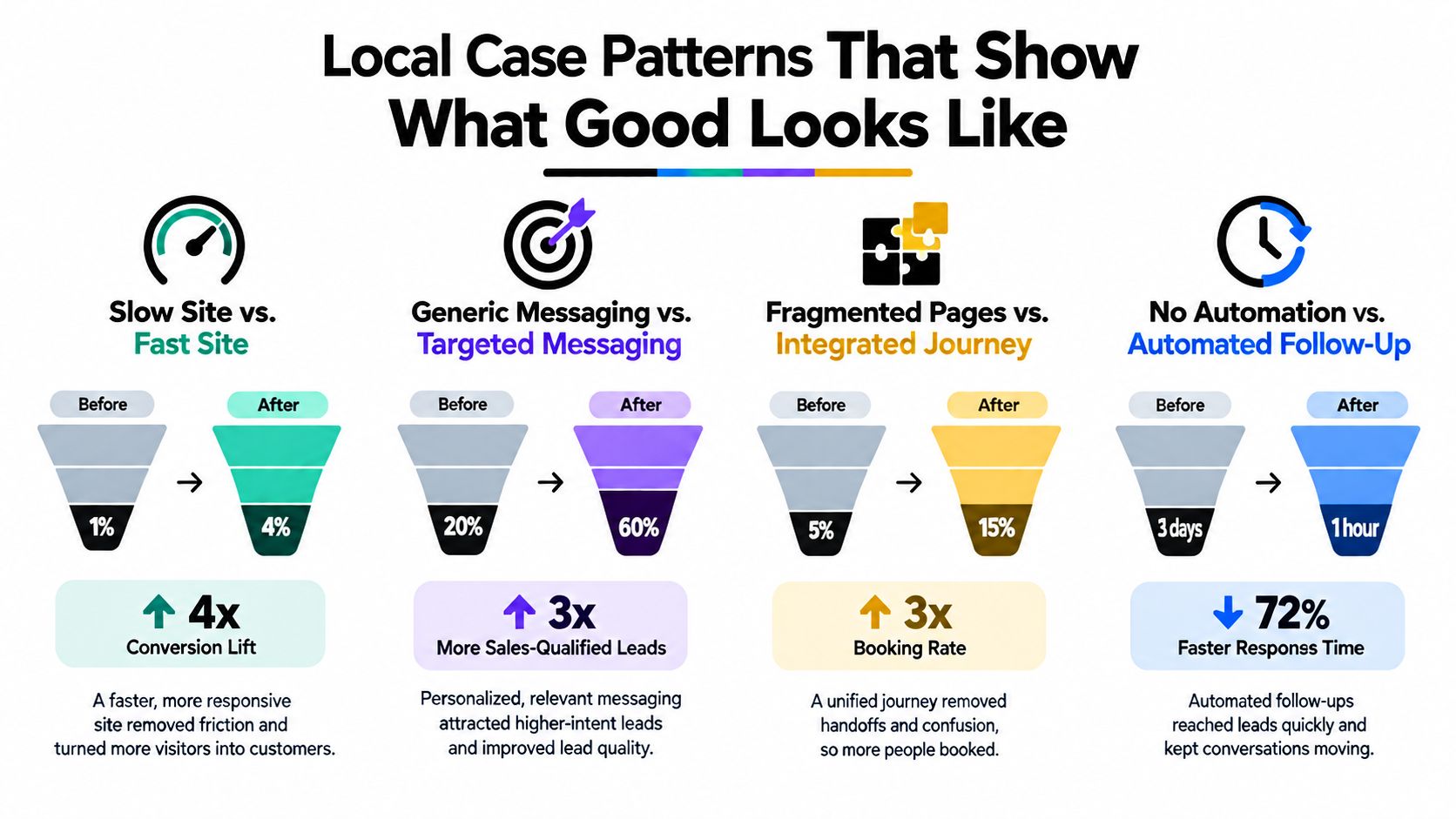
For a Sydney service firm, the first pattern is often a slow mobile journey. The homepage carries oversized imagery, third-party scripts and several competing messages. The remedy is not “make it faster”. The team removes unnecessary weight, prioritises the first screen, simplifies the route to the service page and measures whether qualified visitors reach the contact action.
Four patterns worth auditing
Generic messaging versus targeted messaging. A firm may describe itself with broad claims that every competitor can use. Rewriting around a defined audience and high-value problem gives search pages, social posts and sales conversations a shared position. Track lead fit, not just form volume.
Fragmented pages versus an integrated journey. A prospect might arrive on a blog post, click to an unrelated services page and then hunt for contact details. Connecting educational content, proof, service detail and booking creates a more deliberate route. Track the page sequence and the action taken after each step.
Manual follow-up versus owned lead handling. An enquiry can land in a shared inbox while the team is in meetings or on site. A confirmation message, CRM handoff, task assignment and reminder sequence reduce the chance that a good prospect disappears without an answer.
Search visibility versus answer visibility. A business can rank for a narrow query yet remain difficult for an AI assistant to understand. Clear service definitions, location context, authoritativeness signals and direct answers help systems interpret the business when people ask for recommendations or explanations through AI tools.
Track the system, not the decoration: conversion rate, booked discovery calls, qualified lead rate, source attribution and response time tell you more than a gallery of redesigned screens.
Australian lead-generation websites commonly convert at about 1% to 3% overall, while lead-generation businesses are often placed around 1% to 2.5%, according to Australian website conversion expectations. Another Australian funnel benchmark estimates visitor-to-lead conversion at 2% to 5%, with further stages covering MQLs, SALs, SQLs and opportunities, as outlined in the Australian lead-generation conversion calculator. These ranges are context, not promises. Your useful benchmark is the current relationship between qualified visits, enquiries, booked calls and closed work.
Next Steps to Turn Your Website Into a Lead System
Start with an audit that follows the visitor rather than the sitemap. Open the site on a phone, arrive through a service page and try to book a conversation without using internal knowledge.
Check these points:
Message: Can a suitable prospect identify the service, audience and benefit quickly?
Proof: Does each major service page provide evidence that addresses real objections?
Action: Is there one obvious next step, with a lower-friction option for early-stage visitors?
Mobile: Can visitors call, submit an enquiry or book without pinching, hunting or rereading?
Performance: Are images, scripts and page elements helping the decision or delaying it?
Follow-up: Who receives the lead, how fast is it acknowledged and where is the next task recorded?
Visibility: Do the site's pages answer the questions prospects ask in Google and AI search tools?
Measurement: Can you distinguish traffic from enquiries, qualified leads and booked calls?
A full rebuild makes sense when the platform, structure and content model prevent these improvements. A targeted redesign is more sensible when the existing site has useful rankings, a credible brand and serviceable content. Conversion optimisation may be the right first move when the main problem is a weak booking path, unclear forms or disconnected follow-up.
When briefing an agency, ask for the proposed customer journey, the conversion events, the mobile performance plan and the lead handoff process. Also ask what the team will deliberately leave out. Good strategy includes restraint. A page, integration or animation that doesn't support the acquisition path is budget allocated to appearance rather than pipeline.
Read the guide to how website design and SEO work together before approving a redesign, particularly if organic search already contributes enquiries. The safest project protects useful visibility while improving clarity, speed and conversion.
Raffine Studio builds conversion-focused websites and funnel systems for Sydney buyers agencies, brokers, professional services firms and established Australian businesses. Visit Raffine Studio to review your current conversion path and start a practical conversation about design, search visibility, booking and follow-up.