lead generation funnel, conversion optimisation, B2B service funnels, discovery call booking, speed to lead
How to Build a Lead Generation Funnel for Services
by raffiné studio

A visitor arrives on your website after searching for a buyers agent, commercial lawyer, finance broker or specialist consultant. They read a service page, glance at your credentials, then leave because the next step is vague, the form feels intrusive or nobody responds quickly enough. More traffic won't fix that problem. You need a lead generation funnel that turns relevant attention into a clear, trackable path towards a qualified discovery call.
For Australian professional service firms, the funnel isn't just a marketing diagram. It's the connection between website messaging, search visibility, conversion design, CRM routing, follow-up and pipeline revenue. The strongest systems meet buyers at the right level of intent, remove unnecessary decisions and give sales a fast opportunity to continue the conversation.
The Commercial Reality of Australian Lead Funnels
Many professional service websites still operate as digital brochures. They explain what the firm does, list a few services and provide a generic “Contact us” button. That structure may support credibility after a referral, but it rarely gives a new prospect a persuasive reason to act now.
The assumption that more visitors will automatically create more enquiries is especially risky in Australia. One Australian conversion benchmark reports average desktop conversion of 3.2%, compared with 1.8% on mobile, while mobile represents more than half of national web traffic. The same benchmark places average visitor-to-contact conversion at 1.97%, or roughly 20 contacts from 1,000 visitors. These figures are reported in Australian conversion rate optimisation guidance.
That gap changes the commercial priority. A buyers agency, broker or law firm can't treat mobile layout, page speed, form length and booking access as cosmetic details. They directly influence how much of the existing demand reaches the pipeline.
Traffic is not the same as opportunity
A generic homepage asks visitors to do too much thinking. They must work out whether the firm serves their situation, which service applies, whether the business is credible and how to make contact. High-intent prospects may tolerate some research, but they won't always tolerate confusion.
A focused funnel gives each audience a narrower route:
The right promise: State the problem and outcome in the language the prospect used to find the business.
The right proof: Show relevant experience, process clarity, credentials, testimonials or useful expertise near the decision point.
The right action: Ask for one sensible next step, such as a short qualification form or a discovery-call booking.
The right device experience: Make the form, phone number and calendar easy to use with one hand on a mobile screen.
The Australian eCommerce benchmark of around 1.78% conversion in late 2024, also cited in the same conversion guidance, reinforces the broader point. Most visitors don't enquire or book. Service firms should therefore improve the path for existing high-intent traffic before assuming they need a larger audience.
Practical rule: If a page attracts the right visitor but doesn't make the next step obvious within seconds, fix the page before increasing traffic spend.
This is also why the cost of a website design project should be assessed against the commercial system it creates, not just the visual finish. A website that connects search demand to a credible offer, short form, booking path and follow-up process is a sales asset. A polished brochure without those mechanisms remains dependent on referrals and manual effort.
Mapping the Buyer Journey for High-Value Services
A business owner rarely appoints a commercial lawyer, buyers agent, broker or specialist consultant after one casual visit. The buyer may first search for a problem, return to compare providers, review credentials, ask a colleague, inspect service details and only then decide whether to book.
A useful funnel maps those decisions rather than forcing every visitor straight into a sales conversation. It distinguishes between people who are discovering a problem, people evaluating solutions and people ready to discuss their situation.

Use stage-specific actions
The funnel needs an appropriate conversion action at each point.
Awareness content answers the problem. A construction firm might explain how to assess project risk. An accounting firm might clarify a complex reporting obligation. The visitor may not be ready to speak with anyone, so the page should earn a return visit or offer a useful next step without forcing a consultation.
Consideration content helps the prospect compare approaches. Service pages, process explanations, practical guides and evidence of relevant expertise work here. The reader should understand what the firm does differently and what engaging it involves.
Decision pages remove the final barriers. They should explain who the service is for, what happens in the first conversation, what information the prospect should prepare and how quickly the firm responds. A discovery call is more persuasive when it feels specific rather than like an open-ended sales trap.
Retention begins after the initial engagement. Clear onboarding, useful updates and a professional handover can create repeat work and referrals, particularly in relationship-led services.
The maths exposes weak architecture
Australian lead-generation guidance gives indicative stage ranges of 5% to 10% from visitors to marketing qualified leads, 20% to 30% from MQL to sales accepted lead, 10% to 20% from SAL to sales qualified lead, 25% to 30% from SQL to opportunity, and 20% to 40% from opportunity to close. The ranges and midpoint illustration are provided in Australian lead-generation funnel benchmarks.
The midpoint illustration for 1,000 visitors produces roughly 75 MQLs, 19 SALs, 3 SQLs and about 1 closed deal. That isn't a forecast for your firm. It's a useful diagnostic showing why a homepage-to-client expectation is commercially unrealistic. Small losses at several stages leave very few opportunities at the bottom.
Another Australian benchmark reports B2B landing-page conversion between 8.8% and 18.2%, while general B2B websites average 2% to 5%. It also reports average landing-page conversion around 2.35% to 4.14%, with top-performing pages exceeding 11.45%. Those figures appear in Australian digital marketing statistics and benchmarks.
The lesson is not to promise a particular result. It's to create a dedicated path for each meaningful intent. A page for “commercial property buyer advocacy Sydney” should not send the visitor to a homepage designed for every service and audience. A page for “mortgage broker investment lending” needs different proof, questions and calls to action from a page for first-home buyers.
A practical funnel map should record:
Entry intent: The search, referral, social post or AI answer that introduced the firm.
First conversion: A guide download, enquiry, callback request or booking.
Qualification signal: Service need, location, timing, budget suitability or business type.
Sales handoff: The person responsible, response deadline and next action.
Outcome: Qualified opportunity, unsuitable lead, proposal, client or lost deal.
The principles of funnel building become commercially useful only when each stage has an owner and a measurable next step. Otherwise, the business has content and forms, but no operating system for turning interest into revenue.
Designing High-Converting Landing Pages and Offers
A landing page should exist because a particular audience has a particular reason to act. Sending every visitor to the homepage usually creates a mismatch between the promise that attracted them and the page they see.
A strong service landing page has one audience, one offer and one primary next step. That doesn't mean the page must be short. It means every section supports the same decision.
Build the page around intent
Start with the source. If the visitor arrives from a search for a buyers agent, the headline should address buyers agency, not merely say “Property services”. If the visitor comes from a LinkedIn post about contract risk, the page should continue that conversation rather than introduce an unrelated list of capabilities.
Then structure the page in a deliberate order:
Make the outcome clear above the fold. Explain who the service helps, what problem it addresses and what the visitor can do next.
Add immediate trust. Use relevant credentials, sectors served, process detail, proof of expertise and clear business information. Avoid vague claims that could apply to any competitor.
Show the method. A short explanation of the first conversation, assessment, recommendation and engagement process reduces uncertainty.
Reduce form friction. Ask only for information needed to respond intelligently. A short form can qualify without making the visitor write an essay.
Repeat the next step logically. Place the booking or enquiry action after the value proposition, process explanation and key proof, not only in the header.
Design for mobile first. Keep buttons easy to tap, fields readable and the booking path accessible without excessive scrolling.
Make the offer specific enough to choose
“Contact us” is an instruction, not an offer. A more useful action might be “Book a property strategy call”, “Request a commercial lending review” or “Discuss your business dispute”. The wording should set an accurate expectation about the conversation.
For professional services, a discovery call can be the offer, but it still needs boundaries. Explain who should book, what will be discussed and whether the call is an initial assessment, planning conversation or fit check. That clarity filters unsuitable enquiries while making the right prospect more comfortable.
Use supporting pathways for visitors who aren't ready to book. A practical checklist, service comparison, diagnostic questionnaire or well-organised email sequence can capture lower-intent interest. Don't force that visitor into a high-commitment action, but don't leave them with nowhere to go either.
The best landing page doesn't persuade everyone. It helps the right prospect recognise that the next step is relevant and safe.
Review the lead-generation landing page framework alongside the actual sales process. The page, form and calendar should use consistent language. If the page promises a strategy discussion but the form asks for a generic message and the confirmation email says someone may respond later, the funnel creates doubt at the point of action.
Automating the Speed-to-Lead Follow-Up Sequence
A funnel can attract strong enquiries and still produce poor commercial results if nobody responds promptly. Manual lead handling creates gaps between a form submission, an internal notification, a first reply and a booked meeting. High-intent prospects often contact more than one provider, so those gaps give competitors an opportunity to continue the conversation first.
Australian benchmark guidance reports that responding within 5 minutes makes a business about 21 times more likely to qualify a lead than waiting 30 minutes. It also reports that the odds of contacting a lead can fall by up to 100 times between minute 5 and minute 30. These figures are cited in Australian lead response time guidance.
The precise outcome will vary by service, enquiry quality and sales process. The operational conclusion is consistent: treat a new enquiry as an active sales event, not an item to process last.
Build the handoff before writing the emails
A practical sequence looks like this:
Capture: Record form submissions, tracked calls and booking requests in one CRM record.
Classify: Apply source, service, location and qualification tags so the right person sees the context.
Acknowledge: Send an immediate SMS or email confirming receipt and setting a realistic expectation.
Offer access: Provide a direct calendar route where a discovery call is appropriate.
Alert the team: Notify the responsible staff member with the prospect's details and requested service.
Nurture: If the prospect doesn't book, send useful, relevant follow-up rather than a series of generic reminders.
Escalate: Create a task when a human response, eligibility check or urgent call is required.
The automation should support the relationship, not impersonate it. An instant acknowledgement can confirm that the enquiry arrived, but a professional service business still needs a person to review suitability and provide a considered response.

Connect forms, calendars and CRM records
The common failure is building each component separately. The website form sends an email, the calendar sits in another system and the sales team keeps notes elsewhere. That arrangement makes attribution unreliable and leaves staff to copy information manually.
Use a workflow that preserves the original context. A form submission should carry the landing-page source, service selected, campaign details and answers to qualification questions into the CRM. A booking should update the same record rather than create a second, disconnected contact.
The confirmation page also matters. It should tell the prospect what happens next, offer preparation guidance and provide an alternative contact route if the matter is time-sensitive. This is a small part of the experience, but it prevents uncertainty after conversion.
Review the sequence with the people who answer enquiries. Automation fails when it routes leads to a shared inbox nobody owns, sends messages outside business hours without a clear expectation or asks the sales team to repeat information already collected. The right system gives staff better context and more time for the human parts of qualification.
Optimising for AI Search and Generative Engines
A lead generation funnel built only for Google clicks misses how some buyers now discover professional service firms. Australian guidance reports that AI Overviews appear in 39% of searches, while separate reporting says ChatGPT referral traffic grew 206% year on year from January 2025 to January 2026. These figures are cited in Australian AI search discovery analysis.
The commercial change is more significant than a new referral source. An AI assistant may summarise several providers, answer an early research question and send the buyer directly to a service page. That can compress the awareness stage and make the firm's clarity, evidence and reputation important before the first website visit.
Make the business easy to understand and cite
AI visibility starts with useful, well-structured information. A service business should define:
Who it serves: Include industries, locations, matter types or client situations where relevant.
What it does: Describe services in plain language, including the problem and practical outcome.
How engagement works: Explain the first step, assessment process, scope and likely decision path without making unsupported promises.
Why it is credible: Bring together relevant expertise, author information, business details, original insight and verifiable proof.
Which questions it answers: Cover comparison, pricing approach, suitability, process, risks and common objections.
The Australian AI Visibility Index evaluated 473 buyer-oriented questions across ChatGPT, Perplexity and Google AI Overviews. Its question set included recommendations, pricing, comparisons, brand-specific queries and problem-based searches, as described in coverage of the Australian AI Visibility Index. That range shows why publishing only broad awareness articles isn't enough. A firm must be answerable across the questions buyers ask before they book.
Connect visibility to conversion
Every authoritative article should give the reader a sensible route into the funnel. A problem-based article can point to a relevant service page. A comparison page can explain who should request a consultation. A brand-specific page can make the booking process and qualification criteria clear.
Don't write for an imaginary algorithm. Write information that a buyer can understand, verify and act on. Clear headings, direct answers, descriptive internal links and consistent business details help both human readers and AI systems interpret the offer.
Generative Engine Optimisation therefore belongs at the top of the same commercial system as SEO, landing pages and CRM follow-up. Visibility without a credible destination creates attention. A well-structured destination without visibility remains difficult to discover.
Measuring Funnel Performance and Pipeline Attribution
Form fills are useful, but they aren't the commercial outcome. A professional service firm can generate a healthy volume of enquiries and still struggle if the leads are poorly qualified, sales meetings don't occur or proposals don't become clients.
Measure the funnel as a sequence of decisions. The specific labels will vary by CRM, but the logic should remain consistent:
Acquisition: Record the first meaningful source, such as organic search, paid search, referral, social content or AI-assisted referral where available.
Engagement: Track the landing page, service viewed, form started and booking action.
Qualification: Mark whether the enquiry fits the firm's service, location, timing and commercial criteria.
Sales activity: Record response time, conversation status, meeting attendance and follow-up tasks.
Pipeline: Track opportunity creation, proposal or engagement stage, outcome and value.
Retention: Connect repeat work and referrals back to the original client record where the CRM supports it.
Use one source of truth for the contact and preserve campaign information as the lead moves through the pipeline. Don't rely on platform dashboards alone. Ad platforms can report clicks and conversions, analytics tools can report sessions and events, but the CRM usually holds the information that determines whether the enquiry became commercially useful.
Choose attribution that supports decisions
First-touch attribution helps answer which channel introduced the buyer. Last-touch attribution shows what finally prompted action. Neither tells the complete story for a high-value service that may involve search, a referral, several articles, a service page and a booking conversation.
A practical approach is to retain both first and latest meaningful source, then review the assisted interactions manually or through a multi-touch model where the data is reliable. The aim isn't to create perfect certainty. It's to avoid cutting a channel because it rarely receives the final click even though it introduces suitable buyers.
Review performance by landing page and service, not just by website total. Ask:
Which pages attract visitors who become qualified enquiries?
Which sources produce meetings rather than only forms?
Where do prospects abandon the form or booking process?
How quickly does the team respond?
Which qualification criteria predict a useful sales conversation?
Which opportunities close, and what was their original entry point?
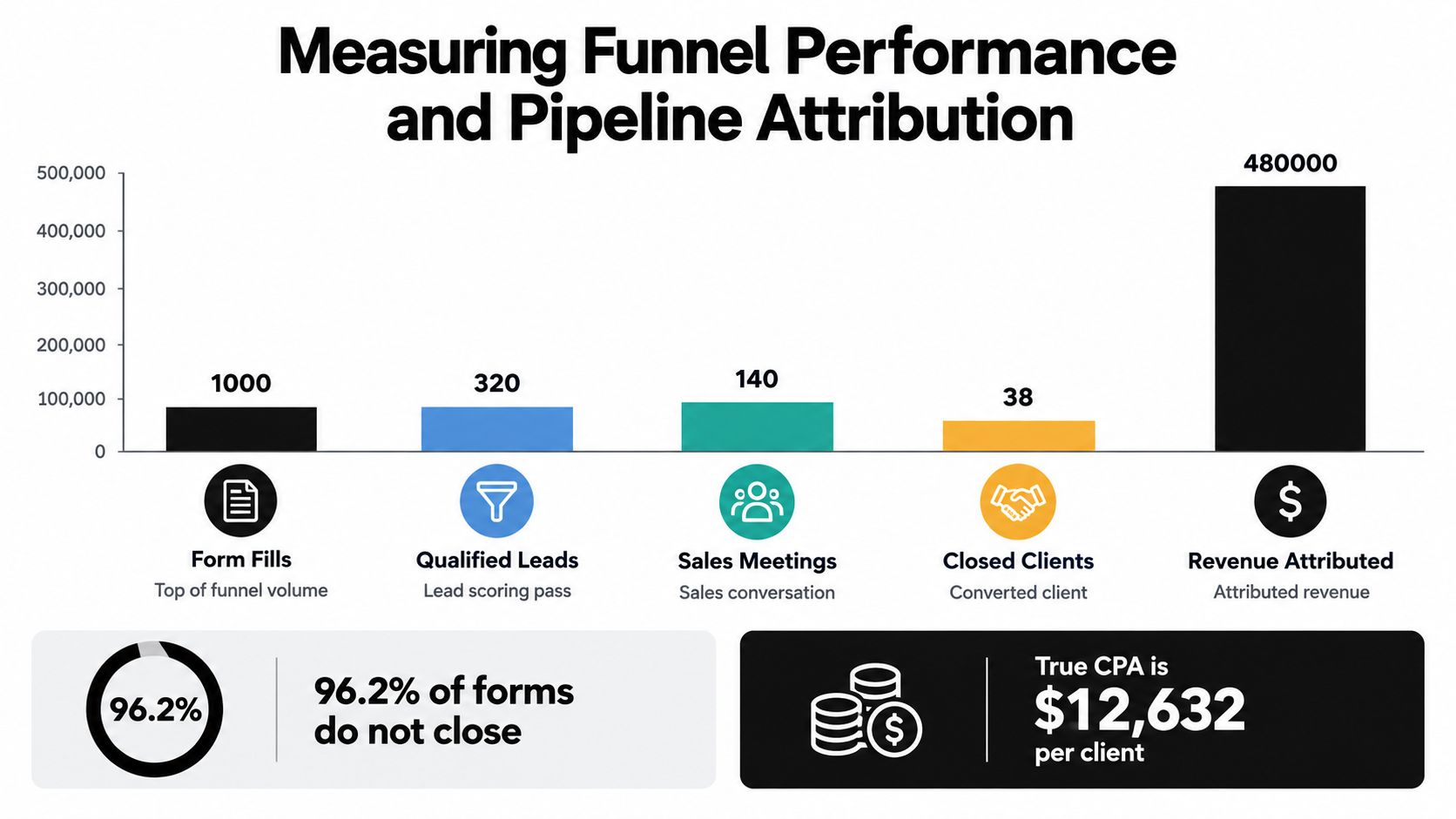
Measure the handoff: A lead-generation report is incomplete until it shows what happened after the form was submitted.
Set a regular review with marketing and sales together. Marketing should see which sources create suitable opportunities. Sales should explain why leads were accepted, rejected, delayed or lost. That feedback should then improve targeting, page messaging, qualification questions and follow-up.
Raffine Studio helps Australian service businesses connect conversion-focused websites, landing-page funnels, SEO, AI search visibility, booking automation, CRM handoff and pipeline reporting into one lead generation system. Visit Raffine Studio to review how your website could turn high-intent traffic into qualified discovery calls and measurable opportunities.