seo for lead generation, lead generation SEO, conversion optimisation, AI search visibility, SEO strategy
SEO for Lead Generation That Books Qualified Calls
by raffiné studio

A service business can rank well, attract steady organic traffic and still have an empty calendar. The usual problem isn't SEO alone. The website attracts people who aren't ready to act, gives serious prospects no clear next step, or sends enquiries into a slow manual follow-up process.
That's why SEO for lead generation should be judged by the quality of the pipeline it creates. For a law firm, buyers agency, broker, accountant, construction company or B2B consultancy, the commercial question is simple: does search visibility produce qualified enquiries and booked discovery calls?
In Australia, 46% of Google searches have local intent, while 88% of mobile searchers contact a business within 24 hours. 78% rely on smartphones for local business searches, and 93% search online for hyperlocal businesses. Those figures make the opportunity clear, but they also raise the standard. Your business needs to appear for the right search, present a credible offer, make booking easy and respond quickly. (Australian local search behaviour and AI search)
What SEO for Lead Generation Really Means for Service Businesses
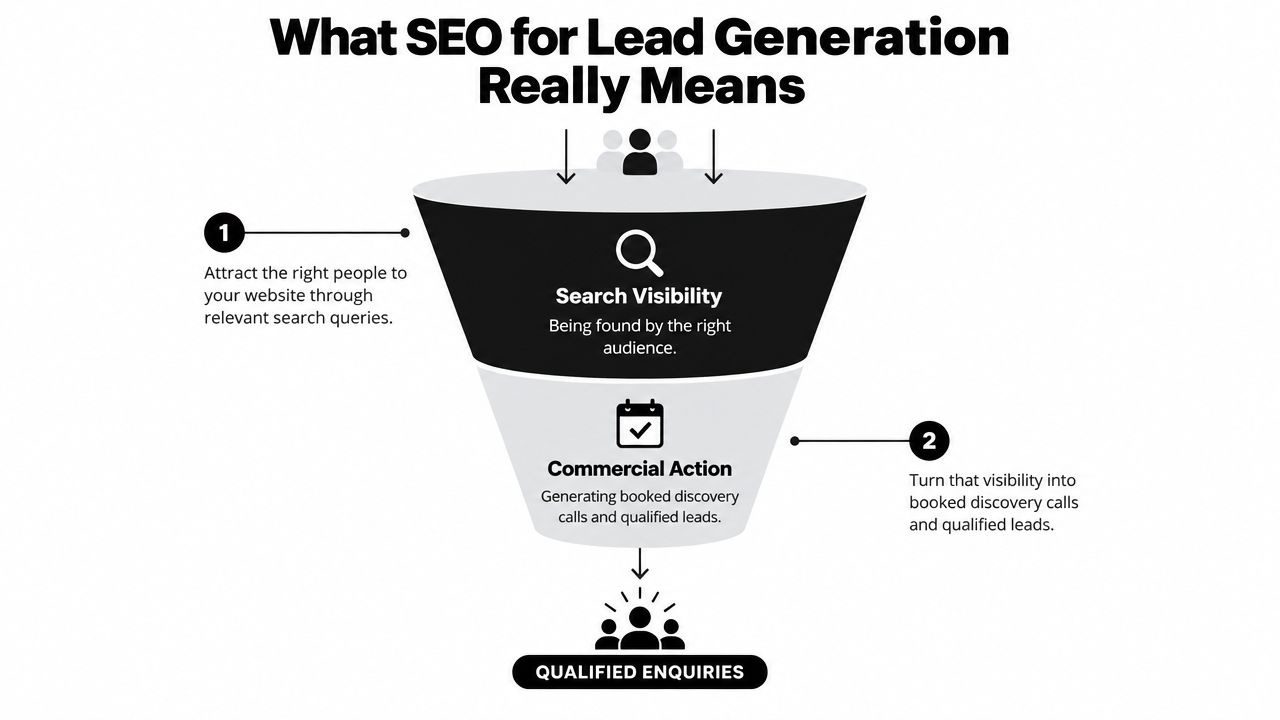
SEO for lead generation is a commercial system that connects website structure, search visibility, conversion paths and follow-up. Rankings are one input. The output is a qualified person taking a useful action, such as submitting a proper enquiry, booking a discovery call or requesting an assessment.
Traffic alone can hide serious problems. A professional services firm might attract visitors searching for general advice, while its profitable service page remains invisible. A buyers agency might rank for property information but fail to explain its buying process. A broker may receive forms that contain no borrowing context, making the sales team spend time qualifying weak opportunities.
The system should follow this sequence:
Website: Make the offer, audience and service areas clear.
Traffic: Attract searches that indicate a relevant need.
Conversion: Give visitors one obvious next step.
Follow-up: Respond quickly and qualify the enquiry.
Growth: Use pipeline data to improve pages, content and offers.
Commercial rule: If your SEO report celebrates sessions but can't show what happened to those visitors, it isn't reporting lead generation. It's reporting attention.
Australian search behaviour supports this shift. Google accounts for about 88.04% of searches in Australia, and around 815,000 people a day search Localsearch.com.au for a local business, with activity peaking near 985,000 daily searches. Regional data also records that 84% of consumers searched for a local business in the past three months, 97% read online reviews before choosing one, and 75% decide which local business to use within 30 minutes of starting their search. (Australian local SEO statistics and search history)
Intent matters more than volume
A person searching “what does a conveyancer do?” may be learning. Someone searching “commercial conveyancer Sydney” is closer to contacting a provider. Both searches can have a place in a content plan, but they shouldn't receive the same page, offer or call to action.
High-value service businesses need to map search intent to a buying journey. Informational content can build familiarity and answer objections. Service pages need to convert demand. Proof pages need to reduce perceived risk. Booking and enquiry flows need to capture the context sales staff require.
The practical measure is progression through the funnel, not a ranking screenshot. Track whether organic visitors become marketing-qualified leads, sales-accepted leads and booked calls. If they don't, fix the post-click experience before commissioning more blog articles.
How to Build a Keyword Strategy Around Buyer Intent
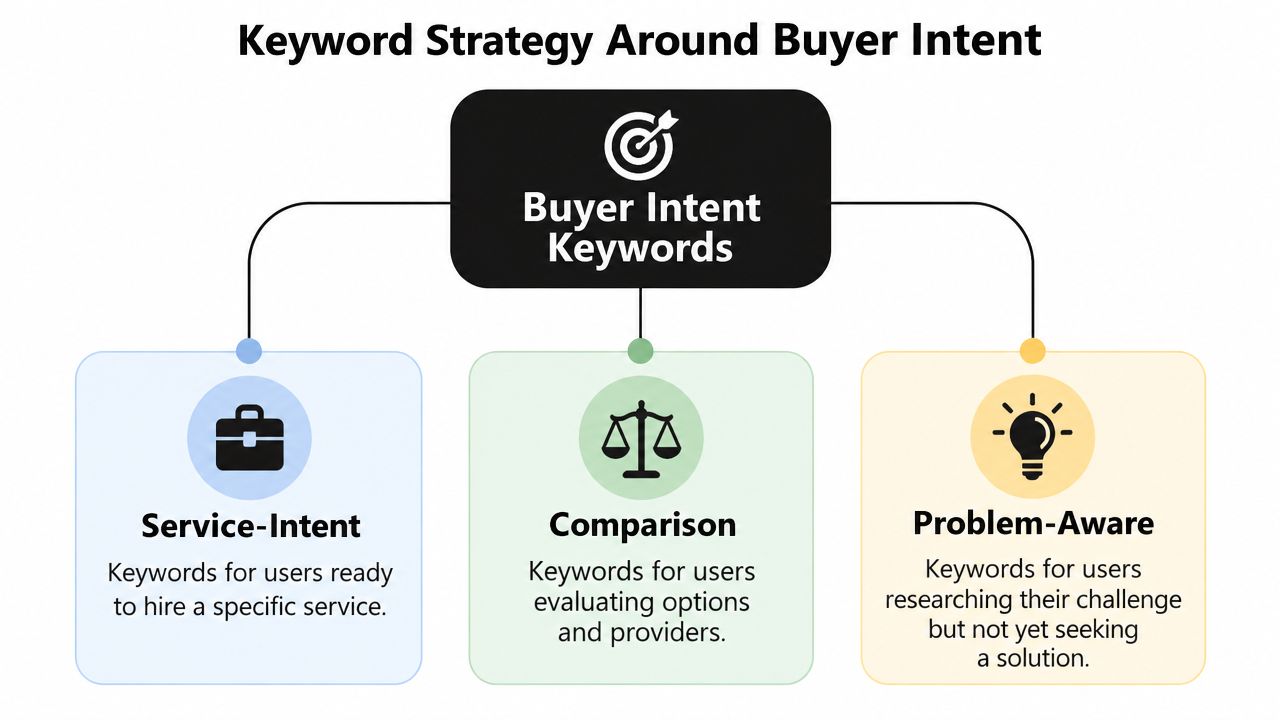
Start with the commercial offer, not a keyword tool. Write down the services that create profitable work, the locations you serve and the type of client your team can handle well. Then classify search demand by how close the searcher is to selecting a provider.
Service-intent searches
These searches name the service, category or location. Examples include “buyers agent Eastern Suburbs”, “commercial lawyer Sydney” and “mortgage broker for self-employed borrowers”. A service-intent page should state who you help, what you do, where you operate, why clients choose your approach and how to start a conversation.
Create separate location pages only when the business serves those locations and can provide useful local detail. Changing the suburb name across duplicate templates won't give buyers a reason to trust the page.
Comparison searches
Comparison searches reveal evaluation. The visitor may be weighing an agency against an in-house option, a specialist against a generalist, or one service model against another. Pages targeting this intent should explain differences, suitability, process, risks and decision criteria.
Use comparison content to help a serious prospect self-qualify. Don't turn it into a disguised sales pitch. A law firm can explain when a specialist practice is appropriate. A buyers agency can outline which clients benefit from full representation rather than occasional advice.
Problem-aware searches
Problem-aware searches describe the challenge rather than the service. Examples include “how to choose an accountant for a growing company” or “why my website gets enquiries from the wrong clients”. These searches usually need an educational article, diagnostic guide or checklist.
They can support lead generation when the article leads naturally to a relevant service page. It shouldn't end with a generic “contact us” prompt. Offer a specific next step connected to the problem, such as a website review, consultation or eligibility conversation.
Map every cluster to a page
Use a simple allocation:
Ready to hire: Service page with a booking or enquiry CTA.
Evaluating options: Comparison or proof page with a clear route to the relevant service.
Researching the problem: Supporting article that answers the question and introduces the solution.
Searching locally: Location-aware service page supported by a consistent Google Business Profile.
Asking a precise question: Structured answer content with clear definitions and related services.
Strengthen an existing page when it already attracts relevant impressions, has usable authority or addresses the same audience with weak positioning. Create a new page when the intent, service, audience or location is different. This approach supports both traditional search and clearer interpretation by AI systems.
For the relationship between website architecture and search performance, see Raffine Studio's guide to website design and SEO.
The following video provides another perspective on connecting SEO work with lead generation:
Turning Search Content Into a Lead Funnel That Converts
Content doesn't generate a lead just because it includes a target keyword. It generates a lead when the visitor understands their problem, recognises a credible solution and can take the next step without hunting through the navigation.
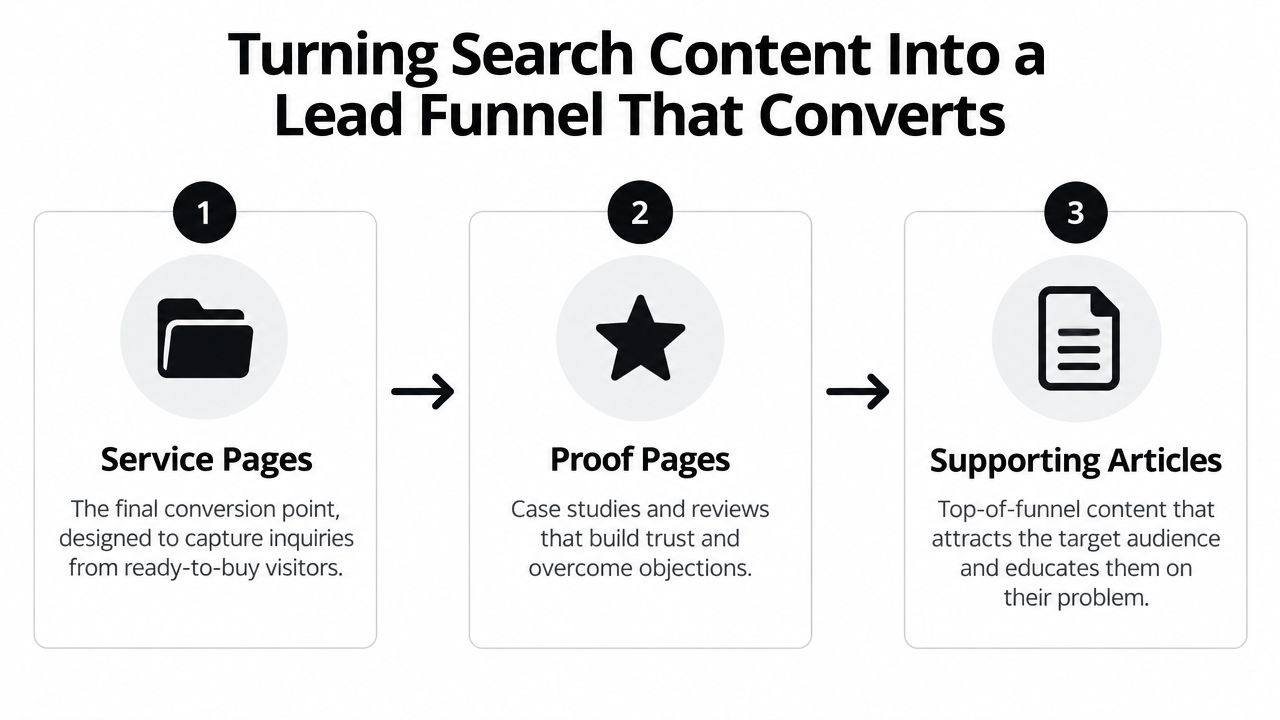
A useful content funnel has three jobs.
Supporting articles attract and educate. They answer problem-aware questions, clarify terminology and help prospects understand the cost of inaction. A construction company might publish guidance on planning a commercial build. An accounting firm might explain the financial controls a growing business needs before expansion.
Proof pages remove doubt. These can include testimonials, credentials, process explanations, review excerpts and carefully presented examples of the work. They should answer the questions that stop people enquiring: can this team handle a similar situation, does it understand my sector and what will working together feel like?
Service pages convert existing demand. They should make the commercial offer unmistakable. A visitor shouldn't need to read five articles to discover who the service is for or how to book.
Build deliberate routes between pages
Internal links should move visitors through a logical sequence:
Problem: Answer the initial concern in plain language.
Education: Explain options, implications and decision criteria.
Solution: Introduce the relevant service and its process.
Proof: Address trust, expertise and fit.
Action: Offer a booking, enquiry or assessment path.
A supporting article about choosing a buyers agent should link to the buyers agency service page, not merely to another general article. A guide for business owners considering a new accounting firm should connect to the exact advisory service that addresses that decision.
The same principle applies to visitors arriving from LinkedIn, Instagram or a referral. Social content may create the first interaction, but the website needs to continue the narrative. If a post promises a practical explanation and the landing page presents a broad corporate homepage, the business makes the visitor reconstruct the journey.
Read how funnel building works across the website journey when your pages attract attention but don't guide people towards a decision.
Remove dead ends
Every important page should answer three questions quickly:
Is this for someone like me?
Can this business solve my specific problem?
What should I do next?
Use one primary CTA per page. Secondary links can support research, but competing buttons for a newsletter, phone call, brochure, consultation and generic contact form dilute the decision. A qualified visitor shouldn't need to choose between several loosely defined offers.
Technical SEO and AI Search Visibility That Gets You Found and Cited
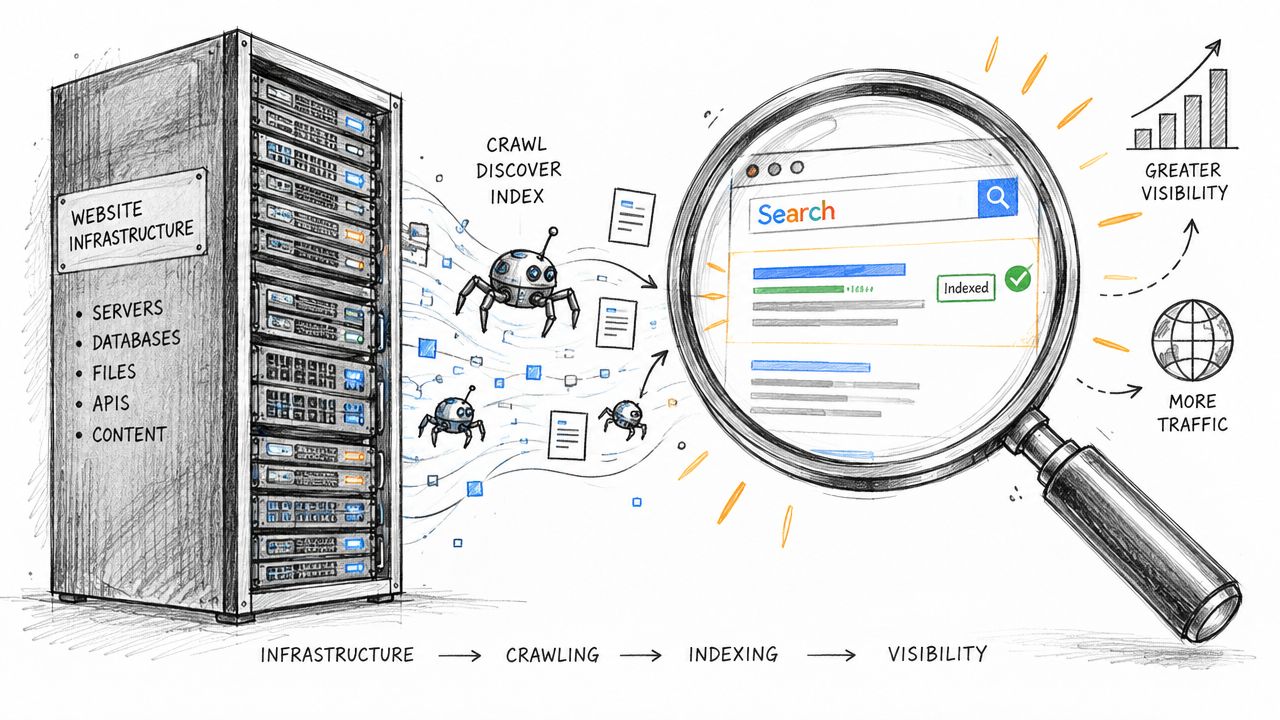
A page can't generate leads if search engines can't reliably crawl, understand and match it to a relevant query. Technical SEO gives Google a clean path through the site, while clear information architecture helps both search engines and AI systems interpret the business.
Start with the fundamentals:
Crawlability: Important service and location pages should be reachable through internal links and not blocked by avoidable technical issues.
Indexability: Check that the pages intended to appear in search are eligible for indexing.
Performance: Review mobile rendering, loading behaviour, layout stability and interaction quality.
Structure: Use descriptive titles, headings, URLs, image alt text and sensible internal links.
Entity clarity: Keep the business name, services, locations, people and areas of expertise consistent across the website and business profiles.
Structured data: Use relevant schema where it accurately describes the organisation, services, locations, reviews or other page elements.
Treat AI visibility as a separate search surface
Classic SEO aims to earn a place among blue links. Generative Engine Optimisation also aims to make the business understandable and citable when a buyer asks ChatGPT, Gemini, Perplexity or Google AI Overviews for a recommendation.
Australian search behaviour is already moving in that direction. A 2026 Australian AI-search summary reports that 27% of Australians use generative AI for at least half of their searches, 64% encounter Google AI Overviews, and more than 70% of Australian queries end without a website visit when AI answers directly. (Australian AI search behaviour summary)
Another Australian adoption summary reports that 12% of Australians identify AI tools as their primary way of finding information online, up from 5% twelve months earlier. (Australian AI adoption statistics)
The implication is practical. Pages should define services clearly, use descriptive headings, answer likely follow-up questions and support important claims with evidence that a system can interpret. Your organisation also needs consistent signals across its website, professional profiles, directories, reviews and relevant third-party references.
AI-search test: Ask whether an assistant could identify what you do, who you serve, where you operate and why a buyer should consider you without guessing.
Don't treat AI visibility as a replacement for Google SEO. Treat it as an additional discovery and recommendation channel. Raffine Studio's AI search optimisation service covers the practical relationship between technical structure, content clarity and emerging answer engines.
How to Align Pages and Offers to Book More Qualified Calls
Qualified search traffic often leaks at the offer layer. The visitor arrives on a page that ranks for the right service, but the headline is vague, the proof is buried and the CTA asks for a commitment that hasn't been explained.
Compare two page approaches.
Weak conversion approach | Stronger conversion approach |
|---|---|
“Solutions for modern businesses” | A specific service for a defined audience |
Several equal CTAs | One primary booking or enquiry action |
Long generic contact form | Short form that captures useful qualification details |
Claims without supporting evidence | Relevant proof placed beside the decision |
“Get in touch” | “Book a discovery call about your property search” |
Manual inbox monitoring | Booking confirmation and prompt lead handoff |
The stronger version doesn't rely on louder copy. It reduces uncertainty. A professional services page should clarify scope, client fit, process, expertise and the next conversation. A buyers agency or broker should make the service model, geography, financial context and qualification process easier to understand.
Match proof to the objection
Proof needs to sit where doubt appears. Credentials help when the buyer questions expertise. Reviews help when they question trust. Process detail helps when they fear a confusing engagement. A clear service boundary helps when they worry the provider isn't suitable for their situation.
Avoid inventing broad claims about outcomes. Use genuine testimonials, verified credentials, relevant project descriptions and specific explanations of how the service works. If confidentiality prevents detailed case material, explain the type of problem handled and the decisions involved without exposing private client information.
Make the booking path short
A booking path should work on mobile, show what happens next and avoid unnecessary fields. Ask only for information that helps the team prepare or qualify the conversation. Connect the form to the CRM or booking tool so the lead doesn't wait for someone to copy details manually.
For lead-generation sites, Australian guidance commonly places landing-page conversion around 2% to 5%, while a result below 1.5% can indicate poorly targeted traffic or a page that fails to convert qualified visitors. (Australian SEO conversion benchmarks) Use these figures as diagnostic reference points, not promises. A page with low conversion may need a better audience, a clearer offer or less friction. Increasing traffic won't solve the wrong one.
Measure What Matters and Fix Where Leads Leak
An SEO dashboard earns its place when it connects an organic visit to a commercial result. Track the stages separately: MQLs meet your marketing criteria, SALs are accepted by sales, and SQLs are confirmed as genuine opportunities. Then measure booked calls, opportunities and closed work.
An Australian lead-generation conversion benchmark offers a staged model: 5% to 10% of website visitors to MQL, 20% to 30% MQL to SAL, 10% to 20% SAL to SQL, 25% to 30% SQL to opportunity, and 20% to 40% opportunity to close.
Funnel stage | Benchmark rate | What it tells you |
|---|---|---|
Visitor to MQL | 5% to 10% | Whether targeting, page relevance and the offer attract identifiable prospects |
MQL to SAL | 20% to 30% | Whether marketing is sending leads sales considers worth pursuing |
SAL to SQL | 10% to 20% | Whether qualification and early conversations uncover genuine fit |
SQL to opportunity | 25% to 30% | Whether sales can turn qualified demand into a defined commercial opportunity |
Opportunity to close | 20% to 40% | Whether the offer, sales process and follow-up support a decision |
Use these figures as diagnostic reference points, not a forecast. Break results down by landing page, service, location and source wherever the CRM and analytics support it. A strong visitor-to-MQL rate with weak SAL acceptance usually means targeting is too broad or qualification is too loose. Healthy MQL volume with few booked calls points to the form, booking path or follow-up.
Audit response speed before publishing more content
Speed-to-lead directly affects whether search demand becomes a conversation. One Australian lead-response source reports that responding within 5 minutes instead of 30 makes a business about 21 times more likely to qualify the lead, while the average company takes 42 hours to respond to a web enquiry and 23% never respond. (Australian lead-response findings)
Set an automated acknowledgement, offer an immediate booking option and alert the right person through the CRM. Review unanswered enquiries, response time and booked-call rate each week. Your monthly SEO report should show organic qualified leads, accepted leads, booked calls, opportunity value where available and the pages that assisted conversion.
Australian guidance places organic lead-to-customer conversion at roughly 3% to 7%. Judge search by the complete journey, from visibility through MQL, booked call and closed work. Fix the largest leak first, whether it is keyword targeting, page clarity, proof, booking friction or response speed.
Raffine Studio connects SEO, conversion-focused website design, AI search visibility, booking flows and CRM follow-up into a measurable lead-generation system for Australian service businesses. Visit Raffine Studio to review where your website is losing qualified prospects and plan changes that turn search demand into booked calls.