web design case studies, website redesign, conversion optimisation, SEO and GEO, lead generation
7 Web Design Case Studies for Service Firms
by raffiné studio

A polished portfolio can still hide a weak lead engine. The best web design case studies don't just prove that a site looks finished, they show how page hierarchy, enquiry paths, search visibility, booking workflows and measurement work together to create qualified enquiries. That matters for Australian buyers agents, brokers and professional services firms, because a good-looking homepage means very little if visitors can't find the right offer, trust the message, or complete a booking without friction.
The stronger examples also separate documented evidence from interpretation. Public-sector case studies on digital.gov.au frame redesigns as service-delivery work, not decoration, and Australian performance benchmarks keep the conversation grounded in outcomes like bookings, leads and transactions rather than vanity metrics. The seven examples below are most useful when you judge them as parts of a lead-generation system, not as a gallery of screenshots.
1. Raffine Studio
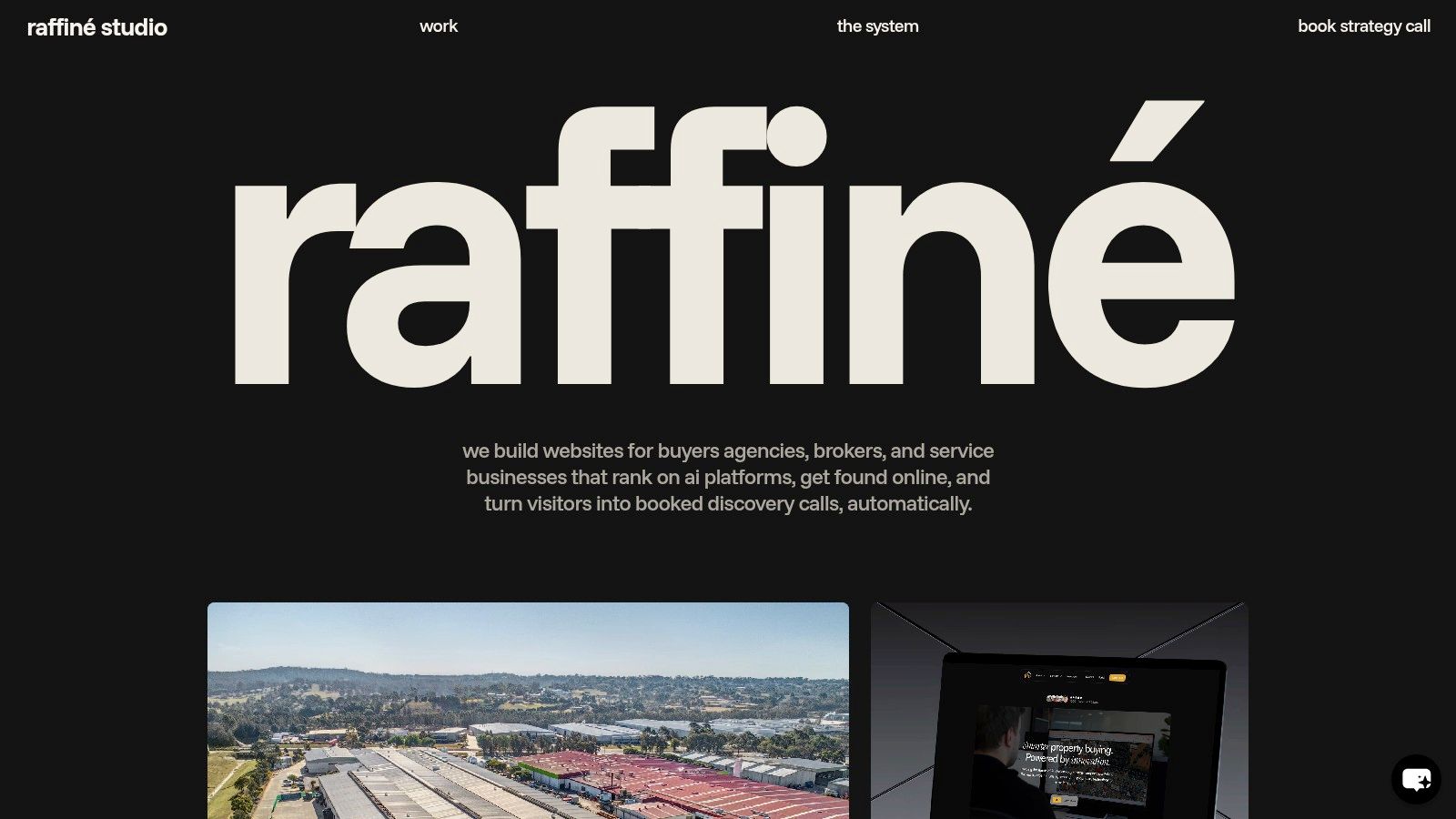
Raffine Studio is a useful example for service businesses that need a website connected to enquiry handling. Its positioning covers conversion-focused websites, funnel systems, SEO, AI search visibility and automated booking. That combination addresses the commercial requirements of Australian buyers agencies, brokers and professional services firms, where qualified enquiries and a reliable follow-up path matter more than visual polish alone.
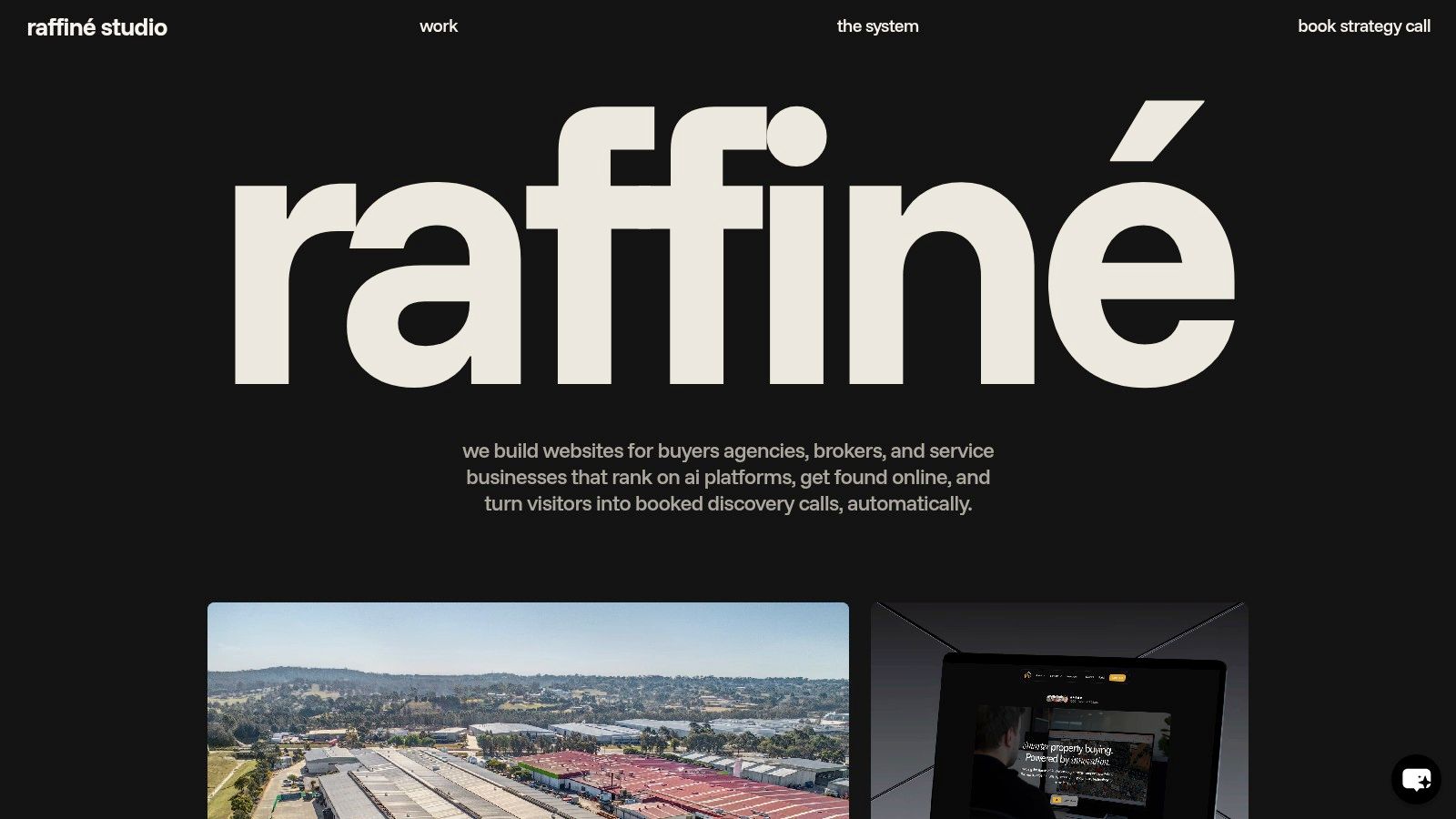
The documented service mix also makes Raffine relevant as a lead-generation system. It connects social content, on-site calls to action, landing pages, CRM handoff and follow-up automation, giving traffic a defined destination and assigning responsibility after a form submission. Public Australian digital projects apply a similar principle in another setting, judging redesigns through compliance, user experience and service outcomes. For a commercial website, the equivalent test is whether the information architecture supports intent, the conversion path is clear, and the lead reaches the right person without manual delay.
The case study is most useful when these capabilities are treated as a system rather than as isolated features. SEO and AI-search readiness can create discovery opportunities, while landing pages, booking tools and CRM connections determine whether that attention becomes a conversation. The available material supports the presence of these components. It does not, by itself, establish a particular lead volume or return, so buyers should request implementation evidence and measurement details before treating the example as a performance benchmark.
Practical rule: a credible lead-generation case study should show the route from traffic source to booked call and explain what happens after submission.
Why it stands out for service firms
Raffine's relevance is strongest where lead quality matters more than raw volume. Its resources on custom web design and related services present a connected lead system for buyers agents, brokers and professional services firms. The View Raffine Studio's custom web design approach explains that this work extends beyond individual pages into the wider conversion process.
Pros
End-to-end system: website, funnels, SEO, AI search and automation are planned as one pipeline.
Commercial focus: the stated direction centres on booked discovery calls and qualified leads.
Sector fit: buyers agents, brokers and professional services are a natural match.
Operational detail: CRM handoff and booking automation can reduce manual follow-up gaps.
Cons
Custom pricing only: buyers need a consultation because no package list is published.
Phased results: SEO and AI-search gains take time, making this a longer-term option.
See the Raffine Studio website for the studio's broader service information.
2. Luminary

Luminary is useful when the brief is complex, regulated or enterprise-scale. Its portfolio spans government, professional services, e-commerce and not-for-profit work, which makes it a practical benchmark for information architecture, content migration and governance rather than quick-turn lead funnels. If you're a professional services firm with a large website, multiple stakeholders or a legacy CMS, Luminary shows how a redesign can be framed as a structured migration project instead of a cosmetic refresh.
The value in these case studies is that they usually explain platform choice, delivery context and technical decisions. That gives buyers something many portfolios don't, a way to judge whether the agency understands enterprise CMS and DXP environments such as Sitecore, Kentico, Optimizely, Umbraco and Jamstack. For service businesses, the lesson is simple. If your site has many content types, multiple service lines or compliance constraints, you need a case study that proves the team can keep structure, search visibility and usability intact while the content moves.
Commercial read: enterprise case studies are less about flash and more about whether the agency can keep a website usable while many people are trying to change it.
Luminary is less compelling if you want evidence of CRM-connected lead capture or booked-call optimisation. The portfolio is broad, but its strength sits in large-scale digital delivery, not in the exact funnel mechanics most buyer-led firms need. That makes it a good benchmark for content operations and technical governance, and a weaker reference if your main problem is enquiry quality.
What to look for in similar projects
Migration depth: whether the agency explains how content was audited and restructured.
Accessibility thinking: whether the case study shows compliance-minded decisions.
Platform clarity: whether CMS and DXP choices are justified in business terms.
Stakeholder handling: whether the write-up shows how competing requirements were resolved.
For agencies working on service-led sites, Luminary is a reminder that structure matters as much as visual design.
3. Humaan

Humaan is the kind of portfolio you study when you want to understand interaction quality, visual trust and clean presentation. Its case studies are concise, design-led and varied across education, health, e-commerce and public-interest work, so the value is in the polish of the execution rather than a heavy explanation of funnel mechanics. That makes it especially relevant for firms where credibility is influenced by how the interface feels on first contact.
For professional services and healthcare-adjacent businesses, that matters more than people admit. The client doesn't always compare agencies on typography or animation, but they do notice whether the site feels considered, whether mobile interactions are smooth, and whether the service story is easy to follow. Humaan's work is a good reference point for micro-interactions, visual systems and narrative clarity in that sense.
See Raffine Studio's landing page examples if you want to compare design polish with conversion intent.
Where Humaan is strongest
Humaan's case studies help answer the question, “Does this site feel like a trustworthy place to enquire?” That's not the same as proving lead generation, but it's still commercially relevant because trust is a conversion input. For buyers agents, brokers and law firms, a homepage that looks careless or crowded can undermine enquiry rates before the user reaches the form.
Its limitation is just as clear. The write-ups don't foreground CRM integration, booking automation or multi-step funnel logic the way a lead-generation system should. If you're assessing agencies for a commercial redesign, Humaan is a strong benchmark for presentation quality, but it's not the strongest reference if your goal is booked calls and measurable attribution.
Great visual design reduces doubt. It doesn't replace the need for a clear offer, a sensible path to enquiry and a follow-up system.
Use Humaan as a benchmark for interaction quality, then ask the harder question, can this same standard support a sales journey, or is it mainly good to look at?
4. NOW Digital
NOW Digital is the portfolio to study when your website has to operate inside a complicated ecosystem. Its work for enterprises and government, including clients such as AEMO, Services Australia, City of Yarra and the Australian National Maritime Museum, makes it useful for judging service design, legacy migration and accessibility-conscious delivery. The practical value is in seeing how digital teams handle multiple stakeholders, technical integrations and content-heavy environments without losing sight of the public user.
The case studies are especially relevant for organisations that need a site to support many paths at once. That includes professional bodies, industry organisations, councils and larger service firms where the website is doing more than generating leads, it's also a service portal, a content hub and a credibility signal. NOW Digital's project pages show the kind of decisions that matter in that context, such as platform changes, integration work and accessibility considerations.
What service businesses can learn
The main lesson from NOW Digital is that information architecture is a business decision. If users can't find the right path quickly, the site becomes expensive to maintain and ineffective as a front door to the organisation. For service businesses, this translates into clearer service-page grouping, better internal linking and more disciplined content structure.
That said, the portfolio is still enterprise-skewed. The case studies are strong on technical rationale and delivery context, but less explicit about booked-call pathways, CRM mechanics and lead quality. If you're a broker, buyers agency or advisory firm, you can still borrow the structural discipline, but you'll need another reference point for lead follow-up and conversion design.
Useful filter: if the agency can explain how it handled accessibility, governance and migration, it's more likely to handle a complicated service website without turning it into a content mess.
NOW Digital is a strong benchmark for regulated and stakeholder-heavy environments. It's less directly useful for lean, conversion-led SME funnels, which is why it sits better in a comparison set than as the only example you review.
5. Rysen
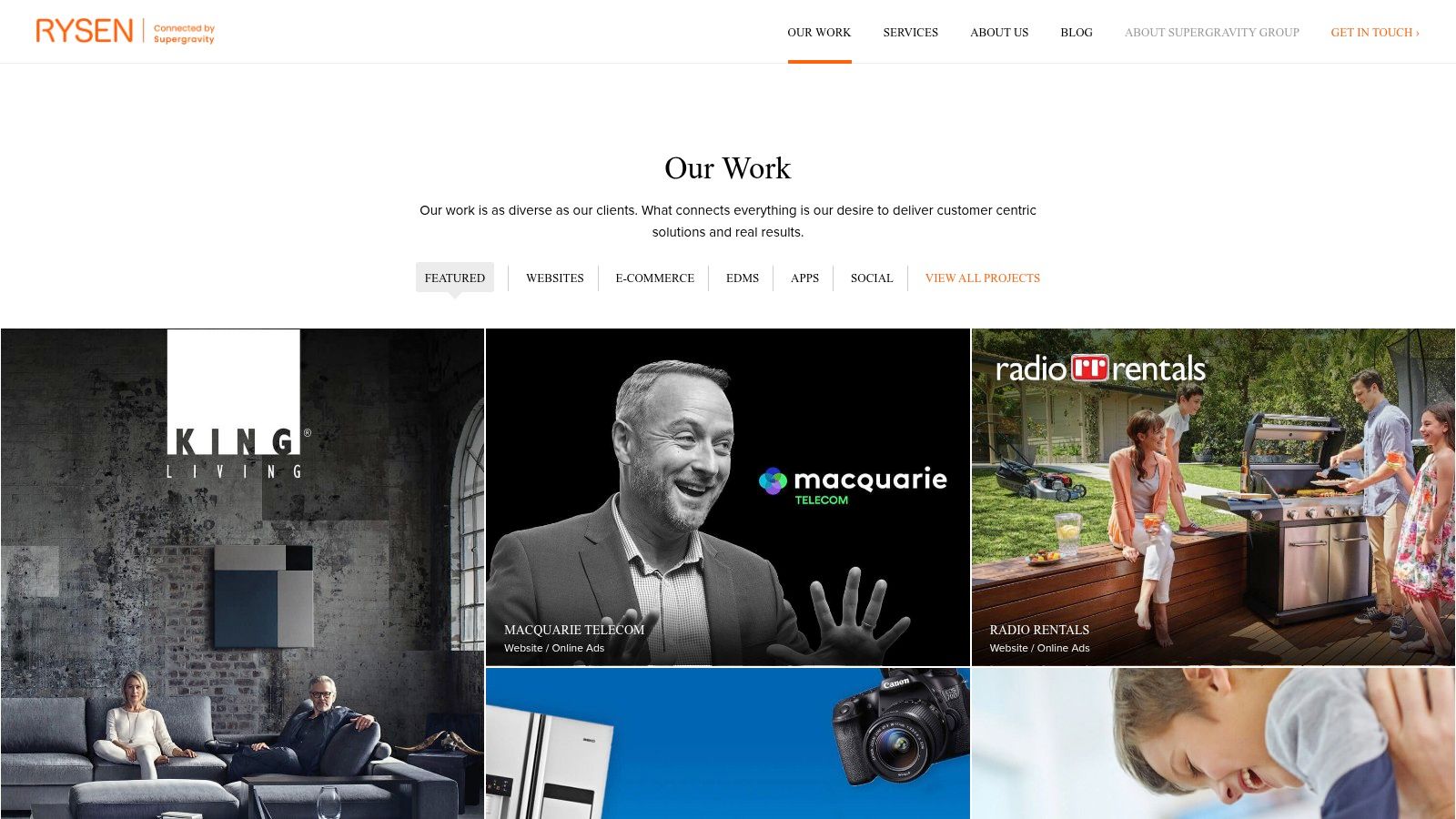
Rysen is one of the better references for teams that care about commerce journeys, merchandising and practical conversion design. Its case studies span retail, finance, hospitality and apps, which gives it a broader commercial feel than many agency portfolios that stay too close to one sector. For Australian buyers agents and brokers, the value is in the page-type patterns, product presentation and friction reduction thinking, not in e-commerce for its own sake.
The portfolio is particularly helpful for understanding how category pages, product pages, calculators and checkout flows can be designed to keep momentum. That maps well to service businesses, because an enquiry journey often breaks down in the same way a checkout does. Too many steps, unclear next action, weak trust signals and a mobile form that's annoying to complete. Rysen gives you a practical lens for spotting those issues.
Best fit for conversion-minded teams
Rysen works best as a reference when you want to compare page flow and task completion, not just branding. The mix of websites, e-commerce and app work gives the agency a useful conversion vocabulary, even if the case studies don't always open up the analytics stack in detail. That makes it a strong inspiration source for teams redesigning service pages, calculators or enquiry forms.
The downside is the same one you see in many design-led portfolios. The work shows execution well, but it doesn't always unpack the measurement side thoroughly enough. If you want to know how the redesign changed attribution, lead quality or CRM performance, you'll need to ask directly.
Use Rysen to check
Whether pages guide users to one next action.
Whether mobile layout supports fast task completion.
Whether trust cues appear early enough in the journey.
Whether calculator or form patterns reduce hesitation.
For service firms, that's still valuable. It gives you a practical way to judge whether a portfolio understands conversion psychology, not just aesthetics.
6. Mo Works
Mo Works sits in a useful middle ground between design, content and acquisition. Its case studies often combine website work with SEO, technical support, brand messaging and automation, which makes it relevant for businesses that need more than a website refresh. That blend matters for Australian service firms because the underlying issue is often fragmented execution, one team writes the copy, another handles the site, and nobody owns the path from first visit to follow-up.
The strongest part of the portfolio is its cross-functional scope. You can see how the agency works across government, B2B and broader communications environments, which makes the case studies useful for organisations where marketing, stakeholder messaging and digital delivery overlap. That's common in professional services, especially when the website has to support credibility, recruitment, enquiries and community-facing content all at once.
Review Raffine Studio's article on branding and web design if you want a more conversion-led version of that brand and web relationship.
Why it matters commercially
Mo Works is a good reminder that a website doesn't live alone. If the messaging is inconsistent, if the content strategy is weak or if SEO is treated as an afterthought, the site may look improved while the commercial outcome stays flat. That's why its mix of website, content and ongoing support is relevant to service businesses planning a redesign.
The limitation is that some case studies stay high level. They can be useful for understanding the kind of work delivered, but not always for evaluating funnel depth, lead attribution or booked-call performance. So use Mo Works to assess whether a team thinks across brand, web and acquisition, then push for clearer measurement if your business depends on qualified enquiries.
The best multi-discipline portfolios don't just show more services. They show how those services connect to a single commercial outcome.
7. Redback

Redback is a strong reference for content-heavy, outcomes-oriented websites in government, certification and economic development settings. The portfolio is useful because it shows how WordPress can support long-term evolution, not just launch-day design. That matters for organisations that publish a lot of content, manage many stakeholder groups or need the website to support ongoing campaigns and resource-led enquiries.
The case studies are most valuable where the site has to stay organised over time. For a service business, that translates into better page hierarchy, cleaner internal linking and a site structure that still makes sense six months after launch. Redback's work also shows why scalable engineering matters, because content-rich websites tend to fail when they are built as isolated pages instead of as systems with a maintenance plan.
Where it fits in a buyer's decision process
Redback is useful if your organisation needs long-term support and iterative improvement. That's common in public-sector and industry environments, but it also applies to professional services firms that publish thought leadership, landing pages and service content regularly. A design that looks fine on day one can become expensive if the team can't update it cleanly.
What's less visible in the portfolio is deep attribution detail. You can see the work, and you can see the outcomes at a project level, but not always the full chain from traffic source to lead quality to CRM handoff. That makes it stronger as a benchmark for scalability and content governance than for funnel automation.
For firms that need durable digital infrastructure, Redback is worth studying. It shows how a website can be built to support ongoing communication rather than one-off launches.
7 Web Design Case Studies Comparison
Agency | Implementation complexity 🔄 | Resource requirements ⚡ | Expected outcomes 📊/⭐ | Ideal use cases 💡 | Key advantages ⭐ |
|---|---|---|---|---|---|
Raffine Studio | Moderate–High, integrated funnels, CRM & automation coordination | Moderate, design, SEO/AI and CRM integrations; custom scope | High 📊, measurable booked discovery calls & qualified leads; ⭐⭐⭐⭐ | Buyers agents, brokers, professional services needing conversion systems | End-to-end funnel + SEO/AI-search + scheduling automation |
Luminary | High, enterprise DXP, multi-site and migration complexity | High, enterprise CMS, governance and specialist teams | Strong 📊, traffic lift, accessibility & performance benchmarks; ⭐⭐⭐ | Enterprise relaunches, regulated/high‑traffic sites, large migrations | Broad platform expertise, 70+ case studies, award‑recognised work |
Humaan | Medium, design-led builds focused on interaction polish | Medium, UX/design specialists; high production value | Good 📊, improved interactions, visual trust & storytelling; ⭐⭐⭐ | Education, health, NFP, micro‑interactions and visual systems | Consistent UX rationale, high production values, recognised design work |
NOW Digital | High, Sitecore/Azure integrations and complex stakeholder coordination | High, enterprise tech stacks, compliance and service design resources | Strong 📊, IA, accessibility and performance improvements; ⭐⭐⭐ | Government and enterprise service transformations with legacy systems | Detailed technical rationale, accessibility/compliance focus |
Rysen | Medium, e‑commerce UX, merchandising and performance redesigns | Medium, commerce platforms, analytics and merchandising teams | Good 📊, improved PLP/PDP and checkout conversions; ⭐⭐⭐ | Retail, finance, hospitality e‑commerce and CRO projects | Practical commerce patterns (PLP/PDP/checkout), omni‑channel examples |
Mo Works | Medium, combines site rebuilds with SEO, content & automation | Medium, cross‑functional delivery (brand + web + SEO) | Good 📊, integrated growth outcomes and ongoing SEO support; ⭐⭐⭐ | Projects needing alignment of design, content strategy and acquisition | Bridges design, content and acquisition; sector diversity |
Redback (RB) | Medium, modern WordPress engineering for information‑dense sites | Medium, WordPress development and long‑term support | Good 📊, scalable CMS and UX improvements; awards‑backed results; ⭐⭐⭐ | Government, NFP and industry bodies with content‑heavy sites | Scalable WP engineering, long‑term iteration and support |
Turn Portfolio Inspiration Into a Measurable Website Plan
The useful lesson from these web design case studies is not that one agency has nicer visuals than another. The key distinction is whether the work shows a complete commercial system, from information architecture to enquiry path to follow-up. Australian buyers agents, brokers and professional services firms should be especially strict here, because a redesign that improves appearance but leaves booking friction, weak internal links or poor lead handling in place won't change the commercial result.
A sensible review process starts with the action you want the visitor to take. If the goal is a booked call, every case study you compare should help answer four questions.
What is the primary action? Look for clear enquiry paths, not just broad brand storytelling.
How is the content structured? Check whether the page hierarchy supports quick decisions on mobile and desktop.
What happens after the form? Ask whether CRM handoff and automation are part of the system.
What evidence is disclosed? Prefer agencies that show outcomes, constraints and the thinking behind the work.
That's the standard public digital case studies already point toward. Australian government examples treat redesigns as measurable service delivery, while local commercial examples show that outcomes matter when redesigns lift enquiries, transactions or lead volume. In practice, the best agency for a service business is usually the one that can explain how a website becomes a repeatable lead-generation system, not the one with the flashiest mockups.
If your current site is generating traffic but not enough qualified enquiries, or if your forms, follow-up and service pages aren't working together, it's worth reviewing the whole system. Raffine Studio builds conversion-focused websites, SEO, AI-search visibility and automation for Australian service firms that need better leads, not just more visits. A short strategy conversation is the fastest way to see where the friction is and what to fix first.
Raffine Studio helps Australian service businesses turn websites into lead-generation systems that attract qualified traffic, convert visitors into enquiries and booked calls, and automate follow-up. If you want a practical review of your current site, visit Raffine Studio and explore how conversion-focused design, SEO, AI-search visibility and booking automation can work as one system.