sales funnel template, funnel templates, lead generation funnels, buyers agent marketing, conversion optimisation
10 Sales Funnel Template Resources for Service Firms
by raffiné studio

Across Australian sites, average conversion rates are often reported at about 1% to 3%, e-commerce sits around 1.78%, and lead-generation landing pages can convert at roughly 8.8% to 18.2% when traffic is highly targeted and the offer is focused. That's why the best sales funnel template isn't the prettiest one. It's the one that matches the journey you need: a single landing page for a focused campaign, a multi-step funnel for qualification and nurture, or a booking-first flow for high-intent service enquiries.
Most advice on sales funnel templates is too design-led. It assumes that if you import a polished layout, swap the logo, and tweak the headline, you've built a funnel. For buyers agents, brokers, law firms, accounting firms, and other professional services, that usually fails where the money changes hands. Not on the page design itself, but between enquiry, qualification, booking, CRM hand-off, and follow-up.
A useful sales funnel template has to support the whole lead path. That means the page structure, the form logic, the scheduler, the CRM fields, the follow-up triggers, and the way your team responds once someone puts their hand up. If the template can generate enquiries but your team can't operate the next step, it isn't a good template. It's just a good mock-up.
There are really three decisions here.
Journey shape: Do you need one page, a short sequence, or a booking-first flow?
Operational fit: Can your team manage automations, pipeline stages, and follow-up properly?
Stack fit: Does the template work with your existing website, paid traffic, SEO content, and CRM?
Raffine Studio works across that full stack, from websites and lead-generation funnels through to SEO, AI search visibility, and booking automation. That matters here because a sales funnel template only performs when traffic, conversion, and follow-up are connected.
1. ClickFunnels Marketplace
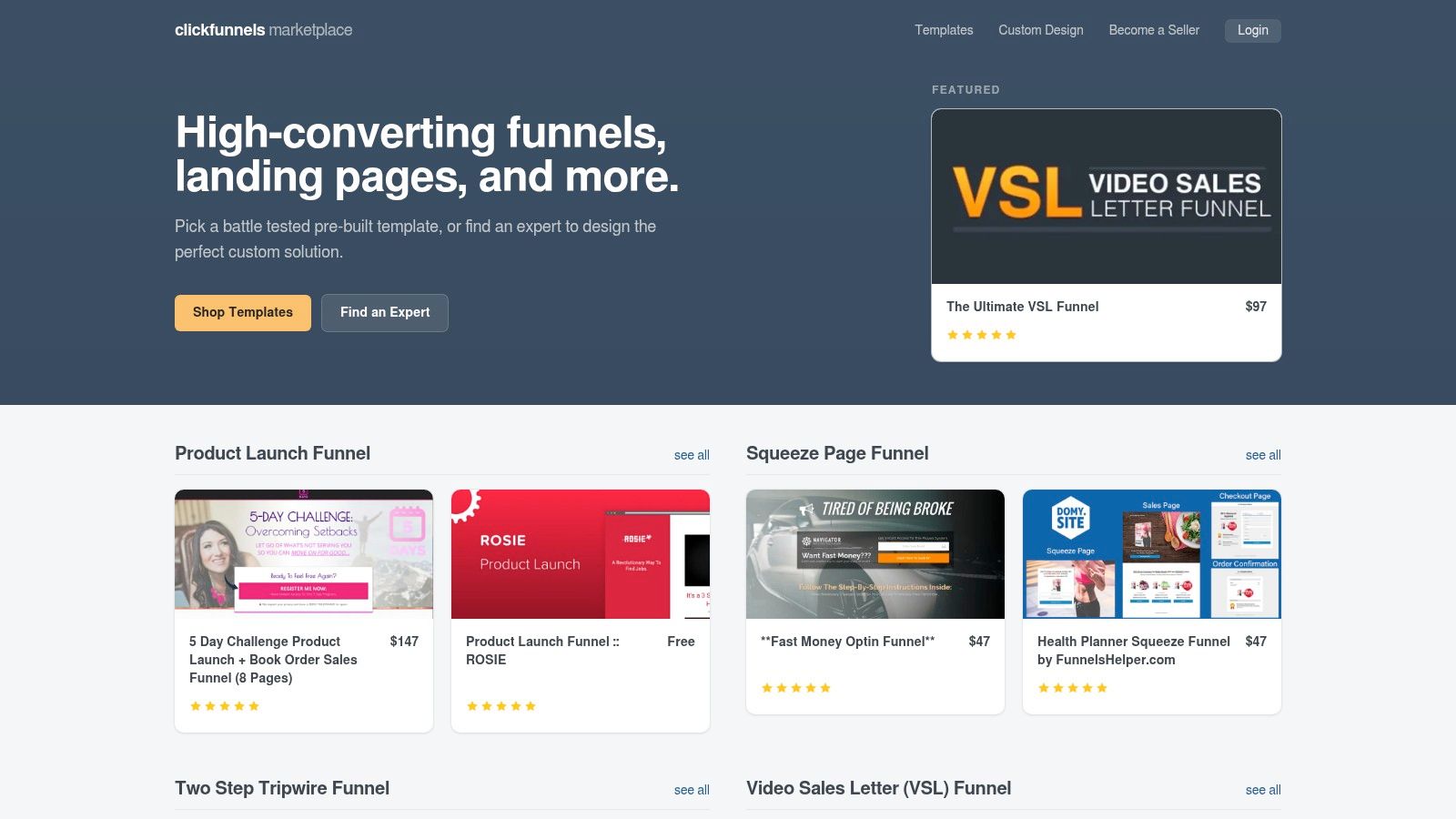
If you want the fastest route to a full multi-step funnel, ClickFunnels Marketplace is still one of the clearest options. It's built for importing complete funnel sequences, not just isolated pages, so it suits firms that already know they need more than a homepage and a contact form.
That's particularly useful for brokers or buyers agents running a consultative sale. You can start with an application funnel, qualification step, thank-you page, and booking flow instead of forcing everything into one page and hoping the lead sorts itself out.
Where ClickFunnels fits best
The strength here is structure. You'll find templates built around opt-ins, webinars, applications, quizzes, sales pages, and upsells. Some are single-page. Many are proper sequences with several connected steps.
For service businesses, the better use case is usually the application or booking pathway. A high-value service often needs some pre-qualification before a call, especially if the team wants to protect calendar time.
Best for: Firms that want a packaged multi-step funnel with minimal setup friction
Less ideal for: Teams that want their funnel tightly integrated into an existing custom website experience
Watch for: Template quality varies, so don't assume a strong visual design equals a strong conversion path
Practical rule: If your offer needs education, filtering, and a booked call, a full funnel sequence usually works better than a single imported landing page.
ClickFunnels can work well when the offer is distinct and campaign-led. It's less elegant when the funnel needs to feel embedded in a broader brand site, especially for more established professional services firms.
If you're weighing whether you need a funnel platform at all, Raffine's guide on what funnel building actually involves is the better starting point before choosing a template library.
What usually goes wrong
The common mistake is importing a “funnel-in-a-box” and leaving the default sequencing intact. Service businesses rarely sell the same way info-product marketers do. Your proof points, qualification questions, and call-to-action language need to reflect a real advisory sale, not a generic online offer.
2. GoHighLevel Template Library and Marketplace
GoHighLevel Template Library and Marketplace isn't really a page-template tool in the narrow sense. It's closer to a deployable client acquisition system. That's why it's strong for agencies, broker groups, and firms that want the funnel, the CRM, the automations, and the booking layer in one platform.
For buyers agents and brokers, that matters more than template count. The page is only one part of the journey. The bigger win is having the page, form, calendar, SMS, email, pipeline stage, and internal assignment logic connected from the start.
Why it suits booking-led service funnels
HighLevel's “snapshots” are the key differentiator. They can package funnels, websites, forms, workflows, emails, SMS, and pipelines together. That makes it a practical choice when you want repeatable deployment across multiple offers or business units.
The trade-off is complexity. This isn't the platform for someone who just wants a clean landing page live by this afternoon. It asks more of the operator, but it gives more operational control in return.
Australian lead-generation guidance is clear that funnel performance doesn't stop at the form. High-performing teams aim to respond within 5 minutes, and some aim for under 60 seconds, while only 5-10% of website visitors become MQLs before further drop-off through later stages, as noted in Raffine's analysis of sales funnel strategy in Australia. That's exactly the kind of gap HighLevel can help close if it's configured properly.
The practical trade-off
Best for: Teams that need page templates plus booking flows, CRM routing, and follow-up automation
Less ideal for: Smaller firms that won't maintain workflows once they're built
Strong use case: Discovery-call funnels where speed, routing, and attribution matter as much as page design
A good GoHighLevel template isn't just a page layout. It's a sales process with software wrapped around it.
Used well, it supports a multi-step or booking-first approach better than most page-first tools. Used poorly, it becomes a cluttered stack full of half-built workflows no one trusts.
3. GetResponse Conversion Funnel templates
GetResponse Conversion Funnel is a sensible middle ground for firms that need more than a landing page but don't want the operational weight of a larger all-in-one platform. It combines pages, email automation, and webinar functionality in one place, which makes it useful for nurture-led service funnels.
That's a good fit when your sales process needs warming up before the booking. Think property education offers, broker guides, or professional services firms that win clients after a short sequence rather than on the first visit.
Where it works commercially
GetResponse is strongest when content and nurture are part of the acquisition model. You can run a lead magnet, follow with email sequences, and direct the lead into a booking flow once interest is clearer.
That's often more realistic than pushing every visitor straight to a discovery call. For colder traffic, a soft-conversion offer can reduce friction and build context before the hand-off to sales.
Best for: Lead magnet and nurture sequences that end in a call or consultation
Less ideal for: Firms wanting heavy custom design control or deep CRM orchestration
Strong use case: Educational funnels where email is part of the sales motion
Australian benchmark reporting puts median landing-page conversion at 2.35% across industries, while the top 10% of pages reach 11.45% or higher, according to 3P Digital's Australian conversion benchmark report. For service firms, that gap is a reminder that the template matters less than the match between traffic intent, offer structure, and follow-up path.
What to change before launch
Don't use a generic e-book or webinar template as-is. For service businesses, the follow-up sequence needs to bridge naturally into a consultative next step. That usually means rewriting the thank-you page, calendar invitation, and lead scoring logic so the funnel qualifies intent instead of just collecting email addresses.
4. Leadpages Templates Library
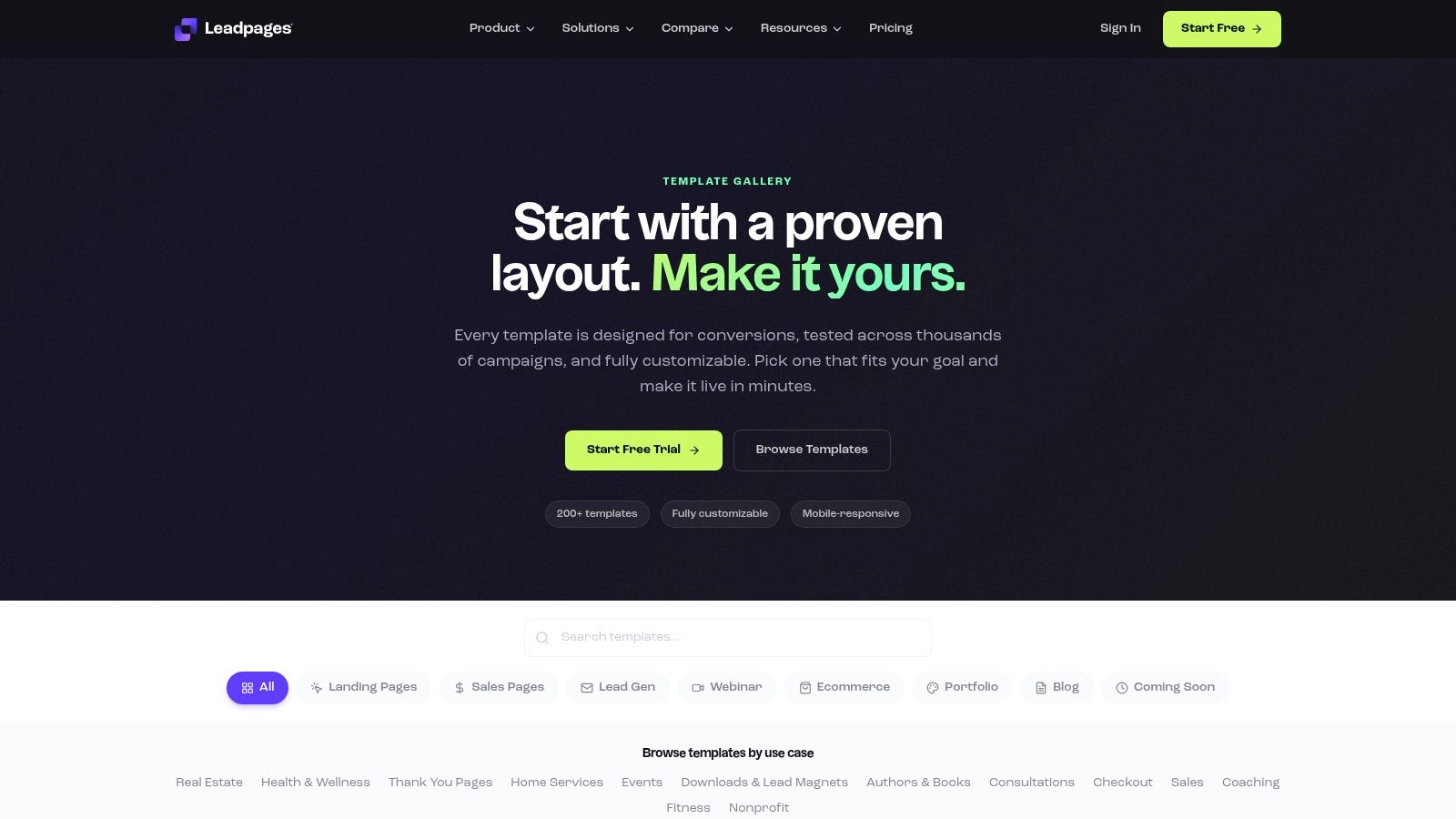
Leadpages Templates Library suits firms that need the front end of a funnel live this week, not a new platform rollout that drags on for a month. That matters for buyers agents, mortgage brokers, and professional services teams testing one offer in one market before they commit more budget.
The useful question here is not how many templates Leadpages gives you. It is what stage of the buyer journey it can support with the least friction. Leadpages works best at the point where a visitor is ready to respond to one clear offer, such as a suburb report, borrowing assessment, fee guide, or strategy call, and the business already has somewhere sensible to send that lead next.
That makes it a strong fit for single-page and booking-first campaigns.
A buyers agent can run a page for a suburb-specific downloadable guide, send the lead to a thank-you page with a call booking option, and pass form data into an existing CRM. A broker can do the same with a borrowing capacity check or refinance review. The build is usually faster than forcing the main website to handle campaign traffic, and the trade-off is obvious. You get speed and simplicity, but not much native depth once leads need branching logic, multi-owner follow-up, or serious reporting.
For teams comparing page-first builds, Raffine's guide to sales funnel landing page template options is useful if the main decision is whether a focused landing page should sit in front of your wider funnel.
There is also a practical limit that gets missed. Leadpages can capture demand well, but it is weaker as the journey becomes more tracking-led or sales-process heavy. If your firm needs source-level attribution across multiple campaigns, lead scoring by service line, or different follow-up paths for investors, owner-occupiers, and referral partners, the template is only the shell. The work shifts into your CRM, calendar rules, and sales process.
Use it if the journey is short and commercially clear:
one offer
one audience segment
one primary action, form completion or booking
one downstream system that already handles qualification and follow-up
Skip it if the team expects the page builder to solve pipeline design.
Before launch, Australian service firms usually need three edits. Replace generic US-style copy with local borrowing, property, or advisory language. Tighten compliance wording around claims and outcomes. Rebuild the thank-you step so it does a job, either pushing high-intent leads to a booking, or warming lower-intent leads with the next piece of proof. That is the difference between a template that collects contacts and a funnel that supports an actual business journey.
5. Unbounce Landing Page Templates
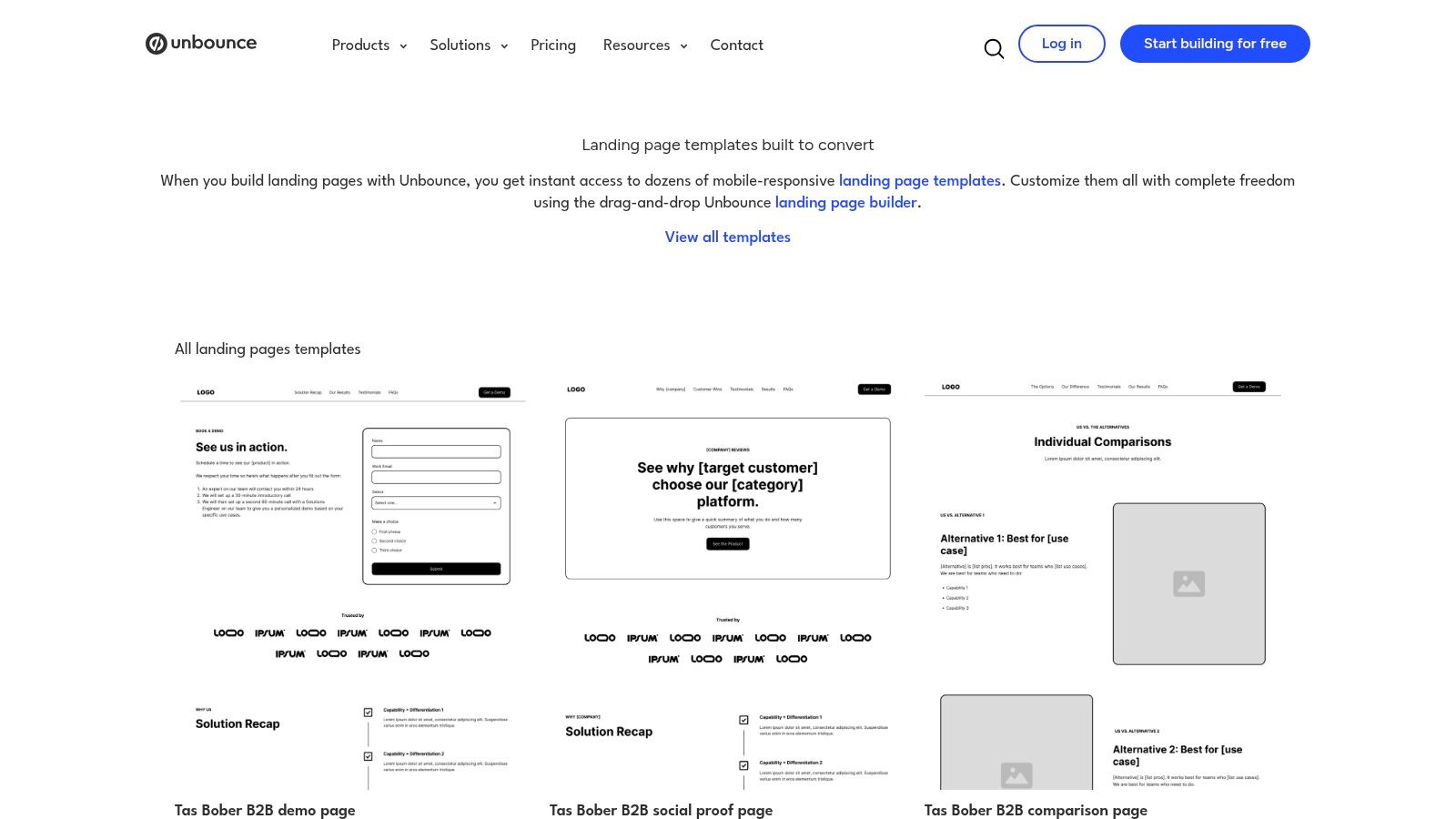
Unbounce Landing Page Templates make sense when the journey starts with intent that already exists. Someone searches a specific loan scenario, a buyers agent service in a defined suburb band, or a time-sensitive advisory problem. In that situation, the job is not to build a long funnel from scratch. The job is to convert a qualified click without sending it into a generic website path.
That is why I treat Unbounce as a journey tool before I treat it as a template library. It suits single-page and short-path funnels best, especially where the commercial risk sits in weak message match between ad, keyword, and landing page.
For Australian brokers, buyers agents, accountants, and legal firms, four practical uses show up repeatedly:
ad-group-specific landing pages for high-intent Google Ads traffic
booking-first pages for consultations, discovery calls, or finance reviews
multi-step form variants where qualification needs to happen before the CRM
campaign testing where each service line needs its own page logic
The value is in control. Dynamic text replacement, faster page variation, and easier testing help teams align the headline, proof, and call to action to the traffic source. That matters more in expensive search categories, where a broad service page can waste good clicks.
Unbounce is less convincing if the business journey depends on heavy CRM orchestration after the first conversion. It can capture the lead well. It does not replace pipeline rules, segmented nurture, or broker-specific follow-up logic across refinance, first-home-buyer, investor, and commercial enquiries.
A useful way to judge the templates is by funnel shape.
If you need a single-page funnel, Unbounce is strong. Build one focused page, one offer, one action.
If you need a booking-first funnel, it also fits. Send ad traffic to a page built around intent, trust signals, and a calendar step.
If you need a multi-step funnel, use it selectively. The front-end experience can work well, but the handoff matters more than the page sequence.
If you need a tracking-led funnel across multiple channels and long sales cycles, the template is only one layer of the system.
That trade-off is often missed. Teams buy Unbounce for templates, then discover the harder problem is attribution, qualification, and sales routing.
Raffine's landing page design services are relevant here because Unbounce performs best when the page structure, offer framing, and proof sequence are built around the actual buyer journey, not just the template layout.
For buyers agents and brokers in Australia, I would rarely launch a stock template unchanged. The usual edits are local trust signals, service-area specificity, compliance-safe claims, and a stronger thank-you step. Sometimes that thank-you page should push straight to a booking. Sometimes it should split the next action by readiness level. That depends on whether the lead is ready to talk now or still comparing options.
Used that way, Unbounce is a strong paid-acquisition conversion layer. Used as a substitute for funnel strategy, it runs out of road quickly.
6. Instapage Templates

A bigger template library is not the reason to buy Instapage. The reason is control.
Instapage suits teams that already know the stage of the journey they need to improve and want tighter execution around it. For a single-page ad funnel, that usually means faster page testing and cleaner stakeholder approval. For a booking-first journey, it means shaping the page around one action, then refining the path into the calendar or enquiry step. For tracking-led campaigns, it becomes more useful because the page can sit inside a broader testing and attribution workflow instead of carrying the whole funnel on its own.
That distinction matters for professional services firms. Buyers agents, mortgage brokers, and advisory businesses rarely fail because the template looked average. They fail because the journey after the click is vague, the handoff is slow, or the offer asks for too much commitment too early.
Instapage helps at the page layer. It does not fix the operating model behind the page.
I would usually look at it in three situations. An in-house team is running multiple paid campaigns and needs more disciplined page iteration. An agency is producing and updating landing pages across accounts with several reviewers involved. Or a larger firm has already validated its offer and now wants better control over message testing, reusable sections, and campaign-specific variants.
For that kind of business, Instapage can support different funnel shapes without forcing one template logic onto everything:
Single-page offer funnels: Strong fit if the objective is message testing, trust sequencing, and cleaner conversion paths from paid traffic
Booking-first funnels: Useful when the page needs to qualify the lead before a consultation request, valuation call, or strategy session
Multi-step funnels: Possible, but usually better when another system handles CRM, automation, and follow-up logic
Tracking-led programs: Best fit in this section of the list, provided the team already cares about experiment discipline and reporting consistency
The trade-off is cost and scope. Smaller firms often buy a premium landing page platform when the bottleneck sits elsewhere. Slow callback times, generic lead forms, poor CRM tagging, and weak thank-you sequencing will erase a lot of the gain from better page design.
For Australian buyers agents and brokers, I would not treat the stock template as the finished funnel. The page usually needs clearer suburb or service-area relevance, stronger trust markers, compliance-safe wording, and a more deliberate post-conversion step. Sometimes that next step should be a booking. Sometimes it should be a qualification form or a segmented follow-up sequence, especially if the lead is early-stage and still comparing providers.
Used well, Instapage is less about finding a pretty template and more about tightening one stage of the buyer journey with precision. That makes it a better fit for mature campaign teams than for firms still working out the basics of offer, qualification, and sales follow-up.
7. Systeme.io Template Library
Systeme.io Template Library suits firms that need a funnel running this week, not a quarter from now. The platform matters less for its template count and more for the stage of the journey it can support with minimal setup.
For buyers agents, mortgage brokers, and other professional services firms, that usually means early validation. A simple lead magnet flow, a short qualification sequence, or a booking-first funnel for discovery calls can all work here if the offer is clear and the follow-up is disciplined. Systeme.io keeps those moving parts in one place, which lowers implementation effort for small teams.
It is usually strongest with single-page and light multi-step journeys where speed matters more than design freedom. If the business still needs to test whether a suburb guide, borrowing assessment, or consultation offer gets traction, that constraint can be useful. Teams spend less time polishing page details and more time checking whether the message pulls qualified enquiries.
A practical way to use it is to match the template to the buying motion:
Single-page funnels for straightforward lead capture and fast offer testing
Multi-step funnels when the firm needs light qualification before a call request
Booking-first setups for service businesses selling consultations, strategy calls, or discovery sessions
Tracking-led programs only if the team is prepared to add better attribution and reporting outside the default template flow
That last point matters. Systeme.io can launch the funnel, but it is rarely the final answer for firms that want tighter CRM routing, deeper reporting, or stricter brand control.
Key limitation to consider
Systeme.io works best as a proving ground. Australian service firms with established referral networks, premium positioning, or more complex compliance reviews will often hit the ceiling faster than they expect. Pages may need heavier localisation, stronger trust signals, clearer service-area positioning, and more deliberate handoff rules after the form fill or booking.
Used with that in mind, the template library does its job well. It helps a small team test the business journey before investing in a more customised stack.
8. CartFlows Templates
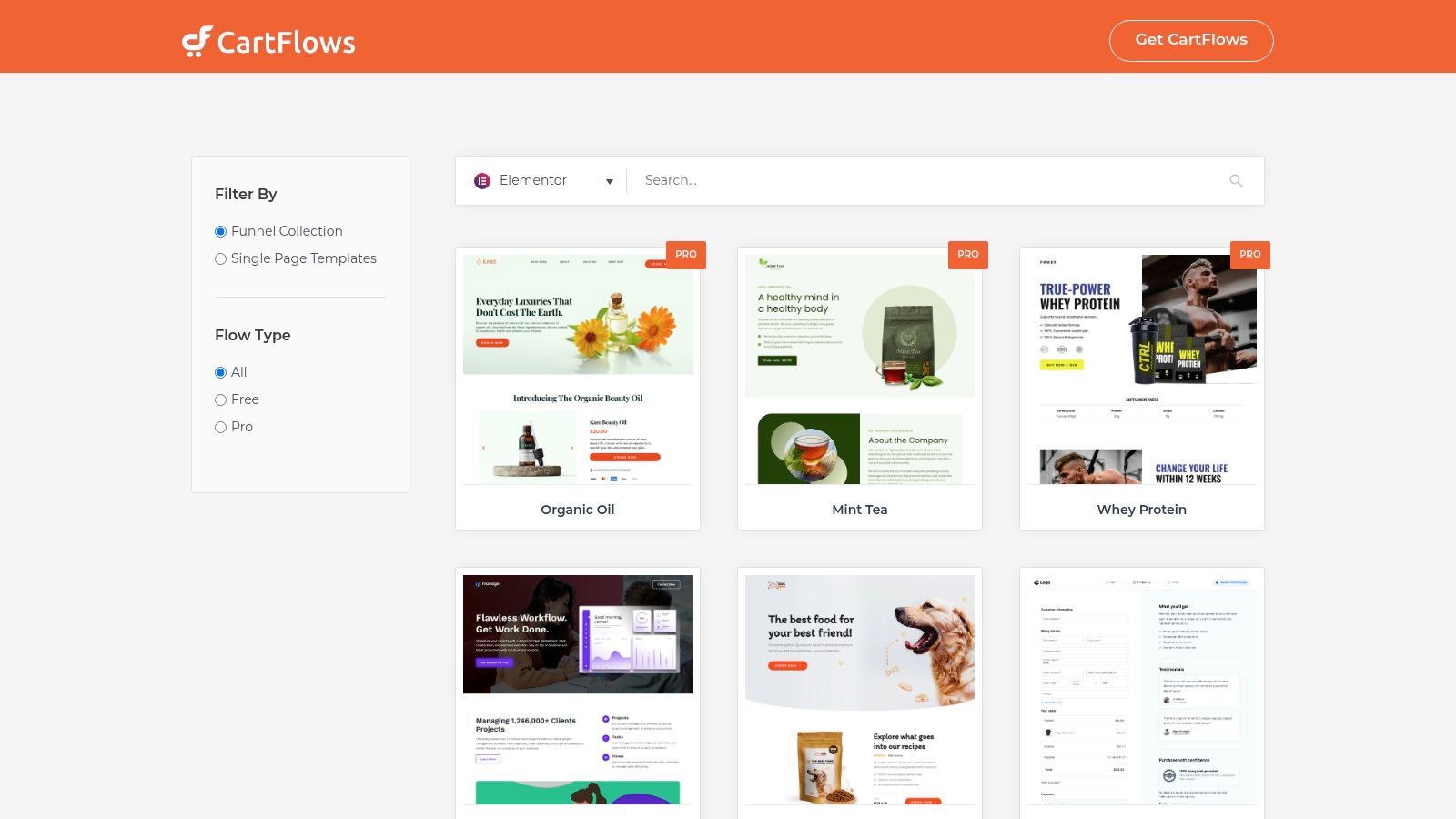
CartFlows Templates are for businesses that want funnel control inside WordPress rather than renting it from a SaaS platform. That's a meaningful distinction for firms already invested in a content-led website and wanting the funnel to sit inside the same ecosystem.
For service businesses, CartFlows makes the most sense when the website is a real acquisition asset and the team doesn't want campaign pages living on a disconnected platform.
Why WordPress ownership matters
Owning the stack can be commercially smart when SEO, content, service pages, and campaign flows all need to support the same business development process. You keep more control over structure, page hierarchy, and supporting content.
That said, ownership creates maintenance. Plugins, updates, WooCommerce logic, page-builder compatibility, and tracking setup all become your problem or your agency's problem.
Best for: Firms with an established WordPress site and long-term content strategy
Less ideal for: Teams wanting the simplest possible launch path
Strong use case: Integrating content, service pages, and conversion flows in one owned environment
Self-hosted funnels can be powerful, but only if someone is actually responsible for maintenance, tracking, and QA.
Where CartFlows is strongest
CartFlows is often thought of through an e-commerce lens, but the broader value is flow control. Even for service businesses, the ability to shape steps, thank-you pages, and conditional next actions inside WordPress can be useful when building structured enquiry paths.
9. FunnelKit Templates
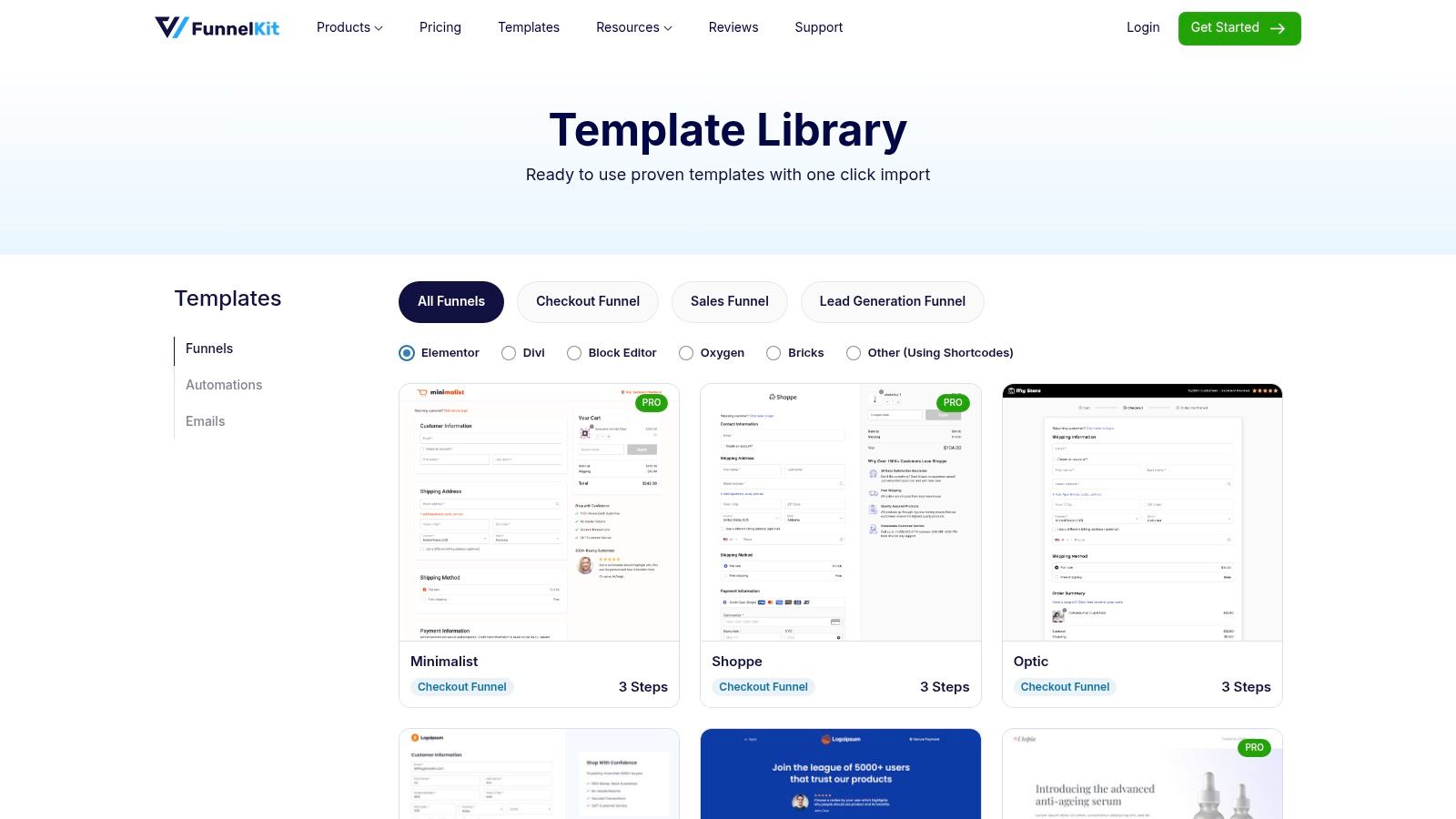
FunnelKit Templates sit in a similar ownership camp to CartFlows, but with more depth around automations and post-action logic. If CartFlows feels like a flow builder, FunnelKit feels more like a funnel operations layer for WordPress.
That can suit service businesses with more nuanced segmentation or follow-up needs, especially if they want behavioural email and SMS tied to specific funnel actions.
Better for the automation-minded WordPress team
The attraction here is the combination of templates, funnel logic, and automations in the same ecosystem. That makes it possible to run a more layered journey without moving to a separate all-in-one platform.
For buyers agents and brokers, that could mean one path for ready-to-book leads and another for leads who need nurturing first. The platform can support that operational difference if it's mapped well.
Best for: WordPress sites needing deeper funnel automation
Less ideal for: Teams without in-house or external technical support
Commercial upside: Stronger ownership without fully giving up automation depth
The caveat is simple. A flexible funnel system can also create messy journeys if no one defines the stages cleanly.
What businesses often miss
The automation layer only helps if the qualification questions, CRM fields, and triggers are thought through before build. Otherwise, you end up with a technically impressive funnel that still sends weak leads into the same generic follow-up path.
10. HubSpot Free Sales Funnel, Pipeline and Dashboard Templates
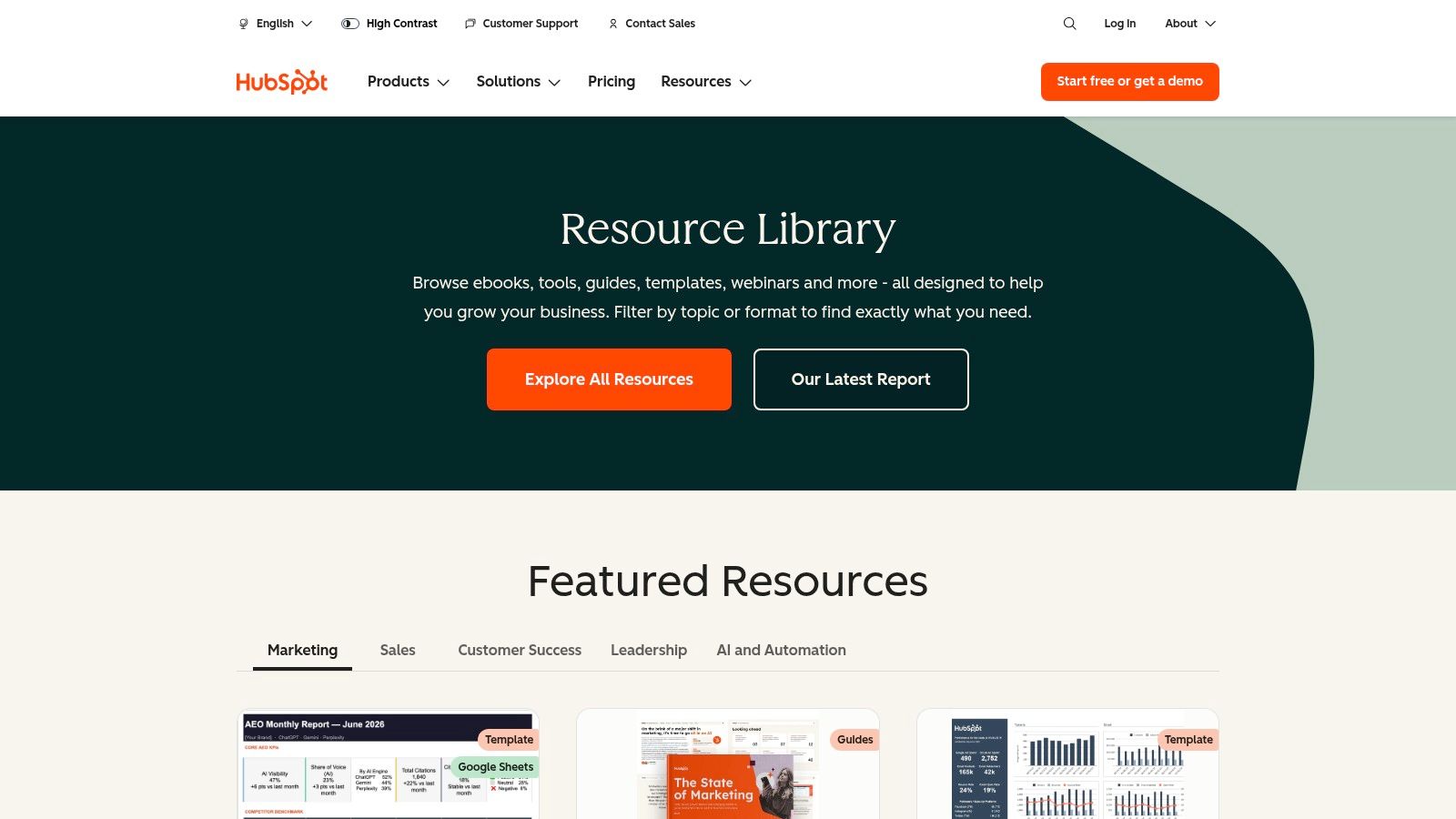
HubSpot's sales templates are different from the rest of this list because they're not primarily web-funnel templates. They're planning and tracking templates. That's still valuable, because many firms don't have a design problem first. They have a visibility problem.
If the team can't see where enquiries become MQLs, SQLs, meetings, or deals, changing page design alone won't fix much.
Best when the gap is measurement
HubSpot's free pipeline and dashboard resources are useful when you need stage definitions and reporting discipline before committing to heavier funnel tooling. For some firms, that's the right first move.
This matters even more when lead follow-up is slow. Australian lead-follow-up guidance reports that many local small businesses take 48 hours or longer to follow up, with an average response time of 47 hours, according to AI Cartel's guide to automating lead follow-up in Australia. If you don't track the hand-off properly, those delays stay hidden.
Best for: Businesses that need pipeline clarity before rebuilding pages
Less ideal for: Teams looking for a ready-made visual funnel to publish live
Strong use case: Defining stages, fields, ownership, and reporting before platform expansion
Why I'd still include it in a sales funnel template list
Because a sales funnel template isn't always a page template. Sometimes the right template is the one that forces the business to define qualification stages, response ownership, and reporting before it spends money redesigning front-end assets.
Top 10 Sales Funnel Template Comparison
Product | Core features & USP ✨ | UX & Quality ★ / 🏆 | Integrations & Automation ✨ | Value & Pricing 💰 | Best fit 👥 |
|---|---|---|---|---|---|
ClickFunnels Marketplace | Multi‑step funnel templates (opt‑in, webinar, application, sales); one‑click import; template bundles ✨ | ★★★★☆, marketplace quality varies | Native funnel flow & checkout (locked to ClickFunnels) | 💰 Mid (platform subscription + template costs) | 👥 Consultants, pro‑services needing fast funnels |
GoHighLevel Template Library & Marketplace | Installable snapshots: pages, CRM pipelines, automations; white‑label agency stacks ✨ | ★★★★☆, agency‑grade complexity 🏆 | Native CRM, booking, SMS/email automations; multi‑account | 💰 Mid–High (agency plans) | 👥 Agencies, white‑label providers, multi‑client setups |
GetResponse Conversion Funnel templates | Funnels + built‑in email sequences, webinars, checkout; guided funnel maps ✨ | ★★★☆☆, solid SMB UX | Email, webinar support, checkout and basic automations | 💰 Low–Mid (all‑in‑one subscription) | 👥 SMBs, solo consultants, budget teams |
Leadpages Templates Library | Large library of landing + thank‑you + scheduler flows; pop‑ups & forms ✨ | ★★★★☆, very fast MVP shipping | Scheduling integrations, forms; pairs with external CRM/ESP | 💰 Mid (page‑focused pricing) | 👥 Small teams, buyer‑agents/brokers needing quick pages |
Unbounce Landing Page Templates | PPC‑optimized landing pages; Dynamic Text Replacement & A/B tools ✨ | ★★★★☆, strong optimization tools 🏆 | A/B testing, analytics; needs external CRM for workflows | 💰 Mid–High | 👥 Paid‑media teams, high‑intent campaigns |
Instapage Templates | 200+ templates; precision drag‑and‑drop, collaboration & personalization ✨ | ★★★★★, enterprise‑grade performance 🏆 | Advanced experiments & personalization; integrates with ad/analytics | 💰 High (premium) | 👥 Enterprise teams, high ad‑spend agencies |
Systeme.io Template Library | One‑click funnels with email, checkout, membership; budget‑friendly ✨ | ★★★☆☆, simple, lean UX | Built‑in email/checkout/automation; limited ecosystem | 💰 Low (free/cheap plans) | 👥 Solo founders, price‑sensitive small businesses |
CartFlows Templates (WP + WooCommerce) | WordPress full‑flow templates; optimized checkout, order bumps, upsells ✨ | ★★★★☆, quality depends on page builder/host | Integrates with Elementor/Divi/Gutenberg; WooCommerce checkout | 💰 Mid (self‑hosted + plugin fees) | 👥 Teams wanting stack ownership & SEO‑first sites |
FunnelKit Templates (WP + WooCommerce) | Templates + FunnelKit Automations (emails/SMS); deep WooCommerce flows ✨ | ★★★★☆, powerful for post‑purchase funnels | Works with major builders; one‑click upsells & A/B tests | 💰 Mid (plugin/license + WP costs) | 👥 eCommerce & WooCommerce offers needing layered funnels |
HubSpot Free Sales Funnel / Pipeline & Dashboard Templates | Free spreadsheet funnel & dashboard templates; stage guidance & upgrade path ✨ | ★★★☆☆, great for planning, not live funnels | Pairs with HubSpot CRM/landing pages if adopted | 💰 Free → Paid (as CRM/marketing needs grow) | 👥 Teams needing funnel planning, KPI tracking before tooling |
Choose the Funnel Your Team Will Actually Run
The wrong way to choose a sales funnel template is by browsing for the nicest design and assuming the rest will sort itself out. The better way is to match the template to the business journey you can support operationally.
If you need one focused campaign and a clear next step, choose a single-page resource. Leadpages and Unbounce are both strong here, though they solve slightly different problems. Leadpages is lighter and faster for practical launch work. Unbounce is stronger when ad-to-page message match and testing matter.
If your process needs qualification, nurture, and a more structured path to conversion, use a multi-step platform. ClickFunnels, GoHighLevel, GetResponse, and Systeme.io all support that in different ways. The difference isn't template volume. It's whether you need a sequence of pages only, or a sequence plus booking, CRM, automation, and internal routing.
If you're working with high-intent service enquiries, a booking-first flow is often the most commercially sensible option. That's especially true for buyers agents, brokers, and professional services firms where the actual sale happens on a call, not on the page. In those cases, the best template is usually the one that reduces friction between interest and booked meeting, then pushes that lead straight into a usable CRM process.
If your immediate problem is visibility rather than page design, start with tracking and funnel-stage clarity. HubSpot's planning templates are useful because they force better definitions. You can't improve conversion properly if you don't know where leads are dropping out or which stages are underperforming.
The broader Australian context reinforces why this matters. One local source notes that Australia's conversion rate lags both global and APAC averages, with Australia at 1.78% versus 1.88% globally and 2.76% in APAC, which strengthens the case for tighter funnel architecture and better capture of limited traffic, as discussed in Searchscope's overview of AI SEO and AI search visibility. It also changes how templates should be adapted. They need to be readable not just for search users, but for AI-assisted discovery as well, especially when service businesses rely on proof, structured information, and strong next steps to win trust.
The final point is the one most template roundups skip. Don't copy template text. Adapt the promise, proof, qualification questions, booking hand-off, CRM fields, and follow-up to your audience. A buyer's agent campaign, a mortgage broker assessment, and a law-firm consultation page might use a similar structure, but they should never sound interchangeable.
Review where your traffic currently drops out. If the breakdown is happening between page visit and enquiry, fix the page. If it's happening between enquiry and booked call, fix the booking and follow-up system. If both are weak, you need a connected website, funnel, search visibility, and automation setup rather than another imported template. That's where a studio like Raffine fits, because the underlying issue usually isn't the template itself. It's the gap between the template and the sales process.
Raffine Studio designs conversion-focused websites and funnel systems for Australian buyers agents, brokers, and professional services firms that need more than a pretty template. If you want a sales funnel template adapted into a real lead path with search visibility, booking flow, CRM hand-off, and follow-up built in, visit Raffine Studio.